
In this article
For experienced individual contributors, career growth often arrives before it is named. A colleague leaves. A cross-functional program loses its owner. A difficult customer segment needs attention. Someone asks whether you can “take the lead” because you understand the history, have the trust of the team, or are simply the person least likely to let the work fail.
That request may be an opportunity. It may also be a transfer of organizational risk into your calendar.
The difference matters because added scope is frequently described with the language of development while remaining vague about authority, priorities, support, title, and duration. You are asked to become more strategic, more visible, or more influential, but the old responsibilities remain intact and nobody can say what work will come off your plate. The result is not always a stronger career story. Sometimes it is a job that has expanded without being redesigned.
Experienced people are especially exposed to this problem. They can see dependencies, anticipate failure modes, and translate between disciplines. Those are valuable abilities. They also make it easy for a company to treat their judgment as spare capacity.
Growth is not measured by how much work you absorb. It is measured by the kind of judgment the organization can now rely on you to exercise.
The expansion that changes the job
Not all complexity is the same. A role can become more demanding because the work becomes richer: you solve harder problems, make consequential decisions, learn a new domain, or coordinate choices that previously stayed within one function. It can also become harder because the role acquires more interruptions, more unowned tasks, and more conflicting requests.
That distinction is more than semantics. A recent meta-analysis of job complexity separates resource complexity, which can support learning and performance, from challenge complexity, which can bring both learning and strain. For an individual contributor, that is a useful starting point: demanding work is not automatically developmental simply because it is demanding.
Consider the difference between leading the technical direction for a product migration and becoming the default person who chases decisions across engineering, support, legal, and sales. The first can develop systems judgment, technical influence, and a clear record of decisions. The second may occasionally do the same, but it can just as easily consume the hours needed for the work that demonstrates those capabilities.
A new responsibility becomes career growth when it changes the level at which you contribute: the problems you are trusted to frame, the decisions you can shape, the people who use your judgment, and the durable capability you build. It becomes role creep when it is primarily an accumulation of unbounded work with no corresponding authority or reprioritization.
Growth is not measured by how much work you absorb. It is measured by the kind of judgment the organization can now rely on you to exercise.
Three different things can hide inside “more scope”
Managers often use one phrase for three very different arrangements. Naming them makes a better conversation possible.
A bounded stretch assignment
This is a defined piece of work that is difficult enough to require new judgment but limited enough to learn from. It has a purpose, an end point, a sponsor, and a known trade-off. You may own a launch retrospective across teams, establish an approach for an emerging customer problem, or lead a technical evaluation that informs an investment decision. The work should expose you to a larger problem without quietly making you responsible for every related problem.
A temporary operating gap
Sometimes a team genuinely needs someone to hold work together during a reorganization, leave, hiring delay, or urgent project. Taking this on may be sensible. But it should be described honestly as coverage, with a date for reassessment and a decision about what happens afterward. Temporary work has a way of becoming permanent when it keeps succeeding quietly.
An unacknowledged role redesign
The third arrangement is the one that deserves the most care. You are still judged on your original deliverables, but you are now expected to run a program, manage a key relationship, mentor several colleagues, resolve priority conflicts, or represent the team in senior forums. That is not merely extra help. It may be a different job.
Role design is supposed to establish responsibilities in a way that supports both performance and the quality of the work itself. The CIPD’s guidance on job design emphasizes that roles should be deliberately designed around work processes, value, and job quality. An individual contributor cannot redesign an organization alone, but they can refuse to treat an informal redesign as a personal productivity problem.
“Can you help?” is a request. “You own this now” is a role change. A career conversation should not blur the two.
The practical question is not whether you are capable of doing the additional work. It is whether the organization is prepared to make the conditions of that work visible.
“Can you help?” is a request. “You own this now” is a role change. A career conversation should not blur the two.
- Core specialist work18 hours per week
- Cross-functional coordination12 hours per week
- Decision preparation7 hours per week
- Unplanned cleanup8 hours per week
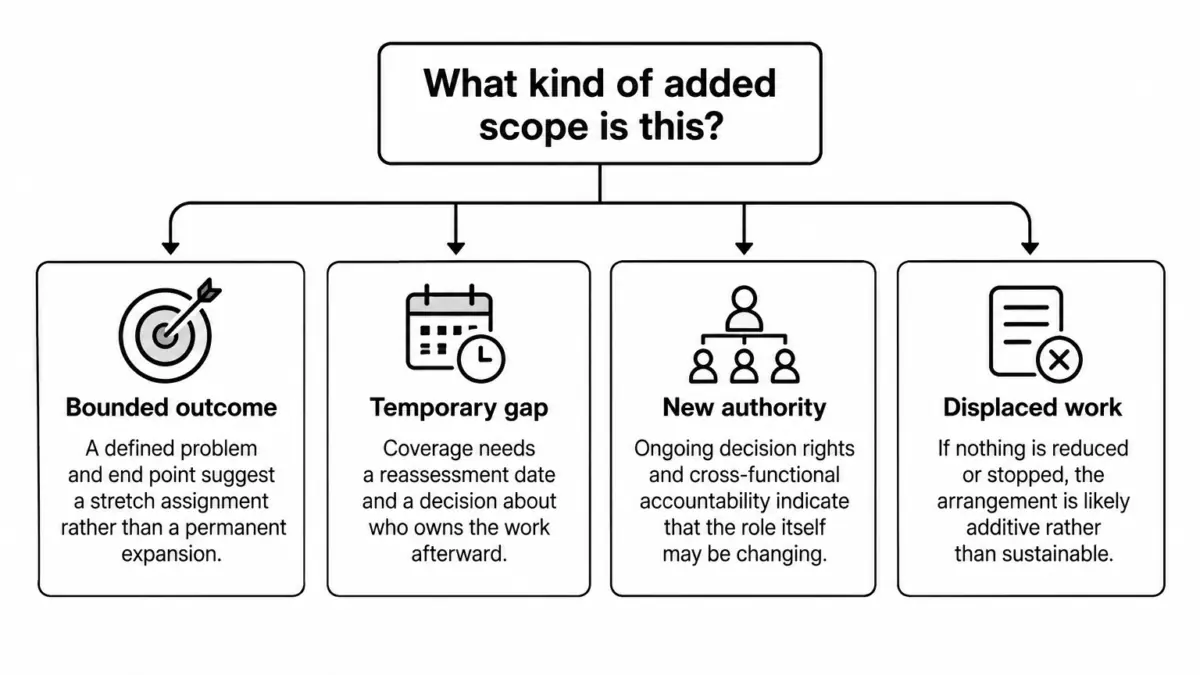
Text version of this visual
- Bounded outcome: A defined problem and end point suggest a stretch assignment rather than a permanent expansion.
- Temporary gap: Coverage needs a reassessment date and a decision about who owns the work afterward.
- New authority: Ongoing decision rights and cross-functional accountability indicate that the role itself may be changing.
- Displaced work: If nothing is reduced or stopped, the arrangement is likely additive rather than sustainable.
Ask what will remain when the emergency passes
Urgency can make any assignment look important. The more revealing question is what remains after the deadline, incident, or vacancy has passed.
If the new responsibility leaves behind a repeatable capability—an operating model, a decision standard, a better technical approach, a trusted relationship, or a clearer way for teams to work together—it may represent meaningful growth. If it leaves behind only a record that you kept a fragile system running, its career value is less certain. Keeping things afloat can be essential work. It is not always promotable work unless the organization can recognize why it required senior judgment.
This is where many growth conversations become unhelpfully personal. Someone says, “I need to show more leadership,” and begins collecting activities that look leadership-adjacent: facilitating meetings, onboarding people, resolving small conflicts, or taking on every cross-functional question. But activity is not a level. The better evidence is the relationship between your judgment and an outcome that other people can use.
Try describing the responsibility in four parts:
- The problem: What decision, risk, or opportunity requires attention?
- The authority: What can you decide, recommend, convene, or escalate?
- The displaced work: Which existing commitments will be narrowed, delegated, delayed, or stopped?
- The review point: When will you and your manager decide whether this was a stretch, temporary coverage, or a continuing part of the role?
These questions are not bureaucratic. They protect against a familiar pattern: an employee is praised for initiative while being evaluated against a job description that no longer captures their week.
Being relied upon is valuable. Being relied upon without a defined decision right can become a ceiling.
Evidence is not a list of sacrifices
When an expanded remit is discussed as a promotion opportunity, people often start documenting volume: meetings attended, requests answered, projects supported, late nights worked, and problems prevented. This record can show effort. It rarely explains level.
A stronger account makes the work legible as judgment. What did you see that others could not yet see? Which choice did you clarify? What trade-off did you surface? How did a team become able to act without waiting for you? Which decisions became faster, safer, or more coherent because you established an approach?
Research synthesized by the National Academies identifies role clarity, autonomy, feedback, task variety, and problem-solving as meaningful features of work design. Its discussion of role clarity and performance is a useful reminder that ambiguity is not a test of character. An employee cannot reliably demonstrate a higher-level contribution if the boundaries and expectations of that contribution are kept obscure.
That does not mean you need a perfect specification before accepting anything new. Senior work frequently begins with ambiguity. The important distinction is whether you are being asked to reduce ambiguity in a meaningful area, with room to make choices, or merely to endure ambiguity created by unclear ownership elsewhere.
In a product or engineering context, compare these two statements:
- “I joined more stakeholder meetings and kept everyone aligned.”
- “I identified that product, engineering, and support were making incompatible assumptions about an account-migration sequence, established a decision path, and documented the criteria teams now use when exceptions arise.”
The second statement does not claim that coordination is beneath you. It shows what the coordination accomplished and where your judgment entered the system.
Being relied upon is valuable. Being relied upon without a defined decision right can become a ceiling.
A role becomes fairer when its expectations can be observed, discussed, and revised—not merely admired after the fact.
Uneven requests deserve a closer look
Added scope is not distributed neutrally in every workplace. Some employees are repeatedly asked to smooth tension, mentor informally, organize the team, represent a perspective, explain decisions more gently, or carry the relational labor around a difficult change. These contributions may be real and worthwhile. They can also be assigned through assumptions about who is accommodating, who is “good with people,” or who will make an uncertain system feel easier for everyone else.
The answer is not to dismiss relational work. Experienced individual contributors often create their greatest leverage through it. The answer is to make the contribution specific enough to evaluate. Guidance on inclusive role requirements makes a related point: behavior-based expectations are clearer and fairer than vague character descriptions. “Build a cross-functional decision process for launch risks” is assessable. “Be a natural leader” is an invitation to subjective judgment.
When a manager offers an opportunity framed in personality terms—“You are so organized,” “People trust you,” “You are great at keeping the peace”—ask for the operating version of the request. Which outcome needs to change? What authority accompanies it? Who else is accountable? How will this work be recognized if it continues?
This is particularly important when you have already proven that you can be dependable under pressure. Dependability should widen your options, not assign you permanent cleanup duty.
A role becomes fairer when its expectations can be observed, discussed, and revised—not merely admired after the fact.
The most useful career question is sometimes not “Can I do this?” but “What job am I being asked to build around myself?”
Negotiate the shape of the work, not only the title
A title may matter, especially where it affects future mobility, compensation, or credibility with peers. But title negotiations are often slow, constrained, or deferred. You still need to decide whether the work itself is viable in the meantime.
Start with the shortest useful agreement. It can be a paragraph in a one-on-one note or project document: the outcome, your decision rights, the existing work that will change, the people whose cooperation you need, and a date to revisit the arrangement. This does not convert a weak opportunity into a strong one. It does reveal whether your manager is prepared to sponsor a real change.
If they cannot identify what you should stop doing, the expectation may be unsustainably additive. If they cannot explain how success will be evaluated, the assignment may be too undefined to support a promotion case. If they can name a business need but not a long-term role, you may choose to help anyway—but as a temporary contribution with a clear boundary, not as an unspoken audition.
There is also a legitimate answer that is easy to overlook: decline the expansion, or accept only a narrower part of it. An experienced IC does not have to prove ambition by saying yes to every gap. You may decide that the work points toward a direction you do not want, that it would hollow out the craft you value, or that the organization has not created the conditions for you to do it well.
That is not a failure of confidence. It is a career decision based on evidence.
The most useful career question is sometimes not “Can I do this?” but “What job am I being asked to build around myself?”
Good growth can feel uncomfortable because it asks more of your judgment. It should not require you to make an undefined role livable through private overwork. When added scope is real, the work becomes clearer over time: the problem is better named, your authority is more visible, and your contribution leaves a structure that others can use. When it is role creep, the opposite usually happens. More depends on you, while less is said plainly about what the job has become.
- Original commitments retained24 hours per week
- New responsibility10 hours per week
- Work explicitly paused8 hours per week
- Unplanned overflow3 hours per week
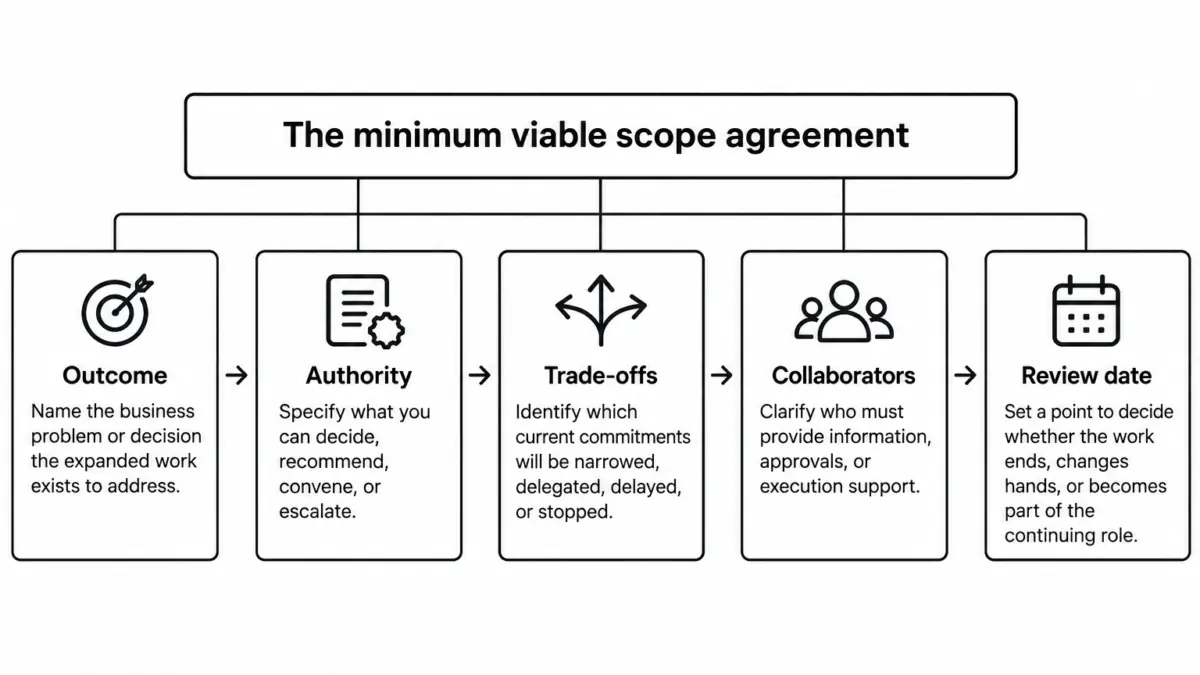
Text version of this visual
- Outcome: Name the business problem or decision the expanded work exists to address.
- Authority: Specify what the individual contributor can decide, recommend, convene, or escalate.
- Trade-offs: Identify which current commitments will be narrowed, delegated, delayed, or stopped.
- Collaborators: Clarify who must provide information, approvals, or execution support.
- Review date: Set a point to decide whether the work ends, changes hands, or becomes part of the continuing role.
 About the author Victoire Boucher
Career coach focused on helping women navigate the tech industry. I’ve worked in product and engineering roles before shifting to coaching full-time. Now I write about imposter syndrome, salary negotiation, and how to grow without burning out.