In this article
Last updated: August 15, 2026. This guide tracks generally applicable U.S. laws that require employers to disclose a wage or salary range in a job posting or at another point in the hiring process. Laws change quickly, and proposed bills are not treated as law.
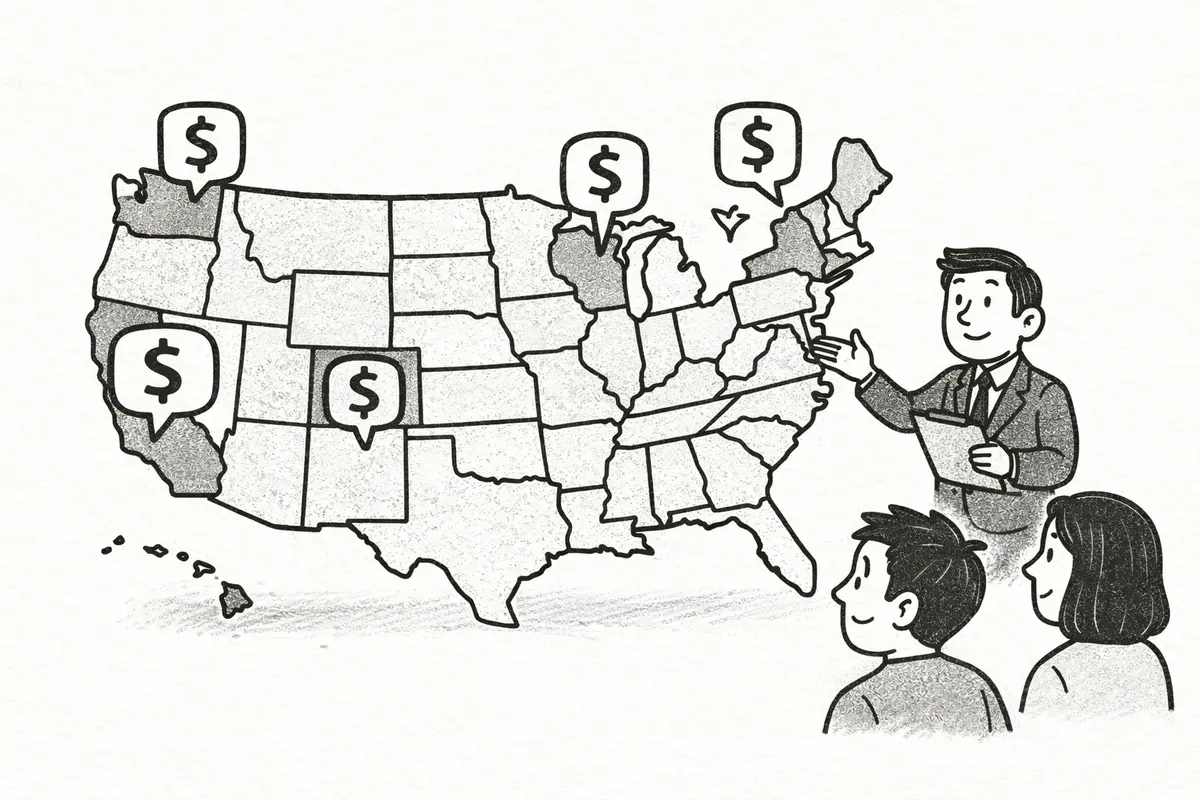
Pay transparency is no longer limited to a handful of states. As of this update, 13 states and Washington, D.C. require covered employers to put pay information in job advertisements. Connecticut, Nevada, and Rhode Island require disclosure later in the hiring process or on request. Delaware has enacted a posting law that takes effect on September 26, 2027.
The details matter. Employer-size thresholds range from one District employee in Washington, D.C. to 50 employees in Hawaii. Some laws require only base pay, while others also require benefits and other compensation. Remote-job rules are especially inconsistent: California and Washington expressly cover many roles that could be performed by a resident, while New York and Illinois also use reporting-line tests.
Quick answer
- Pay in the posting: California, Colorado, Hawaii, Illinois, Maine, Maryland, Massachusetts, Minnesota, New Jersey, New York, Vermont, Virginia, Washington, and Washington, D.C.
- Pay disclosed later or on request: Connecticut, Nevada, and Rhode Island.
- Enacted but not yet effective: Delaware, effective September 26, 2027.
- No general federal posting rule: federal law protects many employees who discuss wages, but it does not impose a nationwide private-sector salary-range requirement.
State and District laws that require pay in job postings
The table below covers statewide laws currently in effect. “Covered employers” is a summary, not a substitute for the statutory definitions and exemptions in the linked sources.
| Jurisdiction and effective date | Covered employers | What the posting must include | Remote-work trigger | Official sources |
|---|---|---|---|---|
| California January 1, 2023; definition updated January 1, 2026 | 15 or more employees, with at least one employee in California | A good-faith estimate of the salary or hourly wage range the employer reasonably expects to pay upon hire. A fixed hourly or piece rate may be listed when applicable. Benefits generally need not be included. | Covered if the position may ever be filled in California, in person or remotely. The range must appear in the posting itself; a link or QR code is not enough. | Labor Code § 432.3; Labor Commissioner FAQ; SB 642 |
| Colorado January 1, 2021; revised January 1, 2024 | Public and private employers with at least one employee in Colorado | Compensation or a good-faith pay range, benefits and other compensation, how to apply, and the date the application window is expected to close. Additional notices apply after selection and for career progression. | Colorado guidance reaches remote jobs that could be performed by a Colorado employee. Stating that Colorado applicants will not be considered does not by itself avoid the law. A limited exemption applies through July 1, 2029 to certain non-remote, out-of-state opportunities. | CDLE overview; INFO #9A guidance |
| Hawaii January 1, 2024 | 50 or more employees; the law does not specify where those employees must be located | The hourly rate or salary range that reasonably reflects the actual expected compensation. Internal transfers and promotions are exempt, as are certain public jobs with collectively bargained compensation. | The statute and published FAQ do not state a separate test for remote jobs. Employers should assess whether the advertised position is Hawaii employment instead of assuming a nationwide remote ad is outside the law. | Act 203 bill text; HCRC FAQ |
| Illinois January 1, 2025 | 15 or more employees; employees outside Illinois count toward the threshold | The pay scale and benefits: the wage or salary range the employer reasonably expects to offer, plus a general description of benefits and other compensation. Internal and external postings are covered. | Covered when work will be performed at least partly in Illinois or outside Illinois while reporting to an Illinois supervisor, office, or worksite. A remote ad is covered when the employer knew or reasonably should have predicted one of those connections. | 820 ILCS 112/10; Illinois DOL FAQ |
| Maine July 29, 2026 | 10 or more employees | The prospective range of pay the employer will offer a successful applicant. A commission-only posting must say that compensation is based solely on commission. Current employees may request the range for their position. | The new statute does not publish a separate remote-work test. A role that can be performed in Maine should be treated as potentially covered until the Maine Department of Labor issues more specific guidance. | Public Law 2025, chapter 771; Maine DOL notice |
| Maryland October 1, 2024 | Generally all public and private employers | A good-faith minimum and maximum wage range, a general description of benefits, and other compensation offered for the position. If no posting exists, the information must be given before compensation is discussed and whenever the applicant requests it. | Covered when the position will be physically performed at least partly in Maryland. An out-of-state company recruiting a remote worker who will work from Maryland is covered. | Maryland Labor FAQ; official compliance webinar |
| Massachusetts October 29, 2025 | 25 or more employees whose primary place of work was in Massachusetts during the prior calendar year | The annual salary or hourly wage range the employer reasonably and in good faith expects to pay. Employers must also provide the range to applicants and employees in specified circumstances. | The posting requirement applies to a position whose primary place of work is Massachusetts. Official guidance gives separate rules for employees who work remotely or travel. | Chapter 141 of the Acts of 2024; official overview; Attorney General FAQ |
| Minnesota January 1, 2025 | 30 or more employees at one or more sites in Minnesota | The starting salary range and a general description of all benefits and other compensation, including health and retirement benefits. A fixed rate must be used when no range is offered, and a range cannot be open-ended. | The statute does not create an express remote or out-of-state-posting exemption. A covered employer should not assume its remote postings are excluded without state guidance or legal advice. | Minn. Stat. § 181.173; CareerForce guidance |
| New Jersey June 1, 2025 | 10 or more employees over at least 20 calendar weeks, plus a New Jersey business, employment, or application-taking connection | The hourly wage or salary, or a range, plus a general description of benefits and other compensation programs. Employers must also make reasonable efforts to notify affected departments of promotion opportunities. | Official guidance says a nationwide posting may be covered when the employer meets the size and New Jersey nexus tests. Examples include an out-of-state employer accepting applications from New Jersey residents for work that can be performed remotely from New Jersey. | P.L. 2024, c. 91; NJDOL guidance |
| New York September 17, 2023 | Four or more employees; temporary help firms have a statutory exemption for certain postings | The good-faith minimum and maximum annual salary or hourly range, a job description if one exists, and a statement when compensation is commission-based. | Covered when the job will be performed at least partly in New York. It also covers an out-of-state job that reports to a New York supervisor, office, or worksite. | Labor Law § 194-b; NYSDOL overview; official FAQ |
| Vermont July 1, 2025 | Five or more employees, with at least one employee working in Vermont | The compensation or good-faith minimum and maximum salary or hourly range. Commission-based roles must say so; tipped roles must identify the tipped arrangement and disclose the base wage or base-wage range. Benefits are not required. | Covered when the job is physically located in Vermont or is remote work that will predominantly support an office or work location physically located in Vermont. | Act 155; Attorney General guidance |
| Virginia July 1, 2026 | Generally all employers; the statute states no numeric threshold | The wage, salary, or good-faith wage or salary range in every public and internal posting for a job, promotion, transfer, or other employment opportunity. Benefits are not required by this section. | The statute contains no separate remote-work test. Employers recruiting an employee who will work in Virginia should treat the posting as covered; other multistate arrangements need a fact-specific review. | Va. Code § 40.1-28.7:12; HB 636 history |
| Washington January 1, 2023; amended July 27, 2025 | 15 or more employees, including out-of-state employees, when the employer has at least one Washington-based employee | The wage scale or salary range, or a fixed amount when only one amount is offered, plus a general description of benefits and other compensation. From July 27, 2025 through July 27, 2027, an employer generally has five business days to cure a notified posting violation. | Covered when a remote position could be filled by a Washington-based employee. A statement excluding Washington applicants does not avoid the rule. Jobs tied to worksites entirely outside Washington may qualify for the out-of-state exception. | RCW 49.58.110; L&I FAQ; WAC 296-123 |
| Washington, D.C. June 30, 2024 | At least one employee in the District; the federal and D.C. governments are excluded from this definition | The good-faith minimum and maximum projected salary or hourly pay in all advertised job listings and position descriptions. The existence of healthcare benefits must be disclosed before the first interview. | Official enforcement guidance applies to postings soliciting employees in the District, regardless of where or how the employer publishes the posting. | D.C. Law 25-138; Attorney General advisory |
States that require disclosure later in the hiring process
These states have pay-transparency rules, but they do not currently require the range to appear in every job advertisement.
| State | When pay must be disclosed | Remote-work note | Official sources |
|---|---|---|---|
| Connecticut Effective October 1, 2021 | To an applicant at the earlier of the applicant’s request or before or when an offer of compensation is made. Employees receive the range at hire, when their position changes, and on their first request. | Published guidance does not provide a special remote test. Employers should apply the rule to Connecticut-based applicants and employees and obtain advice for disputed cross-border situations. | Public Act 21-30; Connecticut DOL FAQ |
| Nevada Effective October 1, 2021 | To an applicant who has completed an interview. For a promotion or transfer, disclosure is required when the employee applied, completed an interview or received an offer, and requested the information. | The statute does not state a distinct remote test. Treat candidates interviewing for Nevada employment as covered. | NRS 613.133; SB 293 text |
| Rhode Island Effective January 1, 2023 | To an applicant on request; the law says the employer should provide the range before discussing compensation. Employees must receive the range at hire, when moving to a new position, and on request. | No special remote test appears in the statute or state poster. Apply the rule to Rhode Island employment and review cross-border roles individually. | R.I. Gen. Laws § 28-6-22; Rhode Island DLT guidance |
Enacted law that is not yet effective
| State | Effective date and coverage | What will be required | Official law |
|---|---|---|---|
| Delaware | September 26, 2027; employers with 26 or more employees. It will cover jobs located in Delaware and non-international remote positions offered by an employer based in Delaware. | Internal and external notices must include the hourly or salary compensation or range, plus a general description of benefits and other compensation. Special rules will apply to commission, tipped, collectively bargained, and urgent temporary roles. | 19 Del. C. § 709C |
States without a general private-sector pay-range disclosure law
As of August 15, 2026, the following states do not have a generally applicable statewide law requiring private employers to disclose a pay range in a job posting or during the ordinary applicant process:
Alabama, Alaska, Arizona, Arkansas, Florida, Georgia, Idaho, Indiana, Iowa, Kansas, Kentucky, Louisiana, Michigan, Mississippi, Missouri, Montana, Nebraska, New Hampshire, New Mexico, North Carolina, North Dakota, Ohio, Oklahoma, Oregon, Pennsylvania, South Carolina, South Dakota, Tennessee, Texas, Utah, West Virginia, Wisconsin, and Wyoming.
“No general statewide law” does not mean there are no relevant rules. A state may regulate salary-history questions, public employers, government contractors, equal pay, wage discussions, or particular industries. Local ordinances may also apply. Delaware is omitted from this list because its 2027 law has already been enacted.
Local pay-transparency rules still matter
State law has overtaken several early local ordinances, but local rules may have a lower employer threshold, broader benefit disclosure, or a different enforcement route. The most relevant local overlays are summarized below. This table does not attempt to list ordinances that only ban salary-history questions without requiring any pay-scale disclosure.
| Local jurisdiction | Practical effect | Official source |
|---|---|---|
| New York City | Employers with four or more employees must include a good-faith minimum and maximum in advertisements for jobs, promotions, and transfers that can or will be performed in New York City. The statewide New York law now overlaps, but the city has its own enforcement framework. | NYC Commission on Human Rights |
| Albany County, New York | The county adopted a salary-transparency rule before the statewide law. Covered employers should comply with both and use the rule that gives the worker greater protection when requirements differ. | Albany County notice |
| Ithaca, New York | Employers with at least four employees whose standard work locations are in the city must state minimum and maximum compensation in covered advertisements. New York State law now also applies. | City FAQ; Ordinance 2022-03 |
| Westchester County, New York | The county requires salary transparency in covered job postings. The statewide law now overlaps, but employers remain subject to the county’s human-rights enforcement process. | Westchester Human Rights Commission |
| Jersey City, New Jersey | The city rule reaches employers with five or more employees, staff, or independent contractors in Jersey City, below the state law’s 10-employee threshold. Covered postings must state minimum and maximum base pay and job benefits. | city guidance; Ordinance 22-045 |
| Cincinnati, Ohio | This is not a posting mandate. An employer with 15 or more employees in the city must, on reasonable request, provide the pay scale to an applicant who has received a conditional offer for covered Cincinnati employment. | Chapter 804 ordinance |
| Toledo, Ohio | This is also a post-offer, on-request rule rather than a posting mandate. Covered employers with 15 or more employees in the city must provide the pay scale after a conditional offer. | Ordinance O-173-19; current Chapter 768 |
How pay-transparency laws apply to remote jobs
“The company is based elsewhere” is not a reliable exemption. The controlling facts can include where the employee will sit, where the work can be performed, which office or supervisor receives the work, whether the employer already has an employee in the jurisdiction, and whether the ad accepts applications there.
| Remote-job scenario | Likely result | Recommended approach |
|---|---|---|
| A nationwide “work from anywhere in the U.S.” role | Likely triggers California, Colorado, New Jersey, and Washington rules if the employer meets their coverage tests. Other state rules may also apply after the employee’s location and reporting line are known. | Publish a compliant range, benefits summary, and other compensation from the start. If pay varies geographically, list clear location-specific ranges and explain which range applies. |
| A remote employee will work from Maryland or Illinois | Maryland covers work physically performed at least partly in the state. Illinois covers Illinois work and certain out-of-state jobs reporting to an Illinois supervisor, office, or worksite. | Use the employee’s actual work location and reporting structure, not the headquarters address, when screening the posting. |
| The employee will live outside New York but report to a New York manager | The New York reporting-line rule can bring the posting within state law even though the employee performs all work elsewhere. | Include the range, job description if one exists, and the required commission statement when relevant. |
| The posting says “not open to California, Colorado, or Washington residents” | The disclaimer may not work. California covers a role that may ever be filled in the state, while Colorado and Washington guidance specifically reject attempts to avoid disclosure merely by excluding residents. | Do not use geographic exclusions as a substitute for legal analysis. If the business truly cannot employ in a state, document the operational reason and ensure the role is genuinely unavailable there. |
| A role has different pay bands in three geographic zones | A single nationwide range may be so broad that it no longer reflects the employer’s good-faith hiring expectations. California’s 2026 definition focuses on expected pay upon hire. | Show each zone and range, for example: Zone A $90,000–$110,000; Zone B $82,000–$101,000; Zone C $75,000–$93,000. State the location rule used to assign a zone. |
A practical national job-posting template
For employers recruiting across several states, one well-designed national template is usually easier to maintain than a separate bare-minimum version for each jurisdiction. A conservative posting should contain:
- Base pay: a genuine minimum and maximum annual salary or hourly rate, or a fixed rate when only one amount is available.
- Geographic basis: the location or zone to which each range applies.
- Benefits: a useful summary of health coverage, retirement, paid time off, and other major benefits rather than “great benefits.”
- Other compensation: eligibility for bonuses, commissions, tips, profit sharing, equity, or similar programs.
- Job description: the core duties and qualifications, particularly because New York requires a description when one exists.
- Application details: how to apply and, for Colorado-connected roles, the expected closing date.
- Version control: the date the range was approved and the evidence used to set it, such as the hiring budget, pay scale, incumbent data, or market benchmark.
Example
Base salary: $92,000–$112,000 per year for employees based in California, Colorado, New York, or Washington; $84,000–$103,000 for employees in other approved U.S. locations. The range reflects the base salary we reasonably expect to pay upon hire. Final pay within the range will depend on job-related experience, skills, and location.
Other compensation: eligible for an annual performance bonus with a 10% target and equity under the company’s applicable plan.
Benefits: medical, dental, and vision coverage; 401(k) with employer match; paid vacation, holidays, sick leave, and parental leave. Eligibility and plan terms apply.
Application window: apply through the listed form. The posting is expected to close on September 15, 2026, but may close earlier if the position is filled.
Common compliance mistakes
Using an implausibly wide range
A range such as “$50,000–$250,000 depending on experience” may fail a good-faith standard if the employer would not realistically hire at both endpoints. California now expressly defines the pay scale as a good-faith estimate of what the employer expects to pay upon hire. Virginia also directs reviewers to consider the breadth of the range.
Listing base pay but omitting benefits
Colorado, Illinois, Maryland, Minnesota, New Jersey, and Washington require some form of benefits or other-compensation disclosure. Washington, D.C. separately requires disclosure of the existence of healthcare benefits before the first interview.
Forgetting internal opportunities
Many laws cover promotions, transfers, internal emails, intranet posts, or other internal notices. New Jersey also requires reasonable efforts to inform employees in affected departments about promotional opportunities.
Assuming the job board is responsible
Employers are commonly responsible for postings they place or direct a third party to place. California requires the employer to give the range to the third party, while Washington excludes unauthorized digital replicas. Review syndicated postings and save screenshots of the live version.
Treating proposed rules as binding law
As of this update, New Jersey’s proposed regulations, including the proposed 60% limit on range breadth, have not been adopted and remain nonbinding. They are useful compliance guidance, but the distinction between the enacted statute and a proposal should be clear.
What job seekers should do
- Save the posting. Download a PDF or take dated screenshots showing the URL, range, benefits, and job location. A live link may change or disappear.
- Ask which range applies. For a remote job, request the geographic band and the factors used to place a candidate within it.
- Compare the offer with the post. Ask for an explanation if the offer falls outside the advertised range or if required benefits were described inaccurately.
- Use the full compensation package. Base salary is only one part of the offer. Evaluate bonus terms, equity, health costs, retirement contributions, paid leave, and required travel.
- Report carefully. Use the enforcement agency linked in the relevant state’s official guidance. Preserve evidence before submitting a complaint, and note any anti-retaliation protections.
What employers should do
- Map every role. Record permitted work states, primary work location, reporting office and supervisor, employer headcount, and whether the ad is internal or external.
- Set the range before recruiting. Use an approved budget, existing pay scale, incumbent pay, and documented job-related factors. Do not let recruiters invent a range when publishing the ad.
- Use location-specific subranges. This is clearer and more defensible than one enormous national band.
- Audit templates and integrations. Check the applicant-tracking system, careers site, social posts, recruiter messages, internal job board, and third-party feeds.
- Train recruiters and managers. Cover pay-range requests, salary-history restrictions, internal transfers, and how to explain placement within a band.
- Keep evidence. Retain the approved range, posting versions, dates, decision rationale, and proof of corrections. California, Maine, and Delaware have express recordkeeping rules, and records are useful everywhere.
- Monitor official guidance. Review state agency pages before launching a new hiring campaign and whenever the company adds an approved remote-work state.
Frequently asked questions
Is there a federal law requiring salary ranges in private-sector job postings?
No generally applicable federal law currently requires private employers nationwide to place a salary range in every job posting. The National Labor Relations Board explains that many employees covered by the National Labor Relations Act have the right to discuss wages, but that is different from a job-posting disclosure mandate.
Can an employer offer pay outside the posted range?
It depends on the jurisdiction and the facts. A posted range generally must reflect the employer’s genuine expectation when the ad is created. Some laws allow a later change based on circumstances such as the applicant’s qualifications or labor-market conditions. A large, unexplained departure can still undermine the employer’s claim that the original range was set in good faith.
Do employers have to publish bonuses and equity?
Not everywhere. California’s posting rule generally focuses on salary or hourly wages, while Colorado, Illinois, Maryland, Minnesota, New Jersey, and Washington require broader information about benefits or other compensation. A multistate template should identify bonus, commission, equity, or profit-sharing eligibility even when an exact value cannot be promised.
Does “remote” mean every state law applies?
No. Each law has its own nexus. The worker’s location, the possible work locations, the reporting office or supervisor, the employer’s existing workforce, and where applications are accepted can all matter. Use the jurisdiction-specific remote column above rather than a single nationwide assumption.
Can a company exclude residents of a transparency state?
A genuine decision not to employ in a state may affect coverage, but a disclaimer is not a universal safe harbor. California, Colorado, and Washington guidance is especially unfavorable to exclusions used merely to avoid salary disclosure. The safer approach is to publish a good-faith range.
Update log and methodology
- August 15, 2026: added Maine’s law effective July 29, 2026 and Virginia’s law effective July 1, 2026; added Delaware’s enacted 2027 rule; incorporated California’s 2026 “upon hire” definition and Washington’s 2025 amendment and 2026 rules; confirmed New Jersey’s proposed regulations remain nonbinding; refreshed all remote-work notes and official links.
- Source policy: the status tables rely primarily on statutes, enacted bills, state labor departments, attorneys general, civil-rights agencies, and official local-government materials.
- Scope: this article tracks generally applicable applicant pay-range disclosure. It does not catalog every salary-history ban, equal-pay law, wage-discussion protection, public-sector rule, government-contract clause, or industry-specific requirement.
This article provides general information, not legal advice. Coverage can turn on facts that do not fit in a summary table. Employers should obtain advice for their workforce and hiring locations, and readers should confirm the current text and agency guidance before relying on a rule.
 About the author Barbara Best
Career Coach · Remote Work Evangelist - USA Hi, I’m Barbara. With over 12 years of experience helping people pivot careers, I specialize in remote job strategies and personal branding. After spending a decade in corporate HR, I shifted focus to coaching mid-career professionals. I believe that work should fit into your life — not the other way around.