
In this article
In early 2026, survey data from the Society for Human Resource Management showed that 43 percent of corporate human resource departments used artificial intelligence applications in their daily operations, up from 26 percent in 2024. Sourcing and candidate screening represented the highest concentration of this technology, with 27 percent of organizations deploying automated screeners at the top of their hiring pipelines. For job applicants in finance, retail, software development, and health services, the initial conversation no longer involves a phone call with a recruiter. Candidates respond to audio prompts on an asynchronous platform, complete structured text queries from a chatbot, or submit recorded video answers. An algorithm processes these inputs before a human reviewer receives the application. Understanding the underlying mechanics of these scoring tools determines whether a candidate advances or ends up rejected by default.
The Machine Reads Transcripts, Not Expressions
A persistent misconception among job seekers is that interview algorithms analyze facial micro-expressions, eye contact, or subtle posture shifts. In early automated video evaluation, vendor marketing highlighted visual analysis as a predictive hiring tool. That model collapsed under technical and legal scrutiny.
In 2021, HireVue, one of the primary software providers in the asynchronous assessment market, removed facial analysis from its platform. Internal research and third-party evaluations confirmed that visual data added no statistically significant predictive value beyond what natural language processing extracted from spoken text. Facial recognition features also exposed employers to legal liability under state biometric privacy laws and bias investigations.
Modern automated evaluation relies primarily on text and audio processing. When a candidate completes a recorded video or audio interview, the system executes three sequential operations:
- Audio Transcription: Speech-to-text engines convert recorded audio into a written transcript.
- Natural Language Processing (NLP): Natural language models parse the transcript for key terminology, structural completeness, sentence syntax, and semantic proximity to job requirements.
- Scoring and Summarization: The software matches extracted data against a pre-configured rubric established by the vendor or the employer’s hiring team, generating a composite score or candidate rank.
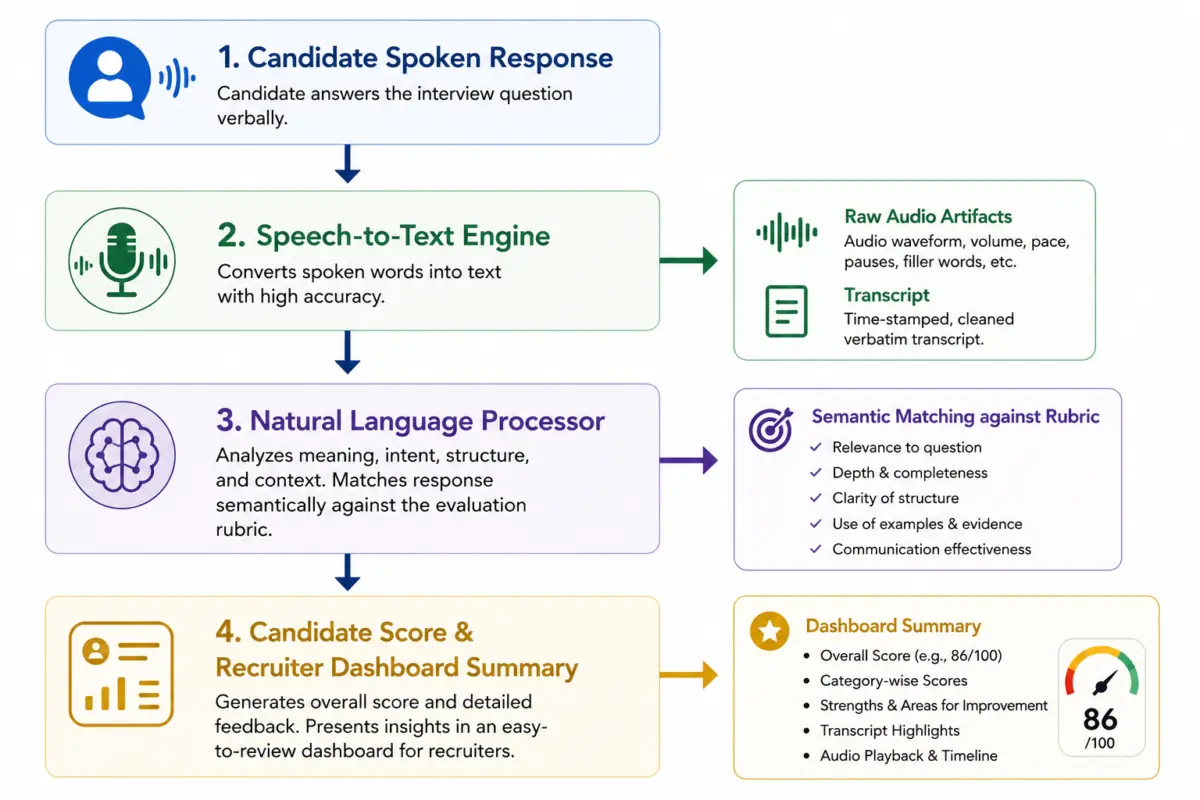
When an applicant submits an asynchronous interview, the primary artifact evaluated by the software is not a video recording; it is a text document generated from spoken words. Candidates who focus on theatrical delivery, exaggerated eye contact, or artificial smile maintenance misallocate their effort. The scoring engine evaluates vocabulary density, context, structural clarity, and direct answers to specific prompt parameters.
What Algorithmic Evaluation Systems Actually Measure
Automated interview platforms evaluate inputs against defined parameters. While specific vendor algorithms remain proprietary trade secrets, independent technical audits and vendor documentation detail four primary scoring vectors.
| Evaluation Vector | System Mechanism | Candidate Impact |
|---|---|---|
| Audio Clarity & Transcription Accuracy | Conversion of raw audio to text via automatic speech recognition (ASR) engines. | Poor audio quality, background noise, or heavy verbal pauses create transcription errors, dropping relevant keywords from evaluation. |
| Semantic Keyword & Competency Alignment | Vector embeddings compare transcript content against job descriptions and competency rubrics. | General or vague statements fail to trigger competency matches; explicit nouns and professional terminology score higher. |
| Answer Structure & Narrative Completeness | Language models detect structural components (Context, Specific Action, Quantifiable Result). | Unstructured stories without explicit resolution yield lower completeness scores regardless of candidate background. |
| Pacing & Time Constraints | Hard cut-offs and system timers measure response duration relative to prompt requirements. | Answers truncated mid-sentence lose structural credit; answers under 30 seconds lack sufficient token density for scoring. |
1. Audio Signal Quality and Transcription Accuracy
Speech-to-text engines make mistakes. Background noise, low-quality microphones, acoustic echo, and frequent vocal fillers (“um,” “like,” “you know”) degrade transcription accuracy. If an engine misinterprets technical terms or drops words due to poor audio quality, those terms disappear from the parsed transcript. The scoring model evaluates only what the transcript records.
2. Semantic Proximity to Competency Rubrics
Employers configure automated screening software around specific competencies—such as project management, conflict resolution, budget allocation, or SQL database optimization. Natural language processors map candidate responses into vector spaces to measure how closely the response aligns with those competencies.
If a prompt asks, “Describe a time you managed a project delay,” an algorithm looks for specific operational markers: cause, mitigation strategy, resource reallocation, and timeline outcomes. Broad summaries (“I handled delays by staying organized and communicating well”) produce low semantic overlap scores because they lack explicit operational nouns and measurable context.
3. Structural Framing (The STAR Method)
Automated parsers look for structural completeness. The traditional STAR method—Situation, Task, Action, Result—functions effectively in AI assessments because language models recognize logical progression.
System Processing Logic: A response that explicitly states the problem background (Situation/Task), outlines individual steps taken (Action using first-person active verbs), and states a outcome (Result with numerical parameters) aligns directly with algorithmic rubrics designed to score thoroughness.
When a candidate omits the result or fails to specify their direct role, the system flags the response as incomplete under structured competency guidelines.
4. Duration and Token Density
Most asynchronous platforms enforce strict time limits per question, typically ranging between two and three minutes. Algorithms require a minimum density of data points—or text tokens—to generate a reliable score. An answer lasting 20 seconds provides insufficient data, resulting in a low score for depth. Conversely, an answer that runs out the clock mid-sentence gets truncated, leaving the system without a documented result phase.
What Audits and Regulations Reveal About Scoring
The rapid adoption of automated hiring systems has triggered regulatory oversight, revealing operational flaws and compliance gaps in automated screening tools.
In New York City, Local Law 144 took effect requiring annual independent bias audits for Automated Employment Decision Tools (AEDTs) used to hire or promote candidates. In December 2025 the New York State Office of the State Comptroller released an evaluation of municipal compliance and enforcement regarding automated hiring systems. The audit revealed that 17 out of 32 reviewed employers using automated screening tools failed to demonstrate full compliance with mandatory bias audit publications and candidate notification requirements.
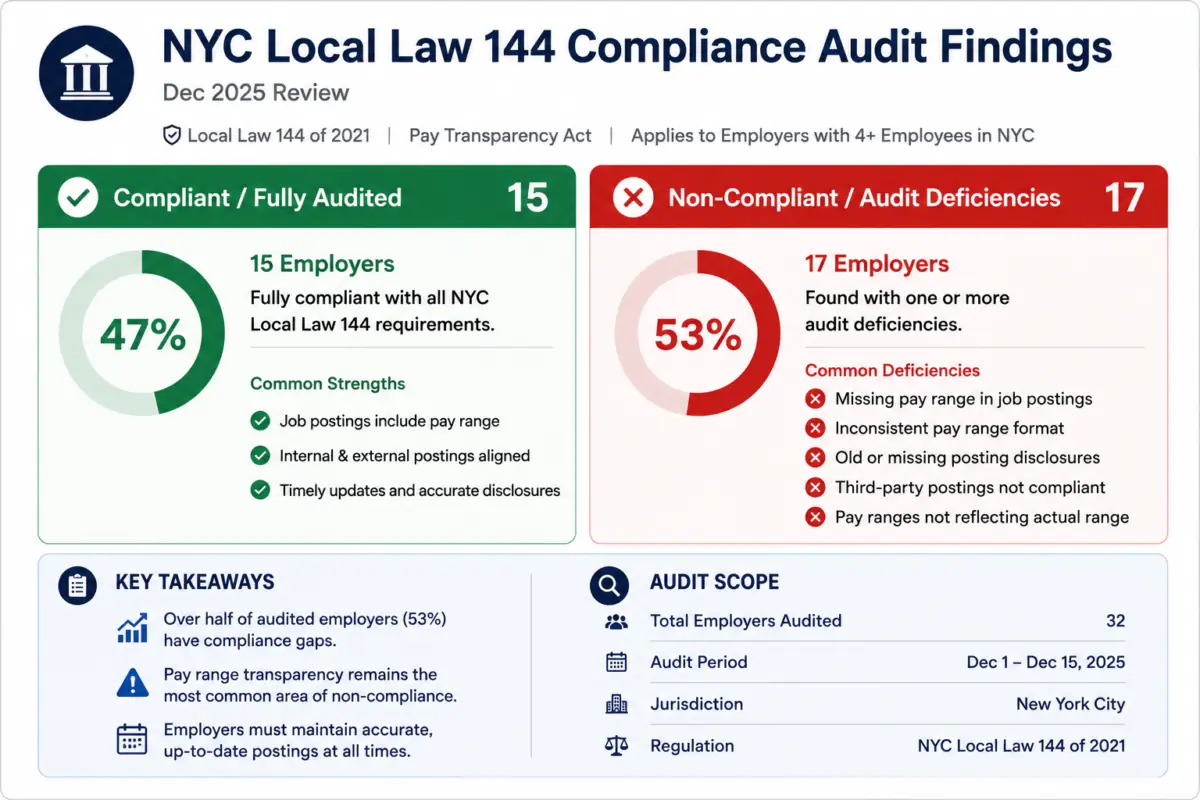
The Comptroller’s report highlighted a core vulnerability: automated tools often rely on historical company data to build candidate scoring baselines. When historical data reflects past hiring biases, the screening algorithm penalizes non-traditional candidates who do not match legacy employee profiles.
At the federal level, the U.S. Equal Employment Opportunity Commission (EEOC) maintains that Title VII of the Civil Rights Act applies fully to algorithmic selection tools. The EEOC’s technical assistance documentation explicitly states that employers remain legally responsible for adverse impact caused by third-party vendor algorithms, even when those algorithms operate as black-box systems.
Across international jurisdictions, the European Union AI Act classifies employment and candidate assessment software as “high-risk” artificial intelligence systems. This classification imposes strict transparency, technical documentation, and human oversight mandates on employers operating within EU member states.
As a practical observation from examining workplace data, employers rarely build these algorithms in-house. They purchase off-the-shelf software and leave default scoring parameters untouched. Candidate success depends not on outsmarting a unique custom system, but on presenting clear information that aligns with standard industry software parameters.
Preparation Strategy: Working With System Mechanics
Preparing for an automated interview requires treating the assessment as a data transmission task rather than an informal conversation. The following operational steps align a candidate’s preparation with the actual mechanics of automated evaluation systems.
Step 1: Optimize the Technical Input Layer
Because transcription accuracy forms the baseline for evaluation technical setup directly impacts candidate scoring.
- Audio Input: Use a dedicated wired microphone or a quality headset rather than built-in laptop microphones, which pick up ambient room echo.
- Acoustics: Select a small room with soft furnishings to eliminate reverb.
- Lighting and Framing: Position a light source directly behind the camera to illuminate your face clearly. While algorithms do not score facial features, human recruiters reviewing flagged videos rely on clear visual presentation during secondary evaluations.
- Pacing and Enunciation: Speak at a deliberate rate (approximately 130 to 150 words per minute). Pause clearly between sentences to assist the speech-to-text segmentation process.
Step 2: Map Responses to Job Description Keywords
Before the interview, analyze the job description to identify core competency nouns, software tools, and domain-specific methodologies.
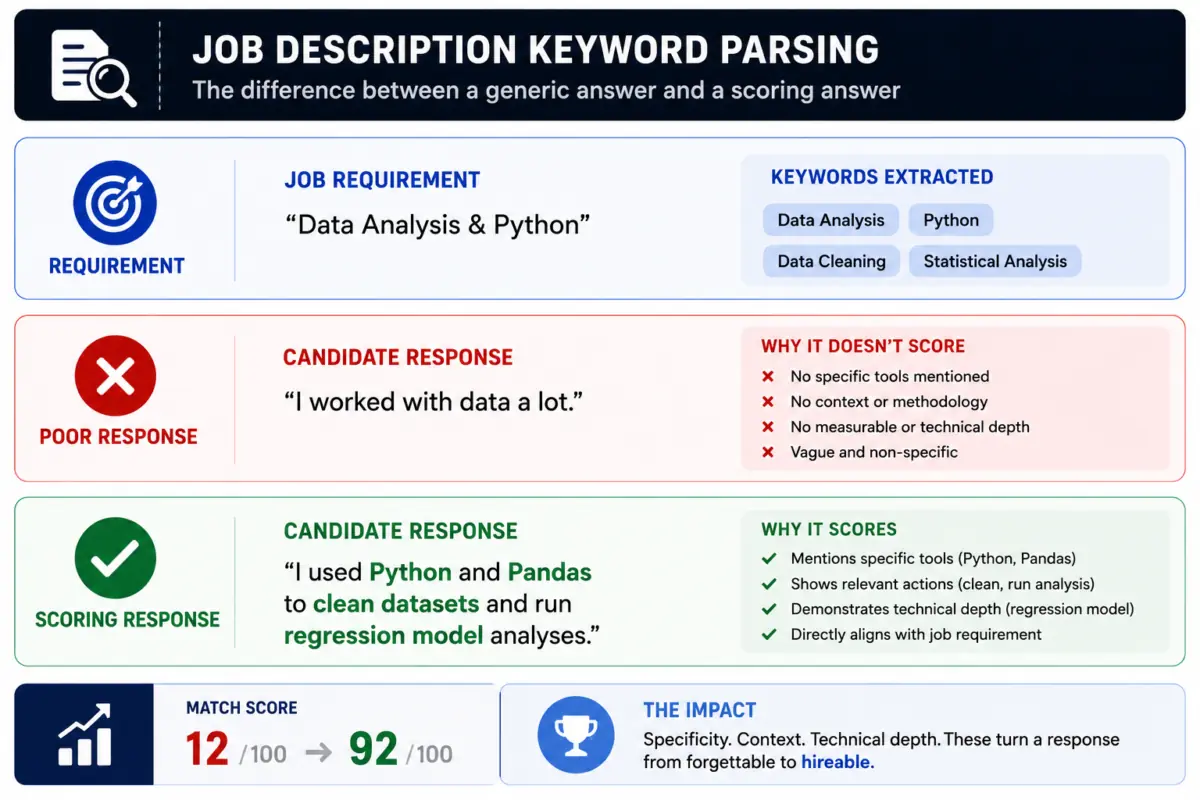
When formulating responses, incorporate specific terminology directly into your answers:
- Replace general verbs with explicit action terms: Use “analyzed,” “implemented,” “budgeted,” “negotiated,” or “architected” instead of “helped” or “did.”
- State explicit tools and standards: Mention specific software, industry frameworks, or regulations relevant to the role (e.g., GAAP accounting, Salesforce, Agile methodology, HIPAA compliance).
Step 3: Enforce the STAR Response Framework
Structure every behavioral response using explicit transition markers that speech-to-text processors and semantic screeners recognize:
- Situation: State the operational context in one or two sentences.
- Task: Define the specific challenge or metric requiring intervention.
- Action: Detail the exact steps you personally took. Use first-person singular pronouns (“I decided,” “I coded,” “I negotiated”) to ensure the software attributes actions directly to you rather than a collective team.
- Result: Conclude with a measurable outcome containing numbers, percentages, timeframes, or cost savings.
Step 4: Manage Prompt Timers
Asynchronous platforms typically display a countdown clock (e.g., 2 minutes or 3 minutes per question).
- The First 15 Seconds: State your direct conclusion or core response immediately. Do not use opening filler (“That is a very interesting question, let me think…”).
- The Middle 90 Seconds: Deliver the structured body of your answer using explicit action steps and technical details.
- The Final 15 Seconds: State the quantifiable result and conclude cleanly before the system timer expires.
Live AI Teleprompters and Anti-Cheating Software
The rise of automated interviews has led to candidate counter-tools, including real-time AI teleprompters that listen to interview prompts and display generated answers on-screen. Using these tools carries high risk.
According to candidate evaluation platform tracking data compiled between late 2025 and early 2026 across roughly 19,000 analyzed technical assessments, candidate attempts flagged for unauthorized live assistance rose from 9 percent to over 38 percent.
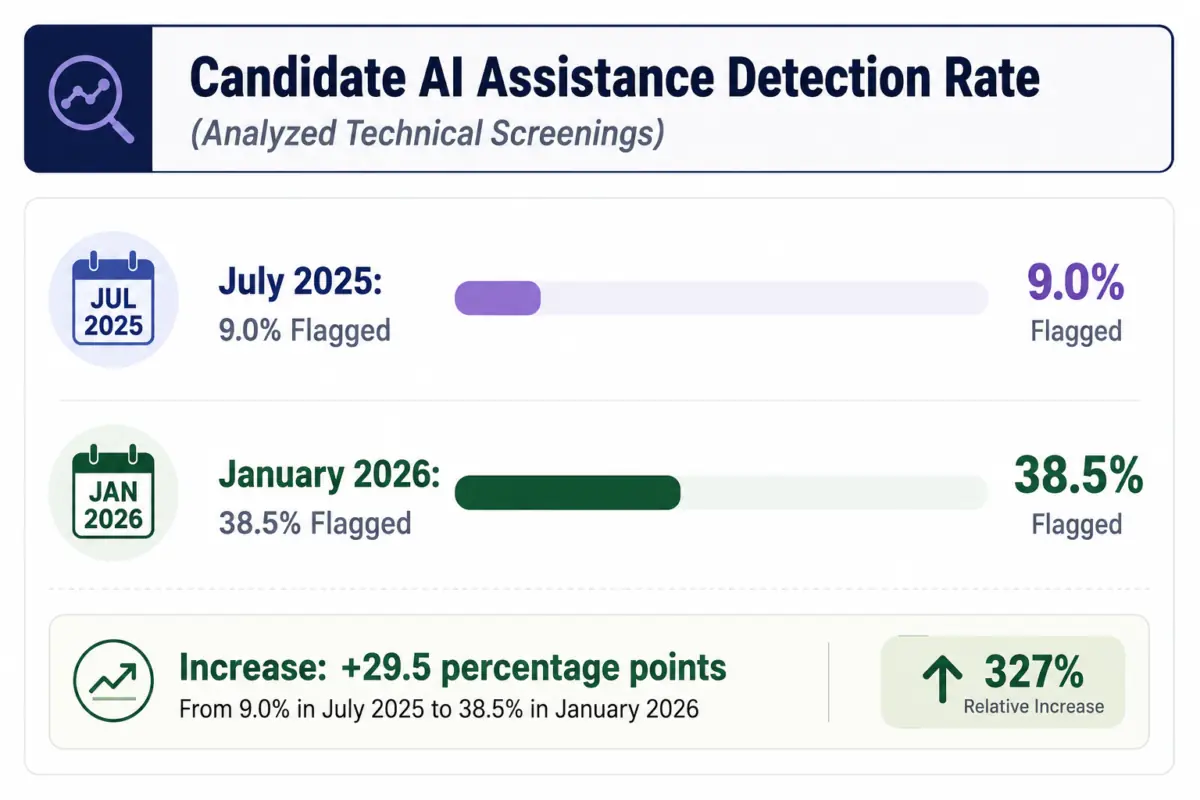
Modern interview platforms integrate anti-cheating mechanisms that analyze several operational metrics:
- Eye Movement and Gaze Patterns: Continuous lateral eye movement across a monitor indicates a candidate reading off-screen generated text.
- Acoustic Fingerprinting: Microphones capture subtle secondary audio feeds or latency gaps caused by local text-to-speech rendering engines.
- Cadence and Delivery Artificiality: Language models output text with uniform sentence lengths. Candidates reading live AI outputs aloud exhibit unnatural pause patterns and monotonic cadence that algorithms easily flag for human fraud review.
Using AI software during preparation to outline past experiences, generate practice prompts, or refine answer structures is standard practice. Attempting to use AI tools live during an interview frequently triggers automated disqualification flags.
From Machine Screening to Human Evaluation
Passing an automated interview screener does not guarantee a job offer; it simply moves the applicant file to a human reviewer’s queue.
Once the software evaluates an asynchronous interview, it generates a summary report for the hiring team. This report typically includes:
- The overall match score or percentile rank relative to other applicants.
- An automatically generated transcript of the candidate’s answers.
- Text summaries highlighting flagged strengths and key phrase omissions.
- Time-stamped links allowing recruiters to view specific video clips.
Recruiters review candidate files selectively. Data from recruiter workflow analysis indicates that hiring managers spend an average of under three minutes reviewing an automated assessment report before deciding whether to schedule a live human interview. They read the text summary, review the parsed score, and occasionally play 30 seconds of video to verify speech clarity and professionalism.
Candidates must maintain consistency across both stages. The specific project details, metrics, and role descriptions provided during the automated screening must match the narrative presented during subsequent live interviews with hiring managers. Inconsistencies between automated transcript records and live conversation raise immediate integrity concerns.
Verified Realities vs. Unresolved Questions
Automated interview tools are designed to reduce time-to-hire and lower recruitment costs for high-volume employers. For candidates, they eliminate informal personal rapport and replace it with structured, algorithmic evaluation.
What Is Verifiably Established
- Automated video screening software evaluates speech-to-text transcripts, semantic relevance, and structural completeness—not facial expressions or body language.
- Clear audio quality, precise industry vocabulary, structured responses (STAR framework), and explicit metrics improve algorithmic candidate scores.
- Live usage of AI answer generators during interviews carries high detection rates and frequently results in automated rejection.
What Remains Unresolved
- Long-Term Performance Validity: Independent empirical proof that AI-screened candidates perform better or remain longer in roles compared to candidates screened by traditional methods remains limited. Most performance claims rely on vendor-funded case studies.
- Regulatory Consistency: Legal frameworks governing automated recruitment tools continue to evolve unpredictably. Compliance enforcement varies widely across state, federal, and international boundaries.
Candidates who approach an AI-powered interview as a structured transmission of verifiable data—focusing on clarity, precise vocabulary, and direct answers—will consistently outperform those relying on general conversation habits.
Article Summary
An evidence-based analysis of how AI interview screening operates, detailing speech-to-text scoring mechanics, regulatory audit findings, and concrete preparation steps for candidates.
 About the author Joshua Ward
Startup Recruiter · Talent Advisor · UK Hey, I’m Josh — a recruiter-turned-writer based in London. I’ve helped build early teams at over 25 startups in the past 7 years, mostly in SaaS and fintech. Now I share insights about how small companies hire, what hiring managers really look for, and how to stand out in a noisy job market.