In this article
The Algorithmic Gatekeeper: The Reality of ATS 2.0 in 2026
One of the biggest misconceptions is that every application is carefully reviewed by a recruiter. In reality, most larger companies rely on ATS software to organize and prioritize applications before a recruiter opens them. The exact workflow depends on the employer, but automation usually plays a significant role. During my seven years leading distributed engineering divisions, I sat on the executive panel that audited our EOR (Employer of Record) compliance protocols and overhauled our applicant pipelines. We discovered that human eyes reviewed fewer than 8% of incoming applications. The rest were filtered out by Applicant Tracking Systems (ATS) executing automated pre-screening protocols.
According to the Jobscan Fortune 500 ATS Usage Report, over 97% of enterprise organizations employ an ATS to manage their hiring pipelines. In early 2024, the enterprise HR platform Workday alone processed over 173 million job applications—a number that has continued to climb exponentially throughout 2025 and 2026.
As application volumes continue to grow, vendors have been adding more AI-assisted matching features to their hiring platforms. Some people call this “ATS 2.0”, although there isn’t a universally accepted definition. These modern systems are no longer basic keyword scanners looking for exact string matches. They are advanced LLM-powered matching engines that perform semantic context analysis, concept extraction, and automated career path modeling.
Traditional advice told candidates to paste keywords in white font at the bottom of their resumes. If you try that today, the modern parser will flag the invisible text, mark it as high-risk manipulation, and auto-reject your file. Modern hiring platforms have become much better at understanding context than they were a few years ago. Instead of relying only on exact keyword matches, many systems can recognize related skills and similar job responsibilities. That doesn’t mean every ATS works this way, but it’s becoming increasingly common.
Under the hood, some newer matching systems compare the meaning of your resume with the job description rather than looking only for exact words. Vendors rarely explain the details publicly, so it’s difficult to know how each platform works.
In practice, this means wording still matters, but describing your experience naturally is usually more effective than repeating the same keyword over and over.
Breaking Down the ATS 2.0 Pipeline
The automated hiring pipeline operates as a multi-stage funnel. First, the parser breaks down your raw document (usually a PDF or DOCX file) into structured text. Formatting problems are still surprisingly common. I’ve seen resumes where tables, text boxes, or multi-column layouts caused sections to appear in the wrong order after extraction. It doesn’t happen every time. Still, I’ve seen it often enough that I usually recommend keeping the layout simple.
Once the text is structured, the semantic analysis engine segments your work history. It extracts your job titles, maps your career progression, and groups your skills into clusters.
If your career progression shows logical growth – such as transitioning from an individual contributor to a fractional lead – the system rewards you with a higher seniority alignment score.
When parsing goes wrong, the result is often much less dramatic than people imagine. More commonly, dates, job titles, or skills are extracted incorrectly, which can make an otherwise strong resume harder to evaluate.
Different systems rank candidates differently. Some calculate matching scores, others simply prioritize applications based on predefined criteria. Recruiters still make the final decision, but automation often determines which resumes they see first.
The Rise of Free AI Resume Checkers: What Are They Actually Testing?
To combat these mechanical gatekeepers, job seekers have turned to free AI resume checkers. These platforms promise to demystify the hiring process by reverse-engineering the ATS scoring mechanim. When I consult for remote-first scaleups, I regulaly audit how these resume checkers interpret candidate data compared to actual hiring systems. The best of these tools operate on sophisticated parsing libraries that mimic the exact heuristics of platforms like Workday, Greenhouse, and Lever.
A high-tier AI resume checker evaluates your document across four critical dimensions: parseability, keyword match rate, structural formatting, and impact metrics. The tool checks whether your font choices, margin widths, and section dividers are compliant with standard parsing frameworks like Apache Tika or PDFBox. It evaluates your language for action-oriented, quantifiable results, highlighting weak bullet points that lack metrics or context.
For a fast, reliable baseline check, you can run your CV through Jobicy’s Free Resume Score tool. This service runs over 20 distinct automated checks to simulate a real-world ATS scan, calculating your compatibility and formatting score in under a minute.
It gives a reasonable estimate of how much of your resume can be parsed correctly.
The Core Dimensions of Automated Evaluation
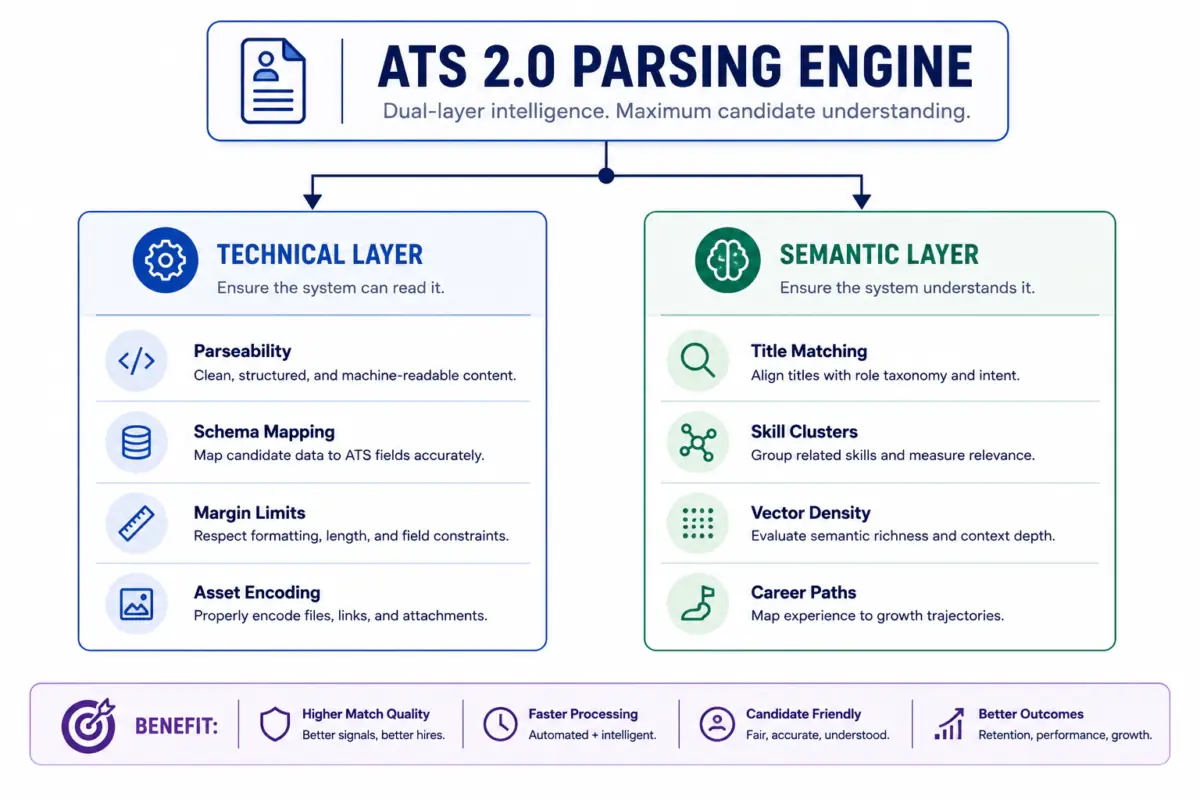
Most resume checkers evaluate two different things. First, whether your document can actually be parsed. Second, whether its content matches the job description.
The semantic layer, however, runs linguistic evaluations. It looks at your action verbs, measures the density of your industry-specific skill clusters, and flags structural red flags like unexplained employment gaps or excessive job-hopping.
Most free checkers use a 0-to-100 grading scale. A score below 60 typically indicates structural formatting issues or a total lack of relevant keyword alignment. A score between 60 and 80 means your document is readable but lacks optimized impact and role-specific keywords. Scoring above 80 suggests your resume is structurally sound and ready for human review. However, as we will explore, a perfect machine score does not guarantee a human will hire you.
Behind the Curtain: An Investigative Audit of AI Scoring Tools
I compared several of the largest resume checking platforms, looking at their reports, pricing models, and the type of feedback they provide.
A significant portion of the resume checking market is controlled by a consolidated group of brands. One thing I noticed is that several “free” resume checkers rely heavily on trial subscriptions. The initial scan may cost very little—or nothing—but additional features are often locked behind recurring plans.
If you are looking for transparent, zero-cost analysis, you must seek out platforms that do not lock their basic analysis behind paywalls or deceptive trial offers. Genuinely free tools like Jobicy’s Free Resume Score provide immediate, structural diagnostics without demanding credit card credentials. These platforms monetize through direct job board sponsorships or optional, transparent premium upgrades, keeping their core parsing engine free and accessible to the public.
Evaluating Genuinely Free Options vs. Paywalled Tools
To help you navigate this space, I compiled an audit of the top testing platforms based on my analysis of their business models, transparency, and parsing accuracy:
| Platform | Core Scoring Engine | Transparency & Pricing Model | Best Used For |
| Jobicy Resume Score | LLM Heuristics & Standard ATS Emulators | Genuinely Free; no signup required for basic scores. | Instant formatting diagnostics, technical parseability checks, and general keyword matching. |
| Teal Resume Checker | GPT-4 Integration & Pipeline Trackers | Free tier available; upsells premium pipeline management features. | Long-term job search tracking and role-by-role keyword optimization. |
| Jobscan | Reverse-Engineered ATS Algorithms | Limited free scans; monthly subscription model for advanced matching. | High-volume applicants targeting specific enterprise ATS systems (Workday, Taleo). |
| Bold Conglomerate Platforms | Legacy Static Checklists | Paywalled; trial-to-subscription billing structures under regulatory scrutiny. | Avoid; high risk of unauthorized recurring charges. |
When you run your resume through a validator, pay close attention to how it handles formatting recommendations. If a tool suggests you add colorful design elements, progress bars, or complex grids proceed with extreme caution. True ATS-friendly platforms will always advise you to simplify your design, strip out graphics, and focus entirely on clean, single-column text hierarchies.
Human vs. Machine: Where AI Checkers Fall Short
While AI resume checkers are excellent at identifying formatting errors and missing keywords, they suffer from critical functional blind spots. They cannot evaluate the qualitative truth of your achievements, nor can they detect whether your achievements display genuine professional sovereignty. A machine checker will reward you for writing a bullet point stuffed with action verbs and high-value industry terms, even if the sentence makes zero practical sense to a human hiring director.
While testing different resume scoring tools over the past few months, I noticed a consistent pattern.
The reason is simple: the resumes were written for the bot not the boss. The text was bloated with repetitive skill keywords and generic action verbs, completely stripping the document of personal voice and unique professional achievements.
Recruiters notice this pretty quickly. The issue isn’t AI itself—many candidates use it—but resumes that still read like an unedited chatbot response tend to stand out for the wrong reasons. According to a 2025-2026 comprehensive recruitment survey published by Resume Now’s Year in Review, over 62% of hiring managers explicitly reject resumes that show signs of unedited, generic AI assistance. If your resume reads like a copy-paste job from a raw ChatGPT prompt, human recruiters will flag it as low-effort application spam and reject it immediately.
What AI Resume Checkers Can’t Tell You
To understand where the machine falls short, look at how an AI checker evaluates a remote worker’s experience versus how I evaluate it as a remote operations director:
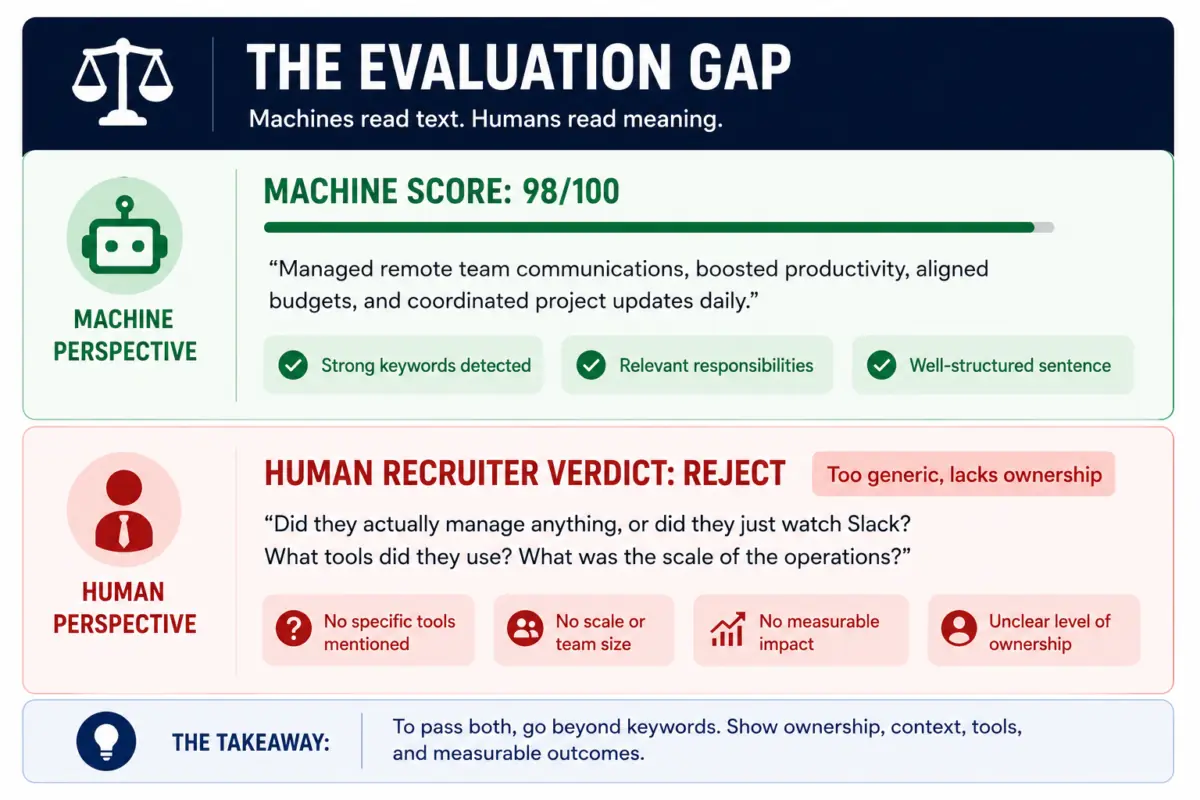
An automated checker might consider this bullet point acceptable because it contains relevant keywords. A recruiter, however, is more likely to ask a different question: “What exactly did this person improve?” That’s why adding specific outcomes usually makes a much stronger impression.
Another area where automated tools sometimes struggle is non-traditional careers. If you have spent the last two years executing fractional leadership roles, managing concurrent advisory retainers, or working through specialized consulting projects, an AI checker will often penalize you. The parser looks at overlapping dates and flags them as chronological errors or career stability risks. A human consultant however, recognizes fractional roles as a major indicator of high demand, specialized expertise, and advanced remote adaptability.
Case Study: Auditing a Senior Remote Tech Resume Across Three Platforms
To demonstrate the division between machine validation and human strategy let us audit a real-world case study. One recent resume I reviewed belonged to a senior operations manager with more than a decade of remote experience. After simplifying the layout and rewriting several achievement bullets, the document scored significantly higher across multiple resume checkers.More interestingly the candidate started receiving noticeably more interview invitations.
The Evolution of a High-Impact Remote Bullet Point
We took a close look at her experience section and targeted her primary bullet points. The transformation of her core achievement demonstrates how to satisfy both the machine’s parsing rules and the human’s desire for real, qualitative proof of impact:
- Original Bullet Point (Human & Machine Fail):“Responsible for managing the remote team’s budget, tools, and general coordination across multiple global regions.”
- AI Checker Automated Suggestion (Machine Pass, Human Fail):“Utilized budget management and remote team management skills to coordinate global operations, maximizing budget efficiency and tool utilization.”
- Final Optimized Version (Machine Pass, Human Win):“Optimized distributed SaaS spend across 14 countries, reducing tool redundancy by 22% and restructuring home-office stipend programs to save $140,000 annually.”
Here’s why I preferred the third version. It still contains the important keywords, but it also tells me something concrete about what the candidate actually achieved. The AI-suggested version corrected the formatting but became an unreadable, keyword-stuffed mess designed solely to trick a basic parser. The final optimized version solved both problems: it kept the high-value keywords (“distributed SaaS,” “restructuring,” “stipend programs”) that the ATS wanted to see, while giving the human hiring manager clear, quantified proof of financial impact and remote operational leadership.
The Remote Resume Blueprint: Formats That Bypass the Bots and Impress Humans
To consistently pass both the initial machine screen and the subsequent human evaluation, you must build your resume on a rock-solid, highly standardized structural layout.
Do not use creative resume builders that offer custom graphics, colored backgrounds, or unique section titles. Use a clean, single-column design with standard one-inch margins and highly readable typography.
When choosing your file format, always default to a clean PDF or a standard Microsoft Word document (.docx). While modern ATS platforms parse PDFs much better than they did a decade ago, some legacy systems still struggle with compressed PDF layers. If you are applying to enterprise firms using older portals, a standardized Word document remains the safest option for clean parsing.
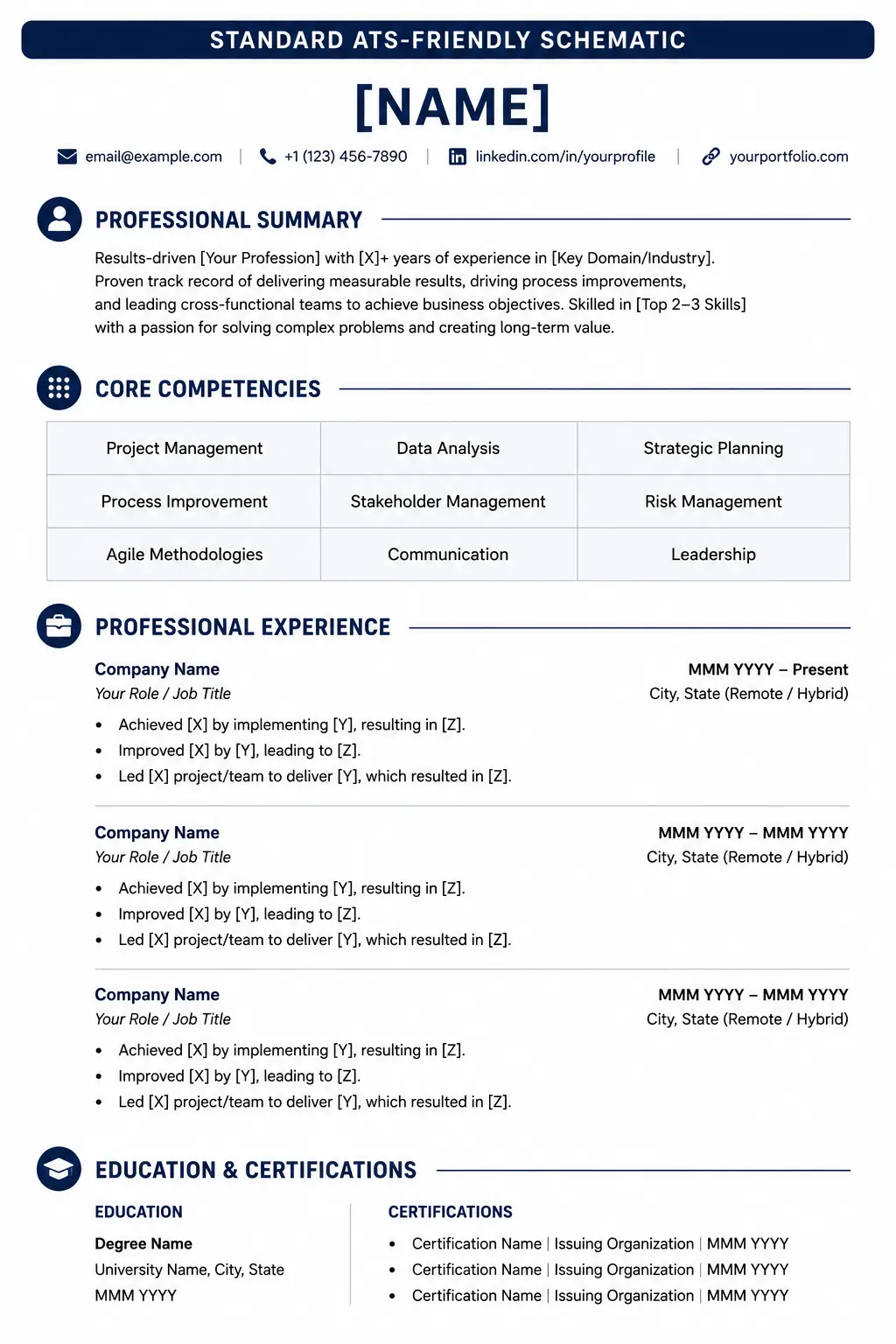
Avoid placing important contact information, portfolios, or professional links in the header or footer sections of your Word document. Many basic parsers completely ignore header and footer data when extracting text, which can leave you as an anonymous, un-contactable profile in the recruiter’s database. Keep all your contact details directly at the top of the main body of the document.
Typography, Structure, and Language Standards
To ensure your document passes both machine and human screens, stick to these five formatting rules:
- Typography – Use universal, system-standard sans-serif fonts such as Noto Sans, Arial, Calibri, or Trebuchet MS. Keep your body text size between 10pt and 11.5pt, and headers between 13pt and 14pt.
- Section Headers – Use standard, easily recognizable section headers. Stick to “Professional Experience,” “Core Competencies,” “Education,” and “Certifications.” Do not use creative titles like “Where I’ve Been” or “My Professional Story.”
- No Graphic Elements – Strip out all text boxes, charts, icons, and progress bars. If a machine parser encounters a graphic, it often interprets it as a block of corrupted characters, which can break your entire layout.
- No Keyword Stuffing – Write for human comprehension first. Integrate your target industry skills naturally within your achievement-oriented bullet points, rather than clustering them in an unreadable block of text.
- Use Live Links – Include clean, clickable hyperlinks to your LinkedIn profile, GitHub, or personal portfolio. Ensure the links are fully written out (e.g.,
https://linkedin.com/in/username) so the parser can extract the URL properly if the formatting layer gets stripped.
Next Steps: Your Pragmatic Resume Optimization Checklist
Instead of a passive summary, here is a practical, step-by-step checklist to optimize your resume for both machine parsers and human recruiters today.
- ☑️ Technical Parseability Audit: Upload your current resume to a free checker like Jobicy’s Free Resume Score to verify that your layout, fonts, and section dividers parse cleanly.
- ☑️ Simplify the Layout: Convert your resume to a single-column format. Strip out any tables, columns, text boxes, and non-standard fonts.
- ☑️ Contact Info Placement: Move your email, phone number, location, and professional links out of the document’s header/footer and place them directly into the top of the page body.
- ☑️ Apply the X-Y-Z Formula: Rewrite every bullet point under your experience section using Google’s X-Y-Z framework: “Accomplished [X], as measured by [Y], by doing [Z].”
- ☑️ De-AI Your Language: Read your resume aloud. Strip out generic, low-value phrases like “highly motivated,” “dynamic self-starter,” or “results-driven leader.” Replace them with objective, metric-backed accomplishments.
- ☑️ Inject Remote-First Terms: Ensure your experience accurately reflects your remote work capabilities. Use precise terms like “asynchronous collaboration,” “EOR management,” “stipend optimization” and “cross-timezone alignment.”
- ☑️ Verify Your Career Timeline: Group any freelance advisory, or concurrent fractional projects under a single, unified “Independent Consulting” block to prevent the ATS from flagging overlapping dates as career anomalies.
- ☑️ Test Your Export Format: Save your final document as a standard PDF. Select all text in the exported PDF, copy it, and paste it into a plain text editor (like Notepad). If the text is readable and in the correct chronological order, your resume is ready to apply.
 About the author Natalya Luft
Remote Culture Consultant · Former HR Director I’m Natalya -- originally from Kyiv, now based in NYC. I’ve spent 15+ years building and managing distributed teams across Europe. I write about culture, communication, and leadership in remote-first organizations. I believe remote work is about trust, not tools.