
In this article
An interview note and an interview judgment are easy to confuse. A panelist writes, “Explained a difficult launch clearly; seemed calm under pressure,” then gives the candidate a high score for stakeholder management. The first part may be useful evidence. The second part may be a conclusion. The phrase in the middle—“seemed calm”—is where a hiring decision can quietly become harder to explain.
Interview panels do not need to remove human judgment. They need to give judgment something sturdier to work from: a shared record of what the candidate said, the job criterion it addresses, and the reason that response meets, exceeds, or misses the required level. That distinction matters most when a candidate is engaging, has a familiar background, or gives an answer that prompts one panelist to say, “I just trust them.”
This guide is for panel members who already have questions and a schedule, but want a cleaner way to turn several conversations into a defensible hiring decision. The process is simple in principle: define the evidence before the interview, capture it while listening, score independently, then use the panel discussion to test interpretations rather than replace them.
The U.S. Office of Personnel Management’s overview of structured interviews describes the core discipline well: use rules for eliciting, observing, and evaluating responses, rather than leaving each interviewer to form an overall impression however they choose. You do not need a complicated assessment center to apply that discipline to an ordinary hiring panel.
The note is not the rating
Start by assigning three different jobs to three different parts of the interview record.
- Notes preserve what the candidate actually said or did in the conversation.
- Ratings state how well that answer met one defined criterion.
- Decision comments explain why the panel chose one candidate after reviewing the completed evidence.
When these get mixed together, a panel cannot tell whether it disagrees about the candidate’s answer or about the meaning assigned to it. That leads to circular discussion: one person repeats that the candidate was “strategic,” another says they were “too high-level,” and neither can point to the part of the answer that supports the claim.
Use notes that are brief enough to capture in real time but specific enough for another panelist to inspect later. Record the situation, the action, the decision point, and the result or learning. Do not try to transcribe every answer. Capture the parts that speak to the criterion.
| What a panelist writes | What it is | How to improve it |
|---|---|---|
| “Managed a difficult client.” | Too compressed to assess. | Record what made the situation difficult, what the candidate did, and what changed. |
| “Customer wanted an impossible deadline; candidate reset scope, brought engineering into a call, and documented a phased plan.” | Usable evidence. | Link it to the relevant criterion, such as stakeholder judgment or prioritization. |
| “Strong communicator.” | A conclusion without a stated basis. | Use it only after identifying the evidence and comparing it with the rating description. |
| “Score: 4. Explained tradeoffs, adjusted the message for two audiences, and gained agreement on a revised plan.” | A supported rating. | Keep the explanation short and tied to the pre-agreed scale. |
A panelist can still notice rapport, clarity, or energy. Those observations may help the candidate experience or tell you that a follow-up question is needed. They should not quietly become a substitute for a job criterion. If rapport is relevant because the role requires persuading skeptical partners, define the observable behavior you want to assess: adapting an explanation, surfacing disagreement, or gaining commitment without concealing a tradeoff.
The UK government’s guidance on fair, structured interviews similarly recommends deciding benchmark answers before interviews and asking panelists to record and mark responses on their own before group discussion. The useful point is not that every strong answer must sound identical. Candidates may reach a sound decision through different experience, language, or examples. The panel needs agreement on what the answer demonstrates.
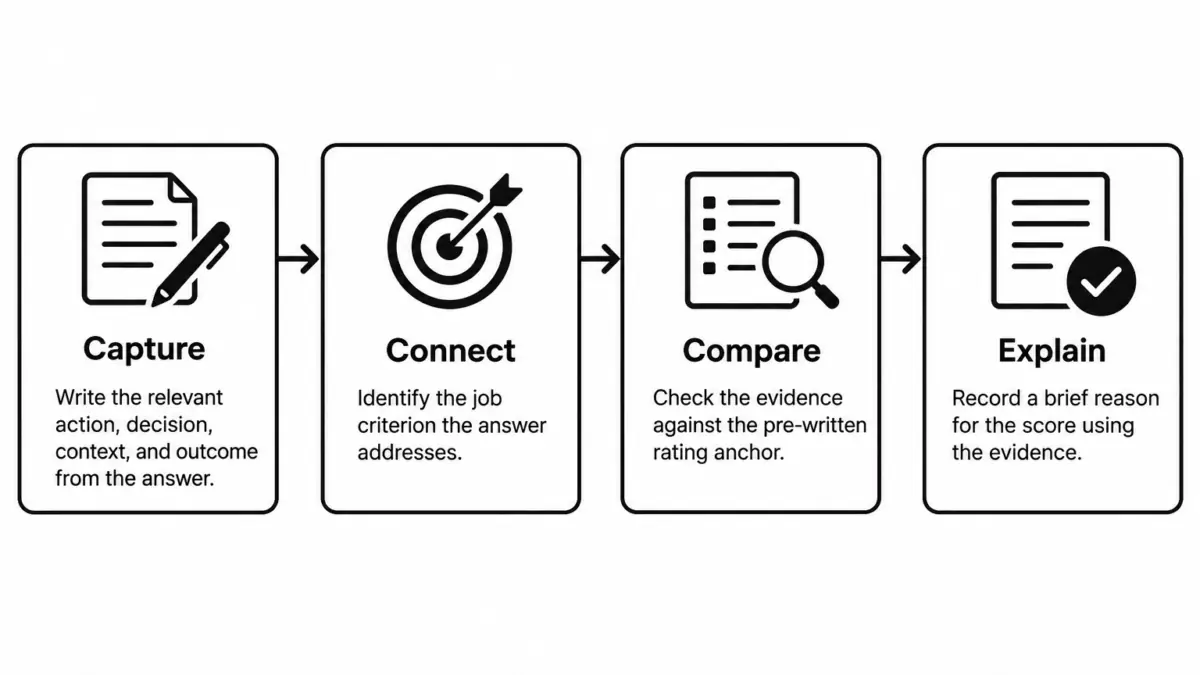
Text version of this visual
- Capture: Write the relevant action, decision, context, and outcome from the answer.
- Connect: Identify the job criterion the answer addresses.
- Compare: Check the evidence against the pre-written rating anchor.
- Explain: Record a brief reason for the score using the evidence.
Build a scorecard that asks for proof
A scorecard is often treated as paperwork that appears after someone has already decided who they prefer. Turn it into a listening tool instead. Each row should make it easier to notice evidence you would otherwise miss.
Limit the panel to the few capabilities that truly separate success from struggle in this role. If the scorecard contains nine or twelve broad traits, panelists will either rush the ratings or duplicate the same impression across several rows. For a role that coordinates competing requests, the deciding capabilities might be prioritization, written judgment, stakeholder communication, and follow-through. “Culture fit” is not a useful fifth row unless the panel can convert it into a job-related behavior and ask every candidate about it in the same way.
| Scorecard field | Example for a program operations role | Why it changes the panel’s discussion |
|---|---|---|
| Criterion | Prioritizes competing work under changing constraints. | Keeps the assessment tied to work the person will actually do. |
| Question | “Tell us about a time two urgent requests could not both be completed as originally planned.” | Gives each candidate the same opening prompt. |
| Evidence to listen for | Clarified stakes, named a decision owner, explained tradeoffs, communicated the revised plan. | Gives note-taking a purpose beyond general impressions. |
| Rating anchor | A higher rating requires a clear decision process and an explanation of how affected people were kept informed. | Prevents a polished story from receiving credit for details it did not contain. |
| Probe boundary | Ask about the candidate’s own role, the information used, and what happened after the decision. | Allows clarification without creating a different interview for each person. |
Write anchors as distinctions in evidence, not personality labels. “Exceptional candidate” is not an anchor. “Identifies competing priorities, explains the basis for a tradeoff, and describes how they adjusted after new information emerged” is much more usable. A lower rating can be equally clear: “Describes activity but cannot explain how priorities were decided or what result followed.”
Keep the scale small. A four-point scale can work well when the panel wants to avoid a comfortable middle option: insufficient evidence, partly demonstrated, demonstrated at the required level, and demonstrated above the required level. A five-point scale is workable too, provided the difference between adjacent scores is written down before the first interview. OPM advises that, absent a documented reason to weight criteria differently, equal weighting is generally the most defensible approach. Its scoring guidance is a helpful reminder that a weighting choice should have a reason, not merely reflect the strongest opinion in the room.
Do not turn the scorecard into a script that blocks useful listening. Its purpose is to preserve a common standard. If a candidate raises a relevant experience you did not anticipate, record it and assess it against the same criterion. The answer need not match your preferred example to be strong.
Use a pre-interview calibration that lasts 15 minutes
Before meeting candidates, ask every panelist to score two short sample answers against one criterion. One answer should meet the standard clearly; the other should sound plausible but lack a key piece of evidence. Compare the scores, then revise the anchor or question if the panel is scoring for different reasons.
This is not a debate about who has better instincts. It is a test of whether the panel has given itself a shared definition of a good answer. If one interviewer treats a candidate’s confidence as evidence of judgment while another requires a description of how the decision was made, the disagreement is in the scorecard design, not the candidate.
| Prompt for the panel | What to check | Adjustment if the answers differ |
|---|---|---|
| “What evidence earns the required-level rating?” | Whether everyone names the same essential behaviors. | Rewrite the anchor to name those behaviors directly. |
| “What would make this answer only partly demonstrated?” | Whether the panel can identify a meaningful gap. | Add a lower-level anchor rather than relying on a vague middle score. |
| “Which follow-up is fair for every candidate?” | Whether a probe clarifies evidence instead of rescuing a weak response. | Add it to the approved probe list or remove it. |
| “Are we measuring the same capability twice?” | Whether two criteria reward the same polished answer. | Merge the rows or make each criterion narrower. |
For example, a panel hiring a remote operations lead may discover that both “communication” and “collaboration” are being scored from the same story about a cross-functional launch. That does not mean the story is invalid. It means the scorecard needs separate evidence: perhaps written decision-making for one row and managing disagreement for the other.
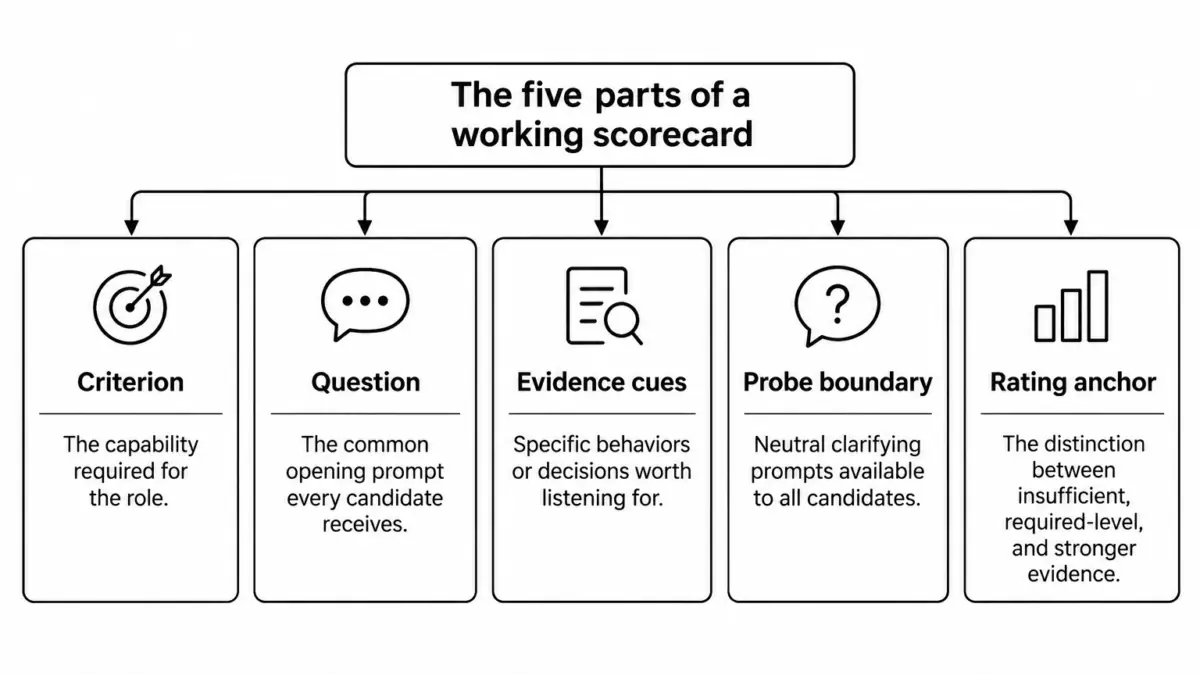
Text version of this visual
- Criterion: The capability required for the role.
- Question: The common opening prompt every candidate receives.
- Evidence cues: Specific behaviors or decisions worth listening for.
- Probe boundary: Neutral clarifying prompts available to all candidates.
- Rating anchor: The distinction between insufficient, required-level, and stronger evidence.
Keep follow-up questions comparable
Panels often lose consistency after the first answer. One candidate gets a gentle prompt—“Could you say more about your role?”—while another receives a detailed coaching sequence that helps them construct a better story. The issue is not that follow-ups are forbidden. It is that a probe can either clarify existing evidence or supply the missing structure for the candidate.
Prepare a short bank of neutral probes for each main question. These should ask for specificity without signaling the preferred answer. “What part did you personally own?” “What information did you use?” “What did you do when that plan met resistance?” and “How did you know whether the decision worked?” are generally more useful than “Did you make sure to involve engineering?”
| Interview moment | Comparable probe | Question to avoid |
|---|---|---|
| The candidate describes a team project but not their contribution. | “What was your own responsibility in that work?” | “Were you the person who brought the groups together?” |
| The candidate says they changed course. | “What new information led you to change course?” | “Was it customer feedback that made you change direction?” |
| The candidate mentions conflict. | “How did you address the disagreement?” | “Did you set up a meeting so everyone could align?” |
| The answer ends without an outcome. | “What happened after that decision?” | “So the project was successful in the end?” |
Set one boundary in advance: panelists may ask approved probes to clarify an answer, but they should not introduce a new scenario, change the difficulty of the question, or offer an example the candidate can adopt. If a candidate needs more time, repeat the original question and allow a pause. Silence is often fairer than filling the gap with hints.
Panel roles make this easier. Assign one person to lead the question, one to watch time and probe boundaries, and everyone to take notes and score their assigned criteria. In a small panel, a single person can lead and timekeep, but the roles should still be explicit. This is especially helpful in video interviews, where candidates may not know which interviewer will speak next.
A panel discussion is most useful when it tests the evidence behind a rating instead of asking people to defend a first impression.
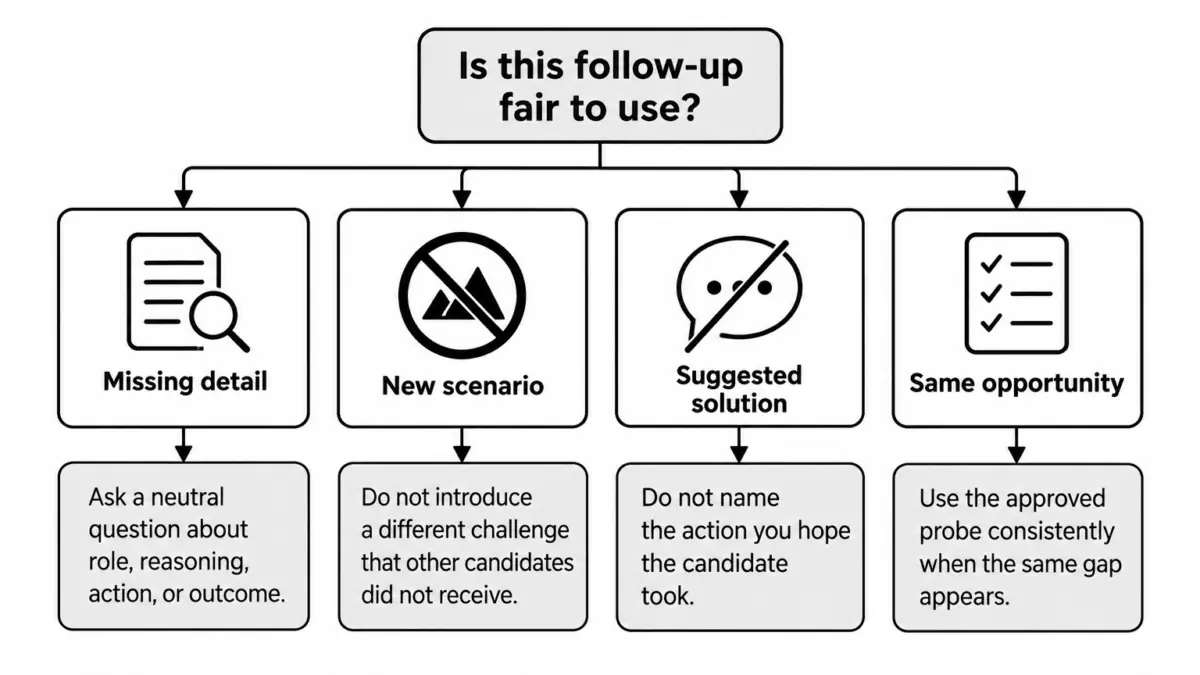
Text version of this visual
- Missing detail: Ask a neutral question about role, reasoning, action, or outcome.
- New scenario: Do not introduce a different challenge that other candidates did not receive.
- Suggested solution: Do not name the action you hope the candidate took.
- Same opportunity: Use the approved probe consistently when the same gap appears.
Rate alone before the panel talks
The most consequential part of a structured panel often happens in the two minutes after the candidate leaves. Someone says, “I loved them,” and the group starts interpreting the interview before quieter panelists have settled on their own ratings. Once a confident view enters the room, it can be difficult to recover an independent assessment.
Use a short silent interval. Each panelist completes the scorecard, writes one sentence of evidence for each rating, and marks any uncertainty. No debate yet. The aim is not to make the panel less collaborative; it is to make the later collaboration more informative.
The OPM’s Structured Interview Guide recommends independent review and rating immediately after the candidate leaves, followed by discussion of notes, ratings, and supporting observations. That order turns disagreement into useful material. A difference between a 2 and a 4 may expose an unclear anchor, an overlooked answer detail, or a panelist who gave too much weight to an unrelated impression.
The figures below are illustrative, not research data. They show why a panel should discuss the evidence behind a score rather than average numbers without context.
Compare explanations before averaging scores
If two panelists both give a 3 for stakeholder judgment, they may have reached that score for entirely different reasons. One may have heard a sound tradeoff process; another may have liked the candidate’s presentation style. Agreement in numbers is not always agreement in reasoning.
Ask each panelist to state, in one sentence, the evidence that most influenced their rating. Start with the lowest and highest scores, then move to the middle. This order prevents the most enthusiastic panelist from setting the terms of discussion.
- Ask: “Which part of the answer supports your rating?”
- Ask: “Which rating anchor does that evidence meet or miss?”
- Ask: “Did the candidate answer the question, or are we filling in the gap from their résumé or our own experience?”
- Do not ask: “Can you come up on your score so we can move on?”
A rating can change after this discussion. That is appropriate when a panelist identifies evidence another person missed, or when the group recognizes that an anchor was applied incorrectly. A rating should not change because the candidate is likable, because a senior panelist has a preference, or because a panel wants a tidier consensus.
- Panelist A2 rating on a 4-point scale
- Panelist B3 rating on a 4-point scale
- Panelist C4 rating on a 4-point scale
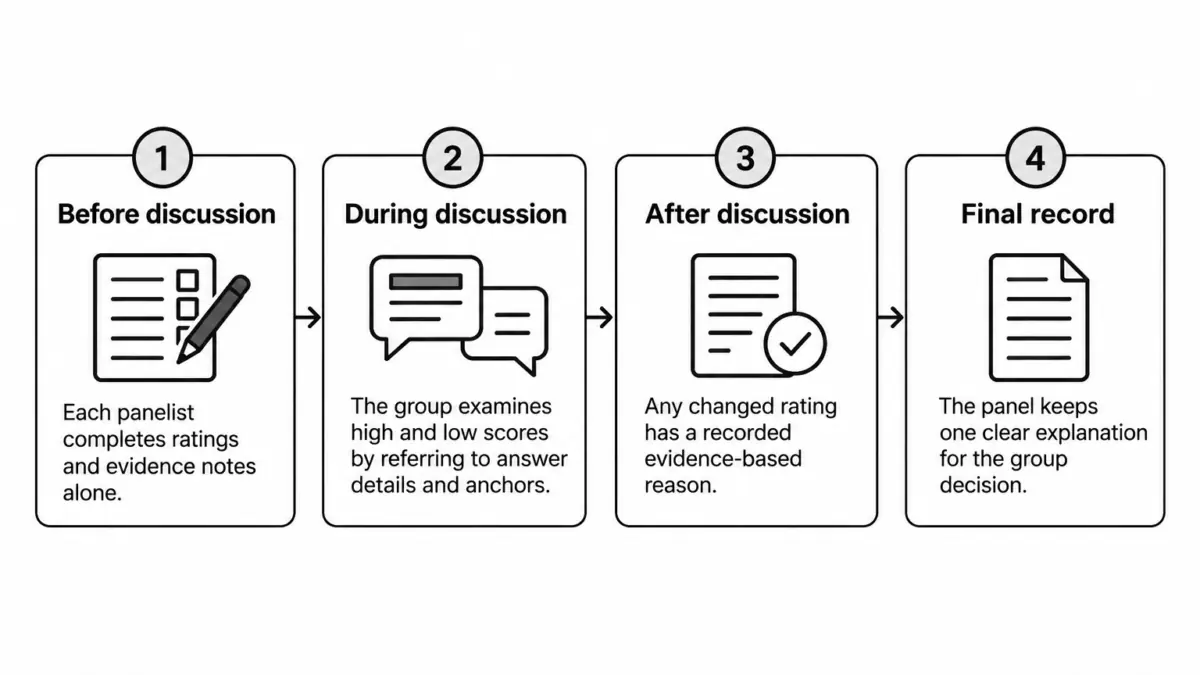
Text version of this visual
- Before discussion: Each panelist completes ratings and evidence notes alone.
- During discussion: The group examines high and low scores by referring to answer details and anchors.
- After discussion: Any changed rating has a recorded evidence-based reason.
- Final record: The panel keeps one clear explanation for the group decision.
Make the final decision candidate-by-candidate, then compare
Comparison is necessary in hiring, but it works best after the panel has assessed each candidate against the same standard. If the first candidate is called “excellent” mainly because they were better than the person interviewed before them, later candidates inherit a moving target.
After all interviews are complete, review each completed scorecard one candidate at a time. Confirm that every required criterion has evidence, identify any material gap, and record the group’s final rating with a brief explanation. Only then place the candidates side by side.
This sequence also helps a panel distinguish two different outcomes that are often blurred together: a candidate who is appointable but not the strongest match for the current role, and a candidate for whom the interview did not produce enough evidence at the required level. The first may be a strong future prospect. The second is a signal to assess whether the question, probe, or candidate response left an essential capability unresolved.
Keep the final decision record plain. It does not need to read like a legal brief or a performance review. It should let someone who was not in the interviews understand what the role required, what evidence the candidate provided, where the panel differed, and how the final choice followed from the agreed criteria. The EEOC’s private-sector employer guidance likewise encourages structured interviews, consistent procedures, accurate records, and documented reasons for selection.
Return to the distinction that begins this process. Notes tell the panel what it heard. Ratings explain what that answer demonstrates. Decisions compare completed evidence against the work the role requires. When those three things stay separate, a panel does not have to pretend instinct disappeared. It has simply stopped letting instinct write the hiring record by itself.
- Prioritization4 rating on a 4-point scale
- Stakeholder judgment3 rating on a 4-point scale
- Written follow-through2 rating on a 4-point scale
 About the author Ines Martínez
Digital Nomad & Resume Strategist · Spain/Mexico ¡Hola! I am a digital nomad and resume nerd who’s helped over 500 professionals craft winning CVs. My background is in UX writing, but I fell in love with career coaching while traveling across Latin America. I write practical guides and templates that actually help people get hired.