
In this article
A small distributed company opens a role, lines up interviews, and assumes the slow part will be finding qualified people. Then the familiar routine begins: the recruiter checks calendars across time zones, the hiring manager changes a question in a chat thread, an interviewer forgets to submit feedback, and someone sends the candidate an update without knowing whether the team is ready to decide.
The unexpected cost is not simply a few lost days. Each workaround changes the evidence available at the end. When interviewers receive different context, ask overlapping questions, or submit opinions after hearing what others thought, the team has a weaker basis for comparing candidates. The company may respond by adding a scheduling tool, more automated reminders, or another interview stage. Sometimes that helps. Often it automates a process whose ownership and assessment rules were never clear.
Before changing systems, run a small experiment through one hiring cycle. The purpose is not to make every interview faster. It is to identify which of three constraints is actually delaying or distorting decisions: calendar coordination, incomplete evidence, or missing decision ownership. For a distributed employer, those are different problems with different fixes.
This experiment works best for a role with enough interview activity to expose handoffs, but not an urgent rescue hire where the team cannot tolerate any process adjustment. Keep the role, interview stages, and selection standard stable while you test the workflow around them.
Start with the handoff, not the software
Hiring technology can route invitations and nudge people for feedback, but it cannot decide what an interviewer is responsible for assessing. That distinction matters because a hiring workflow contains two separate systems. One is administrative: invitations, time zones, meeting links, reminders, candidate updates, and record keeping. The other is evaluative: the job criteria, interview questions, evidence, scorecards, and final decision.
When those systems blur together, teams misdiagnose the problem. A recruiter may appear to be “chasing feedback,” when the real issue is that nobody agreed which interviewer owns judgment on stakeholder management. A hiring manager may request another conversation because the existing feedback is vague, although the team had no rating guide for the question they already asked.
A structured interview does not require an elaborate corporate process. At its core, it means using job-related questions, asking candidates a consistent set of questions, and evaluating responses against defined standards. The U.S. Office of Personnel Management’s overview of structured interviews describes those features and their role in consistent assessment. For a small employer, the practical implication is modest: assign each important criterion to one owner, decide what evidence counts, and capture a score before the debrief.
Choose two roles for the experiment:
- Process owner: keeps the candidate moving, confirms each handoff, and records where work waits. This may be a recruiter, operations lead, founder, or hiring manager. The process owner does not need authority to choose the candidate.
- Decision owner: defines the criteria, assigns interview coverage, checks whether the evidence is sufficient, and makes or recommends the selection decision. For most small teams, this is the hiring manager.
One person can hold both roles for a very small company. The experiment still works, but the two responsibilities should remain visibly separate. Otherwise, a delayed invitation and an unresolved hiring judgment both become “something I need to deal with,” which hides the cause of delay.
Write a one-page evidence map
Before the first interview, the decision owner writes a short evidence map. It should name three to five job-critical criteria, the interview stage where each will be assessed, the interviewer responsible, and the form of evidence expected. For a distributed customer-success lead, the map might assign written prioritization to a short work exercise, customer communication to a structured interview, and cross-functional judgment to a conversation with product and support.
Do not give every interviewer responsibility for every criterion. That looks thorough but produces repetitive interviews and weak accountability. If three people all assess “communication,” no one can explain which type of communication mattered, what the candidate actually demonstrated, or why the scores differ.
The evidence map is also a boundary. It prevents a last-minute request for an extra interview merely because the team feels uncertain. Uncertainty is worth investigating when a named criterion lacks usable evidence. It is not a good reason to reopen every part of the process.
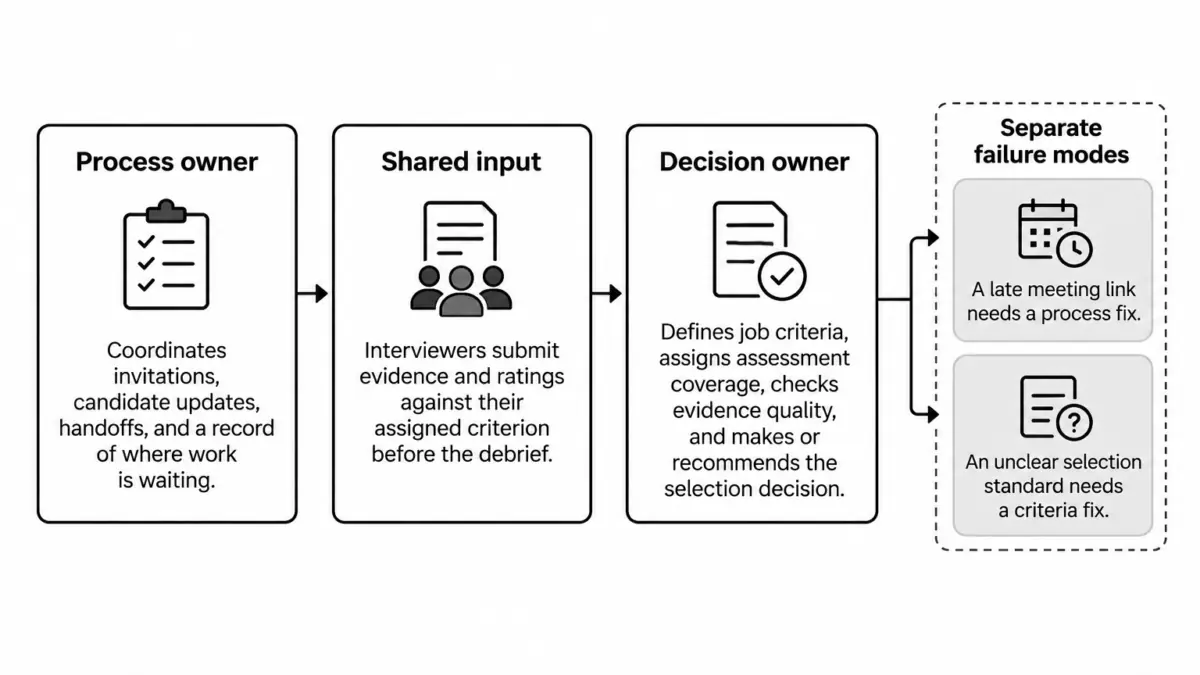
Text version of this visual
- Process owner: Coordinates invitations, candidate updates, handoffs, and a record of where work is waiting.
- Decision owner: Defines job criteria, assigns assessment coverage, checks evidence quality, and makes or recommends the selection decision.
- Shared input: Interviewers submit evidence and ratings against their assigned criterion before the debrief.
- Separate failure modes: A late meeting link and an unclear selection standard require different corrections.
Run the experiment through one live hiring cycle
Use the next suitable role and keep the test deliberately narrow. You are testing how information moves between people, not comparing recruitment platforms or trying to redesign the company’s entire selection process.
At the kickoff, give every interviewer the same compact packet: the role outcomes, assigned criterion, question set or exercise instructions, rating guide, interview time, and feedback deadline. The packet can live in the applicant tracking system, a shared document, or a folder with controlled access. The location matters less than having one current version. A workflow that depends on the process owner copying details into several places will create version drift as soon as the role changes.
Ask interviewers to submit feedback independently before the debrief. Their notes should identify observed evidence, a rating against the agreed criterion, and one concise rationale. “Strong candidate” is a conclusion, not evidence. “Explained how they reset account priorities after an integration failure; identified the customer, engineering, and support tradeoff; did not explain how they would communicate the revised commitment” gives the decision owner something to examine.
The requirement to record a score before discussion is not a demand for false precision. It preserves what each interviewer noticed before the group conversation pulls everyone toward the loudest view. OPM’s Structured Interview Guide explains the value of predetermined questions and rating standards; a small team can adapt that principle without copying a large-agency process.
During the cycle, the process owner records only three observations. Do not collect ten metrics because your team can. The point is to make a useful adjustment after one role, not build a reporting project.
Observation one: where does the candidate wait?
Mark each period when the candidate cannot move forward, then name the dependency. Was the wait caused by unavailable interview times, a missing decision about the next stage, late feedback, a changed role requirement, or an unanswered candidate question?
Be exact. “Scheduling took too long” blends together several failure modes. If the team had interview availability but waited two days for the hiring manager to select the panel, calendar software is not the first fix. If the panel was defined but only offered hours that excluded the candidate’s time zone, the problem is capacity planning. If every time change required a new message from the process owner, the administrative workflow needs a clearer trigger or better tooling.
Candidate communication belongs in the same record. The federal hiring framework maintained by OPM includes applicant status information and regular communication among the measures agencies use to examine their hiring process. That does not prescribe a small employer’s timing, but it is a useful reminder that process visibility is part of the hiring experience, rather than a courtesy added after the “real” work is done.
Observation two: where does evidence go missing?
At each debrief, compare the evidence map with the completed scorecards. Look for three patterns: a criterion nobody assessed, two interviewers assessing the same thing while another area went uncovered, or ratings without notes that explain what drove them.
A missing scorecard is an operational issue. A submitted scorecard that does not answer the assigned question is an assessment-design issue. Treat them differently. The first may call for a deadline and an escalation path. The second may call for a better prompt, a clearer rating guide, or a different assessor with closer knowledge of the work.
For example, a technical founder may be assigned to assess collaboration on a remote product team. They return detailed notes about the candidate’s technical choices because that is what they naturally notice. The correction is not another reminder. Reassign collaboration to the manager who works across the relevant functions, or revise the founder’s assignment to evaluate technical judgment instead.
Observation three: when does the decision reopen?
After each debrief, write down every new question that appears. Then separate questions that identify a genuine evidence gap from questions that arise because the team never decided what standard it would use.
Suppose a panel says, “We liked both finalists, but can we add a culture conversation?” Ask what job-related decision that conversation would resolve. If the answer is “We need to know whether they can handle disagreement with a remote team,” the team can define that as a criterion and use a focused question or work scenario. If the answer remains “We just need another feeling,” an additional stage will probably produce more impressions rather than better information.
The OPM guidance on interview structure makes a related distinction: higher structure places limits on question choice and evaluation criteria, which makes candidate comparisons more consistent. The lesson for a small employer is not that every conversation must sound scripted. It is that a free-form final round cannot reliably repair an unclear earlier process.
A reminder can repair a missed deadline; it cannot define what evidence an interviewer was meant to collect.
Review the result without blaming the coordinator
At the end of the role, schedule a 30-minute review with the process owner and decision owner. Start with the candidate timeline, then inspect the evidence map and scorecards. Keep the discussion on system behavior. “The hiring manager was slow” may be true, but it does not tell you whether the underlying condition was competing priorities, absent decision rights, an unreasonable feedback window, or a workflow that made the next action invisible.
Use three questions:
- Which wait occurred more than once, and what specific dependency created it?
- Which criterion produced weak or inconsistent evidence, and was the cause ownership, question design, or scorer guidance?
- Which change would remove a repeated handoff without adding a new layer of approval?
Small distributed employers are especially prone to a quiet ownership problem: everyone is trying to be helpful, but no one owns the exact moment when the process advances. A coordinator sends invitations. The manager “will review.” Interviewers “will add feedback.” A founder “will weigh in.” The candidate receives nothing because every next action is implied rather than assigned.
External scheduling advice often stresses confirming the hiring team and panel roles before outreach, preparing materials for interviewers, and collecting feedback after interviews. The SHRM interview-coordination checklist is useful here because it shows how many basic logistics depend on advance role clarity. Your experiment should reveal whether those steps are absent, or merely trapped in someone’s memory.
Make one adjustment, then test it again
Do not respond to the review by changing everything. Choose the repeated constraint with the clearest cause and alter one part of the workflow in the next hiring cycle.
If calendar coordination created most waits, establish interviewer availability before candidate outreach and designate the process owner to confirm substitutions. If scorecards came in late despite clear questions, set a feedback deadline tied to the debrief and make the decision owner responsible for escalation. If debriefs repeatedly revealed unassessed criteria, revise the evidence map and remove duplicate coverage. If candidates waited because the team had not decided whether to proceed, add a decision checkpoint after each stage with one named owner.
Only consider new automation after you can state the trigger in a sentence: “When the final interviewer submits feedback, the process owner checks evidence coverage and either schedules the debrief or asks the assigned interviewer for a specific missing item.” That is a workflow a system can support. “Make hiring move faster” is not.
Do not automate a handoff until one person can describe its trigger, owner, and expected output.
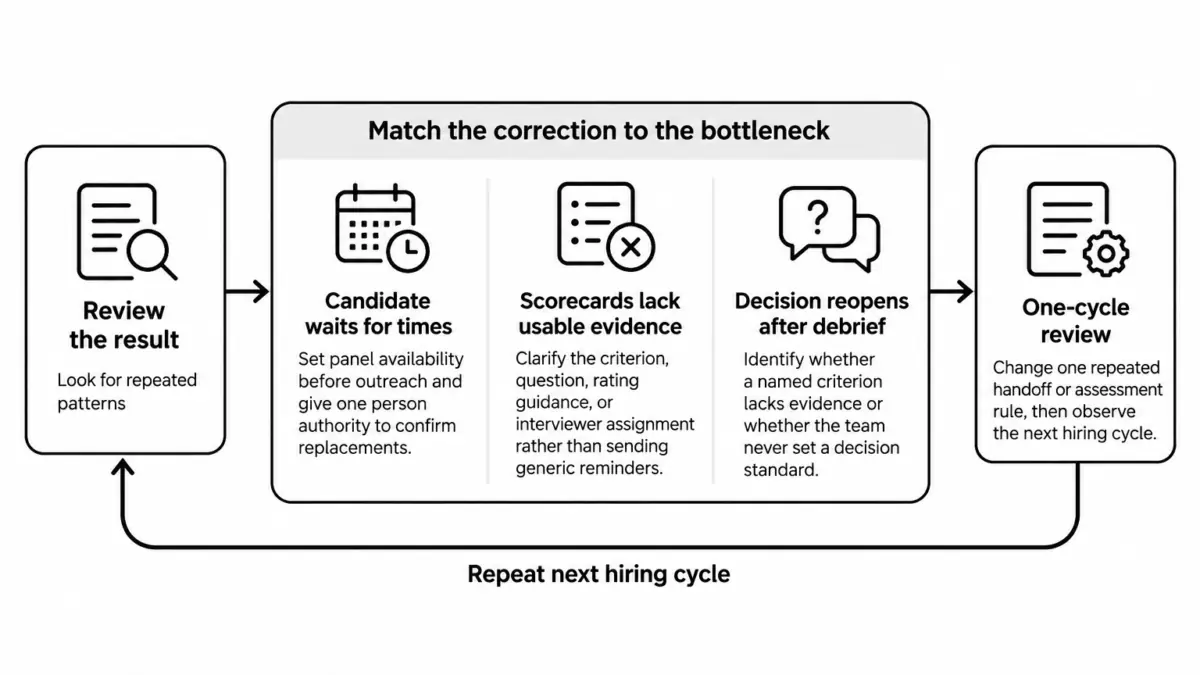
Text version of this visual
- Candidate waits for times: Set panel availability before outreach and give one person authority to confirm replacements.
- Scorecards lack usable evidence: Clarify the criterion, question, rating guidance, or interviewer assignment rather than sending generic reminders.
- Decision reopens after debrief: Identify whether a named criterion lacks evidence or whether the team never set a decision standard.
- One-cycle review: Change one repeated handoff or assessment rule, then observe the next hiring cycle.
Keep the experiment proportionate to the role
Some roles need more than this experiment can settle. A highly specialized hire may require expert review, a work sample, reference conversations, or extra time to align on scarce skills. A senior leadership role may need deeper discussion about scope and decision authority. The right response is to add a stage because it addresses a defined job requirement, not because the existing process feels uncomfortable.
Likewise, do not force every role through the same interview panel. A recurring role may justify a reusable question bank and a stable panel. A first-of-its-kind role may need a shorter discovery phase before the company can define sensible criteria. In that case, the experiment still applies: document what the team needs to learn before it begins evaluating people, and do not mistake that organizational uncertainty for a candidate problem.
The useful outcome is a workflow that can explain itself. The process owner knows what moves next. Each interviewer knows what evidence they own. The decision owner can distinguish an evidence gap from an unmade decision. Candidates receive updates from someone who has a current view of the process.
Use this decision rule after the review: if a delay or disagreement occurred twice in one hiring cycle, change the named handoff or assessment rule before adding another tool, interview, or reminder. One clear adjustment will tell you more than a broad hiring-process overhaul, and it gives the next candidate a process that is easier to follow as well as easier to run.
 About the author Ewald Schäfer
HR Technology Specialist · Germany I’m Ewald — a passionate HR tech consultant from Berlin. I write about the intersection of automation, recruitment, and human capital. After leading several HRIS rollouts across Europe, I now focus on advising startups and writing practical content for job seekers and hiring teams alike. With a strong IT background, I bridge the gap between HR and technology: from API integrations and data security to workflow automation and cloud-based HR platforms. My mission is to help organizations not only digitize but truly optimize their people operations.