
In this article
Small distributed employers often explain candidate silence as a capacity problem. The hiring manager is covering several roles. Interviewers are in different time zones. A decision depends on a budget conversation that has slipped. No single person intends to leave anyone waiting; the process simply moves more slowly than its participants expected.
That explanation may be true, but it is incomplete. A candidate does not experience the internal reasons for a delay. They experience an unfinished interaction: an interview ended, a promised next step did not arrive, and nobody has said whether the process is still moving. When this happens repeatedly, the problem is not merely a missing email. It is a hiring process with no clear owner for its handoffs.
Research on selection communications supports treating this as more than etiquette. A 2025 study of mid-level candidates found that timely rejection communication, particularly at earlier stages, was associated with stronger fairness perceptions, satisfaction, and intentions to reapply or recommend the organization. The useful lesson is not that every employer can make an immediate decision. It is that communication timing changes how candidates interpret the process.
For a small company, the answer is not a stream of warm but vague messages. It is a modest operating system: define the events that require a candidate update, name the person who sends it, and distinguish a real decision from a delay that needs explaining.
Silence is usually a workflow problem
Candidate communication is often assigned to “recruiting,” even when recruiting is one person working part-time, a founder, or a manager who is also doing the job they are trying to hire for. That creates a predictable gap. The person who knows that an interview went well may not know the hiring plan has changed. The person who knows finance paused the role may assume the hiring manager told the candidate. The person with access to the applicant tracking system may be waiting for a decision that nobody has formally recorded.
Messages then become dependent on memory. Someone remembers to send an invitation because it is urgent. Fewer people remember to send an update when nothing has changed. Yet an update during a delay often does more practical work than another automated acknowledgement: it tells the candidate whether they should prepare, wait, move on, or ask a reasonable question.
| Hiring moment | What the team knows internally | What the candidate needs to know | Useful owner |
|---|---|---|---|
| Application review is behind schedule | The team has not yet screened the full pool. | The role remains open and the review date has moved. | Recruiting coordinator or hiring manager |
| Interview feedback is incomplete | One or more panelists have not submitted a view. | A decision is not ready; the stated update date has changed. | Interview process owner |
| Role scope changes | The team is reconsidering level, location, or reporting line. | The process is paused or being redesigned, rather than quietly continuing. | Hiring manager |
| Another candidate is being considered first | The team has a preferred candidate but no final outcome. | The process remains active, with a specific next update point. | Recruiter or designated candidate contact |
This is also why a generic service standard—“respond quickly”—does not solve much. A team needs an event-based standard. If an interview is completed, the candidate receives a next-step message by an agreed point. If that point passes without a decision, someone sends a delay update. If the role pauses, the candidate receives a pause message rather than an invitation to infer the news from silence.
Candidate reactions are shaped by the procedure as well as the result. Research on rejection letters notes that applicants draw conclusions from both explicit and implicit organizational communication, including the timing and wording of an outcome message. A rejection notice is not a neutral delivery mechanism; it is part of the selection process candidates use to judge the employer.
| Weak process promise | Why it fails | Operational replacement |
|---|---|---|
| “We keep candidates informed.” | No one can tell when an update is due. | Send an update after each interview and whenever a stated decision date changes. |
| “The recruiter will follow up.” | The recruiter may not receive a decision or a delay signal. | Name a process owner who checks decision status on a set cadence. |
| “We will move fast.” | Speed is undefined and can encourage promises the team cannot keep. | State the next decision point and the date of the next candidate update. |
| “We will let you know.” | The candidate cannot distinguish active consideration from an abandoned process. | Say whether the candidate is advancing, waiting for a decision, paused, or no longer under consideration. |
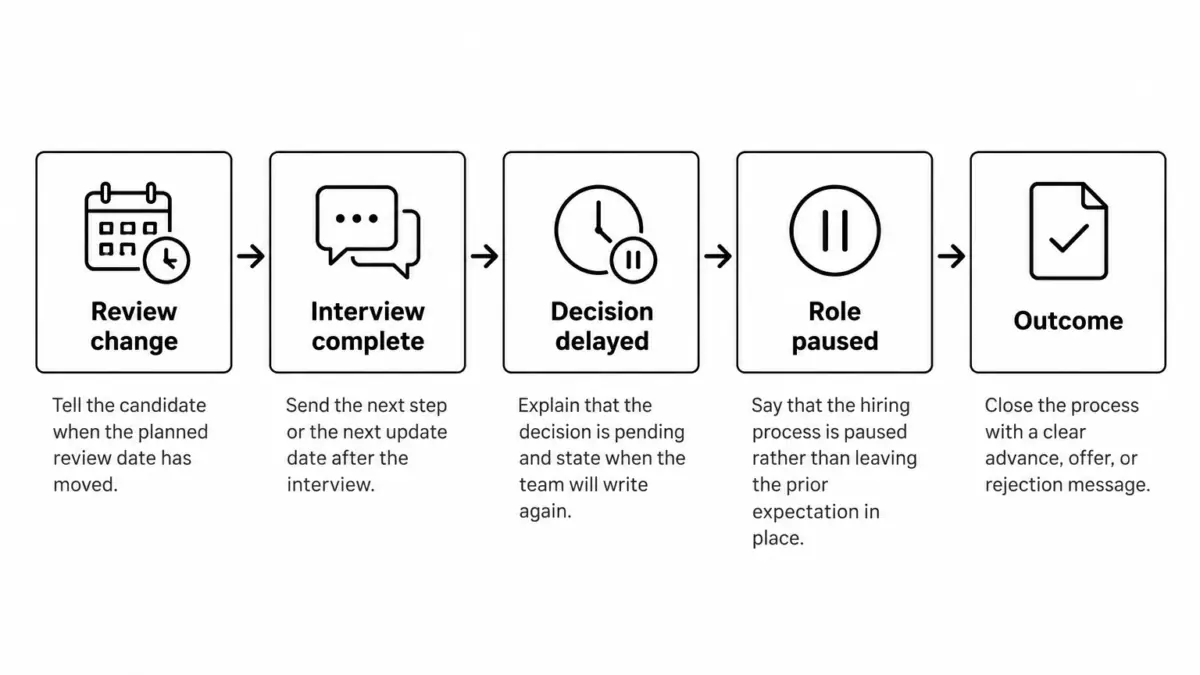
Text version of this visual
- Review change: Tell the candidate when the planned review date has moved.
- Interview complete: Send the next step or the next update date after the interview.
- Decision delayed: Explain that the decision is pending and state when the team will write again.
- Role paused: Say that the hiring process is paused rather than leaving the prior expectation in place.
- Outcome: Close the process with a clear advance, offer, or rejection message.
Promise the next decision, not a date you cannot keep
Distributed teams are vulnerable to false precision. A manager in one country says, “We will decide by Friday,” based on a conversation that has not yet been scheduled with a colleague elsewhere. A recruiter repeats that date to candidates. Friday arrives with a new question about headcount, compensation, or role scope. The candidate receives nothing because the promised decision did not happen.
There is a better form of precision. Instead of promising an outcome, promise the next decision event: “Our panel is meeting on Thursday. We will write by Friday, even if the decision is still pending.” This wording commits to communication, which the employer controls, without pretending to control every dependency.
That distinction matters most when the process contains an assessment or interview. Official guidance from the U.S. Office of Personnel Management describes structured interviews as a way to give candidates equal opportunities to provide information and to evaluate responses consistently through predetermined questions and common standards. Structure makes the assessment more consistent; a clear explanation of what happens after the assessment makes the experience easier to interpret.
| Promise type | Example | Use it when | Risk to avoid |
|---|---|---|---|
| Process promise | “There will be a hiring-manager conversation and a team interview.” | The stages are already agreed. | Adding unannounced stages late in the process. |
| Decision-date promise | “We expect to decide by May 12.” | The decision meeting and approvers are confirmed. | Presenting an estimate as a guarantee. |
| Update-date promise | “We will write by May 12, whether or not a decision is complete.” | A dependency could delay the outcome. | Using the update as a substitute for resolving repeated internal delay. |
One small wording change can prevent a great deal of unnecessary uncertainty. “We are finalizing next steps” says almost nothing. “The panel needs one additional discussion about the role’s scope. We will update you by Tuesday, June 9” gives the candidate a current state, a reason at the right level of detail, and a next communication point.
- Update arrives as promised1 relative uncertainty points
- One day late with explanation3 relative uncertainty points
- One week late with no message7 relative uncertainty points
- Second missed date10 relative uncertainty points
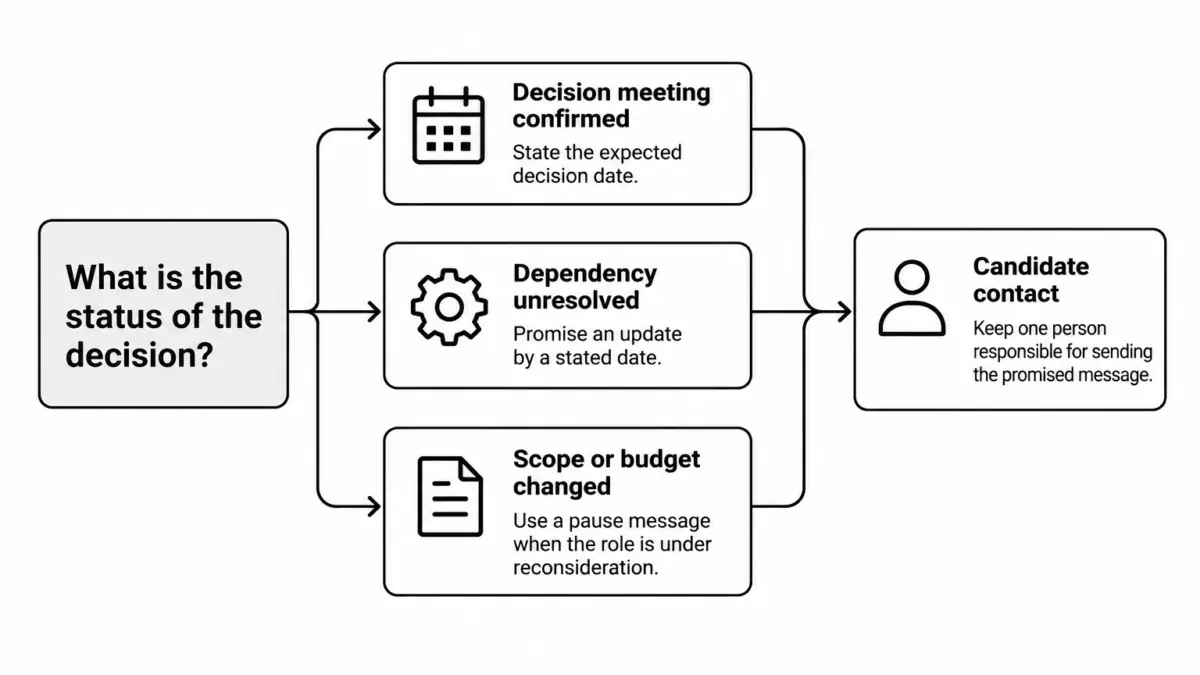
Text version of this visual
- Decision meeting confirmed: State the expected decision date if required participants and approvals are set.
- Dependency unresolved: Promise an update by a stated date instead of promising an outcome.
- Scope or budget changed: Use a pause message when the role itself is under reconsideration.
- Candidate contact: Keep one person responsible for sending the promised message.
Make one person own the handoff
Ownership does not mean one person must make every hiring decision. It means one person is responsible for noticing that a candidate-facing commitment is about to lapse and for obtaining the information needed to update the candidate.
For a lean employer, this can be the hiring manager for one role, an operations lead for several roles, or a recruiter when that function exists. What matters is that the responsibility is explicit. “Everyone will communicate” usually means communication is optional at the exact moment everyone is busy.
Do not confuse the candidate contact with the decision-maker. The candidate contact may write the message, but they need access to a short, current record: current stage, next internal action, person responsible, and next candidate update date. This is a small record, not a reporting burden.
| Field | What it records | Why it matters |
|---|---|---|
| Current stage | Applied, screened, interviewed, finalist, paused, or closed. | Prevents messages based on stale assumptions. |
| Next internal action | For example, panel debrief, budget approval, or reference discussion. | Shows what must happen before the candidate can move. |
| Decision owner | The person who can resolve or escalate the action. | Prevents a coordinator from chasing an unnamed group. |
| Candidate update date | The latest date for a substantive status message. | Turns silence into a visible missed handoff. |
There is an important limit here. Candidate updates should not disclose internal debate, another candidate’s information, or informal interview comments. The job is to communicate the process state, not to open the company’s decision room. A good update is specific about what the candidate can reasonably act on and restrained about everything else.
- Ad hoc follow-up18 candidate-status checks per week
- Shared status record9 candidate-status checks per week
- Named owner and update dates5 candidate-status checks per week
Use different messages for different kinds of delay
Not every waiting period means the same thing. A team that is still reviewing a large application pool needs a different message from a team that has completed interviews but is awaiting budget approval. Reusing one template for every delay produces the polished emptiness candidates recognize immediately.
The information order is simple: state the current status first, name the next action second, give a credible update date third. An apology can be included, but it should not replace the information. This follows a broader point from applicant-reaction research: recruitment interactions act as signals from which candidates form an evolving view of the organization. Research on recruitment interactions and uncertainty suggests that those signals matter after someone has applied, not only before they decide to apply.
Teams should also distinguish between a delay and a pause. A delay means the existing process is still proceeding, just later than planned. A pause means the organization cannot honestly say when or whether the process will resume. Calling a pause a delay creates false hope; calling a short delay a pause can cause a strong candidate to withdraw unnecessarily.
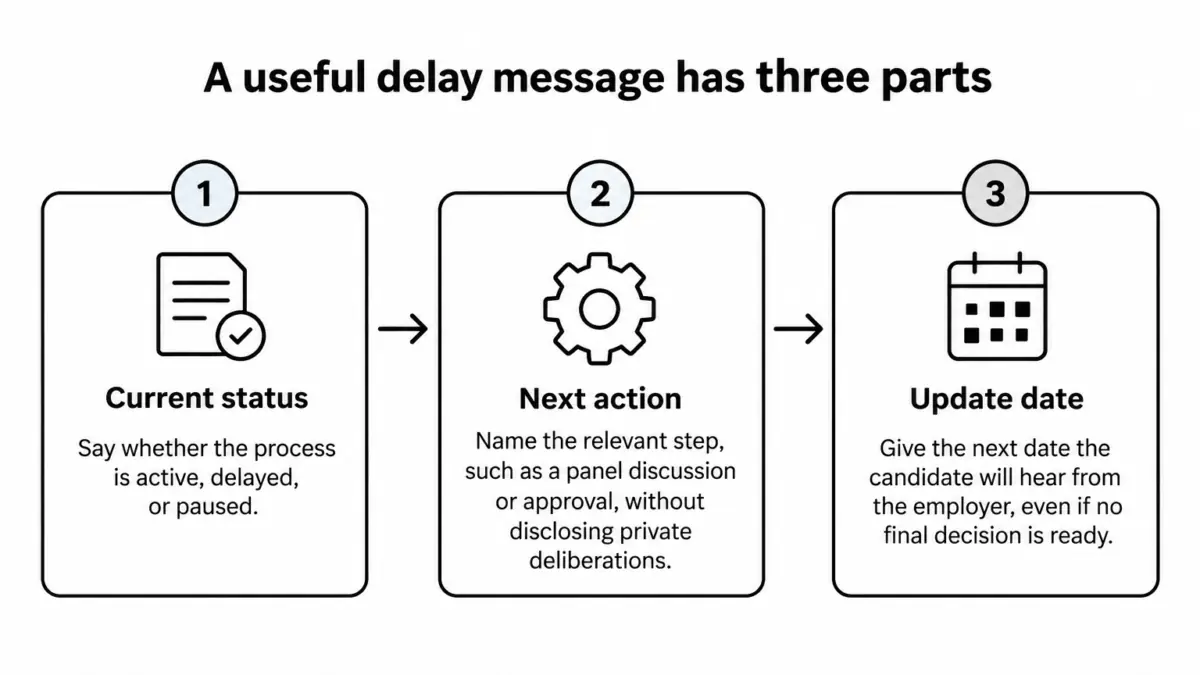
Text version of this visual
- Current status: Say whether the process is active, delayed, or paused.
- Next action: Name the relevant step, such as a panel discussion or approval, without disclosing private deliberations.
- Update date: Give the next date the candidate will hear from the employer, even if no final decision is ready.
Treat final-stage communication as a separate commitment
The closer a candidate gets to an offer, the more care the process requires. This does not mean every finalist should receive a detailed critique of their performance. It does mean a company should not disappear after asking for substantial time, preparation, or scheduling flexibility.
At this stage, employers frequently make a mistake that sounds considerate: they wait to reject other finalists until the preferred candidate has signed. That may be commercially understandable, but it does not justify leaving people with no information. A holding message can say that the team is completing final steps and will update by a specific date. If the candidate is no longer under consideration, say so promptly and plainly.
Interview guidance for selecting officials similarly recommends explaining next steps when concluding an interview. Explaining what happens next at the close of an interview is a small practice, but it establishes a reference point the employer must then honor or revise.
A thoughtful rejection need not be long. It should name the decision, avoid vague praise that implies future consideration without a basis, and thank the candidate for the specific level of participation they gave. After a multi-stage process, a terse automated message may be operationally efficient, but it should be a deliberate choice rather than the default result of a workflow that never recorded the person’s progress.
Build the system before your next opening
The most useful candidate communication policy is short enough to use during a busy week. It might define only five events: receipt of an application, invitation to an assessment or interview, post-interview next step, changed decision date, and final outcome. For each event, name the sender, the trigger, and the latest send date.
That approach will not eliminate delays. A small employer may still change scope, lose an interviewer to an urgent customer issue, or pause a role after new information arrives. The improvement is that the delay becomes visible to the team before it becomes unexplained to the candidate.
Candidate communication cannot compensate for an incoherent hiring process. It can, however, reveal where the process is incoherent: repeated “still deciding” notes may point to a vague role brief, a missing approver, an unstructured debrief, or a workload that the team has not acknowledged. That is useful information. The email is not the system. It is the evidence that the system either held together or did not.
 About the author Ines Martínez
Digital Nomad & Resume Strategist · Spain/Mexico ¡Hola! I am a digital nomad and resume nerd who’s helped over 500 professionals craft winning CVs. My background is in UX writing, but I fell in love with career coaching while traveling across Latin America. I write practical guides and templates that actually help people get hired.