In this article
Experienced people rarely get stuck because they have stopped working hard. More often, they have become very good at explaining why the last difficult piece of work unfolded as it did.
A launch slipped because another team changed scope. A hire did not work because the brief was unclear. A client pushed back because the market moved. Any one of those explanations may be true. But if it is the whole explanation every time, development has quietly stopped.
The useful question after a difficult outcome is narrower: What did I believe early on that turned out to be incomplete, wrong, or too confident?
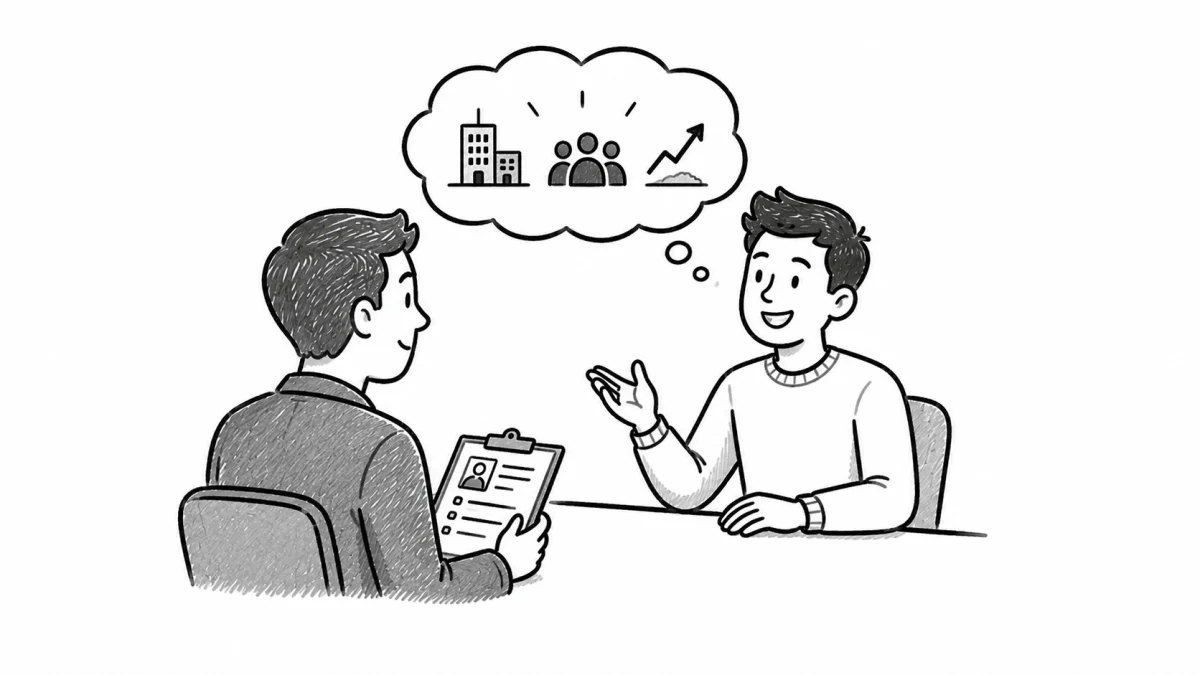
That question is uncomfortable because it asks for a revision of judgment rather than a tidy account of events. It is also the difference between collecting experience and learning from it. In hiring, you can hear this distinction immediately. One candidate describes a project that went sideways as a sequence of other people’s failures. Another can name the tradeoff they missed, the signal they discounted, and what they would now check sooner. The second answer is usually more convincing, even if the project itself was messier.
This is not an argument for turning every missed target into an act of self-blame. Work is full of genuine constraints: weak information, changing priorities, limited authority, bad timing and decisions made elsewhere. The point is to identify the part of the situation that can improve your next judgment. That is where experienced professionals still have room to get sharper.
The career story that should make you pause
There is a polished version of professional reflection that sounds mature but says very little. It often begins with a broad lesson: communicate earlier, align stakeholders, manage expectations. None of those phrases is necessarily wrong. They are just too roomy. They allow a person to leave the original reasoning untouched.
Take a product lead who agreed to a compressed delivery date. “I learned to communicate risks earlier” may be true. A more useful account might be: “I treated verbal agreement from two dependent teams as delivery commitment. I had not checked their planned capacity or asked who would own the integration work.” That is a learning point with edges. It changes what the person asks for next time.
Specificity matters because a professional error is often a chain, not a single bad moment. Research on learning from workplace errors found that a quick correction does not automatically produce learning; deeper analysis of the error was more important, although that study was small and its findings should not be inflated into a universal rule. The study of workplace error situations is still a useful corrective to the instinct to fix, move on and call the matter closed.
The assumption worth naming is usually hidden in an ordinary sentence: “They’ll raise it if there is a problem.” “The customer knows what this term means.” “A senior hire can work it out.” “If the data is available, people will use it.” These are not foolish beliefs. They are working hypotheses. Trouble starts when nobody revisits them after the work proves them expensive.
- Choose one consequential outcome from the past month or quarter.
- Write the explanation you gave yourself when the issue first appeared.
- Underline the assumption inside that explanation.
- Discard lessons that cannot change a future action.
Separate the event from your explanation
Start with the observable event before deciding what it means. This is basic, but senior people often skip it because they have enough pattern recognition to form a plausible diagnosis quickly. Plausible is not the same as tested.
Write down what happened in terms another person could verify: the deadline moved twice; the decision was made without the operational owner; the candidate withdrew after a five-day gap; the forecast used last quarter’s conversion rate despite a changed channel mix. Then write the explanation you gave yourself at the time. Finally, compare that explanation with the information that emerged later.
This separates an outcome from the story attached to it. A missed deadline may reveal poor estimation, unclear ownership, a late dependency, deliberate reprioritisation, or a combination. “We were too ambitious” may conceal all of them.
A structured review can help, provided it does more than invite people to say what went well and what did not. A meta-analysis of after-action reviews found benefits across studies, with effectiveness shaped by features including alignment to the individual or team and the use of objective review material. That evidence on after-action reviews does not mean every piece of desk work needs a formal debrief. It does support a more disciplined look at consequential work than a vague retrospective conversation.
The distinction is especially useful when you are senior enough that people tend to accept your first explanation. Authority can make an untested account feel settled. A good review creates enough friction to keep that from happening.
- Reconstruct observable events15 minutes
- Name the original assumption10 minutes
- Check evidence with others15 minutes
- Define one future cue10 minutes
- List observable events in order before offering a diagnosis.
- Mark what was known at the time of each decision.
- Separate constraints you could not control from signals you could have checked.
- Keep the review focused on one decision chain.
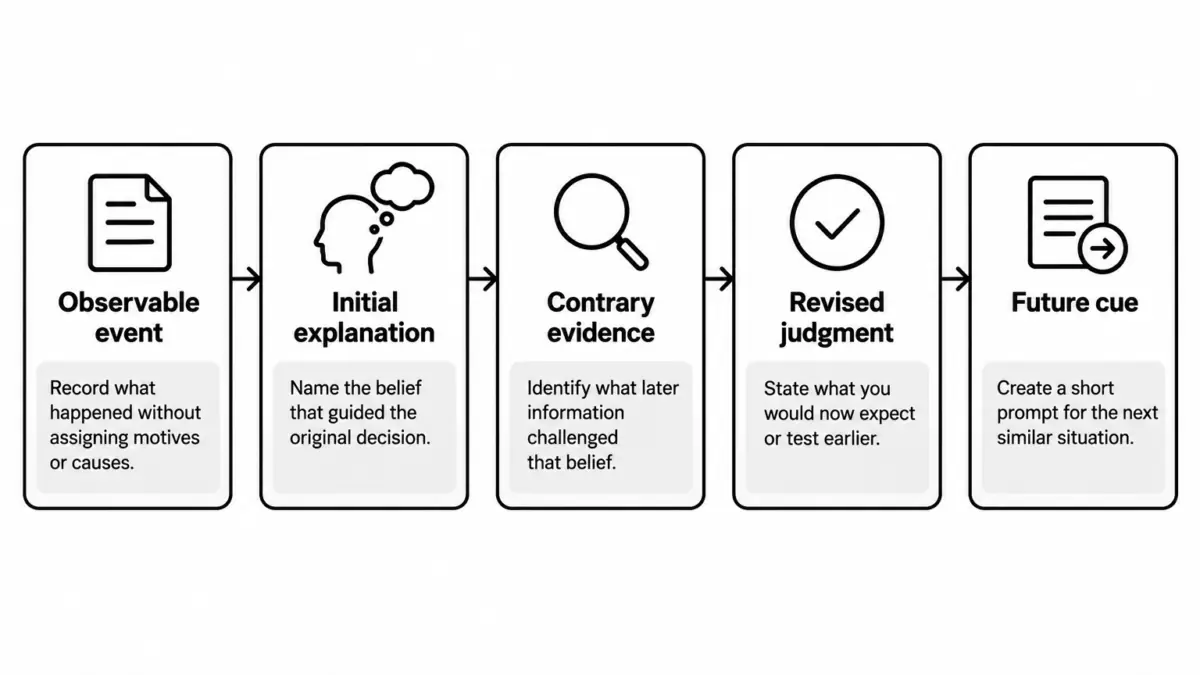
Text version of this visual
- Observable event: Record what happened without assigning motives or causes.
- Initial explanation: Name the belief that guided the original decision.
- Contrary evidence: Identify what later information challenged that belief.
- Revised judgment: State what you would now expect or test earlier.
- Future cue: Create a short prompt for the next similar situation.
Ask for feedback on a decision, not your personality
“Any feedback for me?” is a generous question and a poor instrument. It asks the other person to diagnose a whole professional identity, decide what is safe to say, and produce something useful on the spot. Many will respond with a polite generality.
Give them a smaller object. Ask: “When I argued for option A, what evidence did you think I was underweighting?” Or: “At what point did the handoff become unclear from your side?” Or: “Which part of my brief made it hard to judge whether this role was a priority?”
The recipient can answer from direct observation. You are less likely to receive a personality verdict disguised as development advice. More importantly, you can compare their answer with the assumption you have already identified.
Seeking feedback is not a magic habit that guarantees better performance. A longitudinal meta-analysis of employee feedback-seeking research found links with job and personal resources, while also noting that more research is needed to clarify the relationship with performance outcomes. The review of feedback-seeking research is a useful reminder to avoid the usual workplace slogan: ask more often, therefore improve. The quality of the question and the conditions in which it is asked matter.
There is also a social cost to this work. Asking a peer to revisit a decision can feel exposing; admitting an error can feel worse. Amy Edmondson’s research on team psychological safety describes why asking for help, seeking feedback and acknowledging mistakes carry interpersonal risk. Her study of learning behaviour in work teams is relevant here because individual reflection does not happen in a vacuum. If every question becomes evidence against someone, people will protect themselves instead.
Professional maturity is often visible in the assumption someone is willing to revise, not in the confidence of their first explanation.
- Any feedback for me?1 clarity score out of 5
- How did that meeting go?2 clarity score out of 5
- What evidence did I underweight?5 clarity score out of 5
- Where did the handoff become unclear?5 clarity score out of 5
- Ask one person who saw the work closely.
- Name the specific decision or communication you want examined.
- Ask what information you appeared to overlook.
- Request an example rather than a general impression.
- Thank them without debating the answer in the moment.
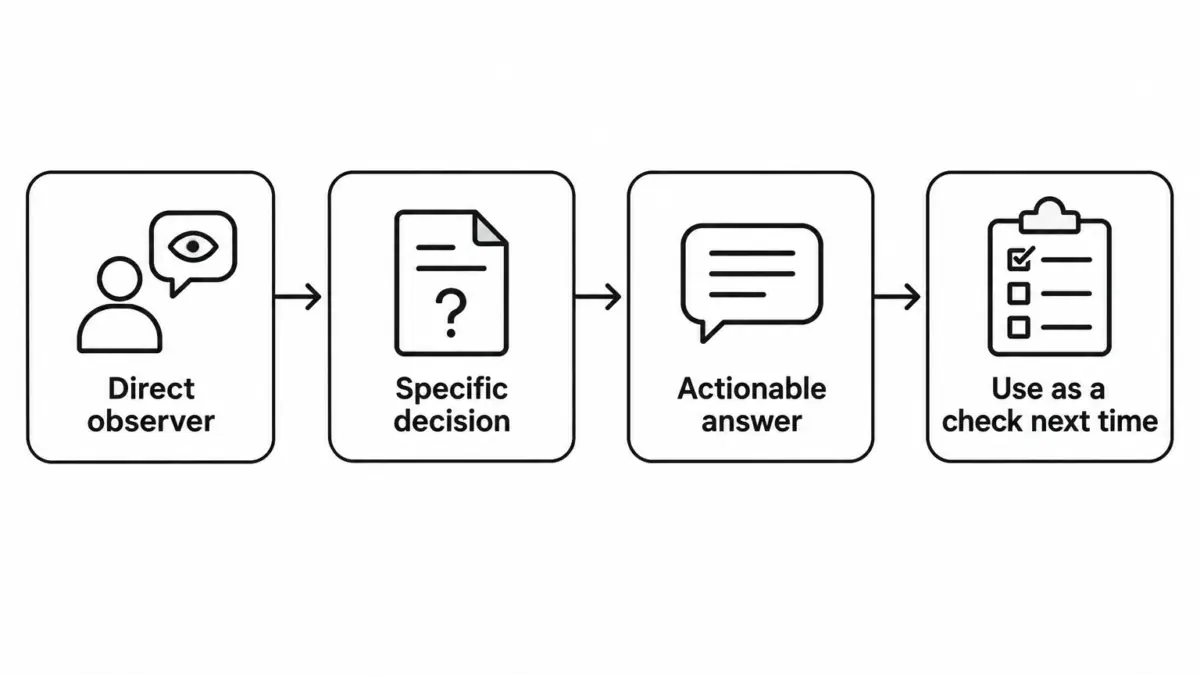
Text version of this visual
- Broad request: Use only when the other person has a clear reason and time to frame a wider review.
- Specific decision: Ask what evidence, assumption or handoff they observed in one piece of work.
- Direct observer: Prioritise someone who saw the relevant decision or communication.
- Actionable answer: Turn the answer into a check you can use on the next comparable task.
Turn the revised judgment into a repeatable cue
A good learning point changes a future action before it becomes another career narrative. The cue should be small enough to use while work is moving.
If you repeatedly discover that stakeholder agreement was shallower than it looked, your cue might be: before committing a date, ask each dependency owner what they will stop or defer. If you learn that your interview debriefs overvalue polish, add a prompt that asks what evidence supports the candidate’s claimed impact. If you find that your own projects get vague at the handoff, require a named decision owner and a written acceptance condition.
Notice what this avoids. You do not need a grand promise to become more strategic, collaborative or resilient. Those labels are too abstract to guide a Tuesday afternoon. You need a prompt that appears at the point where your old assumption usually enters the work.
Repetition alone is not the answer. A large meta-analysis of deliberate practice found that its relationship with performance differed substantially across domains and was very small in professions in the data analysed. That meta-analysis is a decent antidote to the idea that experience automatically compounds. Professional improvement depends on what is practised, what feedback is available, and whether the next attempt actually tests a revised approach.
For experienced professionals, this is often a better use of development time than consuming another broad framework. The work has already supplied the material. The missing step is converting it into a more exact next move.
- Convert the learning point into a short question or check.
- Place it at the moment the relevant decision is normally made.
- Use it on the next comparable piece of work.
- Adjust the cue if it is too broad to use under time pressure.
Use career material without polishing away the learning
There is a career benefit here, but it is not about manufacturing a redemption story for interviews or performance reviews. A mature account of difficult work should still include the scale of the problem, the constraints and the outcome. It should also show the change in judgment.
Try this structure: what was at stake; what you initially believed; the evidence that challenged it; what you changed during or after the work; and the check you now use. It is credible because it gives the listener something concrete to assess.
Compare these two versions. “I learned that stakeholder management is important” tells a hiring manager almost nothing. “I assumed that agreement in a planning meeting meant the operations team could absorb the change. After the rollout stalled, I began confirming capacity and handoff ownership separately before presenting a delivery date” gives them a real picture of how you think.
You do not need to pretend every disappointment made you stronger. Some failures are simply costly. Some environments make thoughtful learning difficult because there is no time, no access to evidence, or no safety to speak plainly. But where you do have room to review the work, resist the smooth explanation. Find the assumption that failed. It is usually more useful than the slogan you were about to write down.
- State what was at stake without inflating your role.
- Name the assumption you later revised.
- Describe the evidence that changed your view.
- Explain the concrete check you now use.
- Keep the outcome honest, including what did not improve.
 About the author Joshua Ward
Startup Recruiter · Talent Advisor · UK Hey, I’m Josh — a recruiter-turned-writer based in London. I’ve helped build early teams at over 25 startups in the past 7 years, mostly in SaaS and fintech. Now I share insights about how small companies hire, what hiring managers really look for, and how to stand out in a noisy job market.