
In this article
A hiring brief often begins with a description of a person: strategic, resilient, influential, hands-on, technically strong. The language sounds specific enough to move a search forward, particularly when everyone around the table has a slightly different picture in mind. But it creates a predictable problem. Recruiters are asked to find a candidate before the team has agreed on what work is performed on the job and what capabilities that work requires.
This matters most in roles that sit between functions. A product operations hire may need to bring order to ambiguous launches, repair a brittle planning rhythm, or turn scattered customer signals into choices a product team can act on. Those are different jobs, even if the title and seniority are identical. A candidate can be impressive in one version of the role and poorly matched to another. If the distinction remains vague, interviewers may assess people against different versions of the job rather than against predetermined, job-related criteria.
The useful unit of hiring design is therefore not the adjective and not even the list of responsibilities. It is the consequential piece of work: the situation this person will inherit, the judgment it will demand, the people affected by it, and the evidence that would show they can handle it. The U.S. Office of Personnel Management explains that job analysis identifies the duties of a role and the competencies needed for effective performance; that foundation can then inform hiring requirements and assessments rather than leaving them to accumulate independently.
A requisition can be complete and still be untestable
Most requisitions are not empty. They may contain a sensible list of deliverables, reporting lines, tools, and years of experience. Their weakness is subtler: they do not distinguish between work that is merely present in the role and work that will make the hire consequential.
Consider the familiar line: “Own cross-functional delivery.” It may refer to a coordinator who needs to surface dependencies early, a program manager who needs to reset a failing operating cadence, or a senior operator who needs to negotiate priorities among leaders with competing incentives. A résumé can support all three stories. An unstructured conversation can make all three candidates sound capable. The selection process becomes clearer only when the hiring team states which version of ownership it actually needs.
A stronger brief names four things:
- The work context: what is changing, blocked, unclear, or unusually important.
- The decision or judgment: what the person must interpret, choose, escalate, simplify, or challenge.
- The working interfaces: whose cooperation, information, or trust is necessary.
- The observable result: what would be different if the work were handled well.
This is not a demand for a fictional first-90-days plan. Teams cannot predict every incoming issue, and candidates should not be asked to solve an employer’s live problems for free. It is a way to identify the recurring class of work that matters at entry. OPM’s guidance on assessment strategy makes a similar distinction: identify the critical competencies required upon entry, then choose methods that can actually assess them.
Once this is written down, several attractive but vague requirements often lose their force. “Executive presence” may become the ability to explain a difficult tradeoff to a skeptical senior stakeholder. “Bias for action” may become the ability to make a bounded decision when the data will not become complete. “Strong communication” may become the ability to write a concise recommendation that separates known facts from assumptions. The language becomes less ornamental and more useful to the recruiter, interviewer, and candidate.
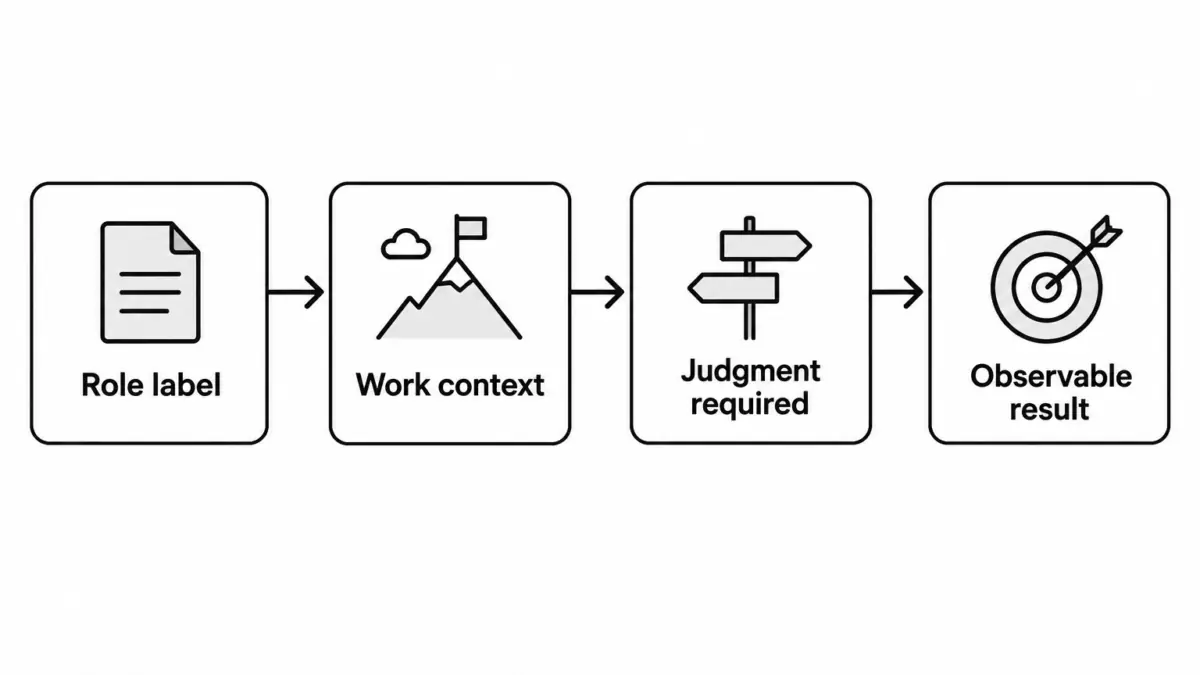
Text version of this visual
- Role label: A title or broad responsibility starts the conversation but does not identify the work that will determine success.
- Work context: Name the changing condition, persistent constraint, or recurring problem the hire will encounter.
- Judgment required: Specify the decision, interpretation, prioritization, or escalation the person must handle.
- Observable result: Describe what would be different in the work system if the role were performed well.
Turn the work into evidence, not a longer wish list
The next move is not to add every desirable quality to the brief. It is to decide what evidence would be credible for the few capabilities that truly matter.
A candidate’s prior title may indicate scope, but it does not show how they handled the relevant difficulty. A portfolio can show output but not necessarily the conditions under which judgment was exercised. An interview answer can reveal reasoning, but only if the question asks about a situation close enough to the role and the interviewer knows what to listen for.
This is why a hiring brief should include an evidence plan. For each critical part of the work, specify the best source of evidence and the question it should answer. For example:
- For stakeholder judgment, use a structured behavioral question about a decision made amid competing interests.
- For written synthesis, use a short, relevant writing exercise with a pre-agreed rubric.
- For technical depth, use a conversation or work sample that reveals how the person approaches a realistic task rather than a generic claim of familiarity.
- For collaboration, collect examples that show the candidate’s contribution, the disagreement or dependency involved, and what changed afterward.
Structured interviewing is not simply asking every candidate the same question. It also requires predetermined evaluation standards. OPM notes that structured interviews use common questions and rating criteria, and that questions tied to job-critical competencies identified through job analysis improve consistency in how responses are evaluated. Google’s structured interviewing guidance similarly emphasizes consistent questions, shared scoring, and predetermined qualifications rather than a decision made from general impressions.
The distinction has practical consequences in a debrief. “I liked her energy” cannot be meaningfully compared with “he has done this before” or “they would fit our pace.” By contrast, a panel can discuss whether a candidate gave sufficient evidence of identifying a dependency, changing course when an assumption failed, and communicating the resulting tradeoff. The conversation may still contain disagreement. It has simply become disagreement about evidence.
A role becomes easier to recruit for when the team can name the work that would make a hire consequential.
- Role context and candidate questions10 Illustrative minutes in a 45-minute hiring-manager interview
- Relevant past example20 Illustrative minutes in a 45-minute hiring-manager interview
- Decision-making probes15 Illustrative minutes in a 45-minute hiring-manager interview
Choose the smallest assessment that can answer the question
Recruiters can be caught between two legitimate pressures. A thin process asks candidates to perform confidence and familiarity. A sprawling process spends candidate time without producing proportionately better evidence. The hiring brief should make that tradeoff explicit before invitations go out.
A brief work sample can be appropriate when the role depends on a capability that is difficult to observe through conversation alone, such as making a written recommendation or prioritizing a realistic set of inputs. Yet the exercise needs to be relevant, bounded, and consistently scored. OPM’s guidance on writing assessments says that such assessments should be grounded in job analysis, linked to critical competencies, and reviewed through standardized scoring procedures. That is a more demanding standard than asking candidates to complete a task because the team would find the output convenient.
Not every capability needs its own stage. If a recruiter screen can establish the practical conditions of the search, it should not try to simulate a hiring-manager interview. If a work sample gives direct evidence of written judgment, a later panel should not ask three variations of the same question. Each stage should reduce a particular uncertainty. Repeatedly measuring the same thing only creates the appearance of rigor.
The question becomes: what is the least burdensome way to learn something we do not already know? It is a useful restraint for teams that are tempted to turn a single difficult hire into a six-round process.
- Résumé1 Illustrative evidence sources for one critical capability
- Structured interview2 Illustrative evidence sources for one critical capability
- Relevant work sample3 Illustrative evidence sources for one critical capability
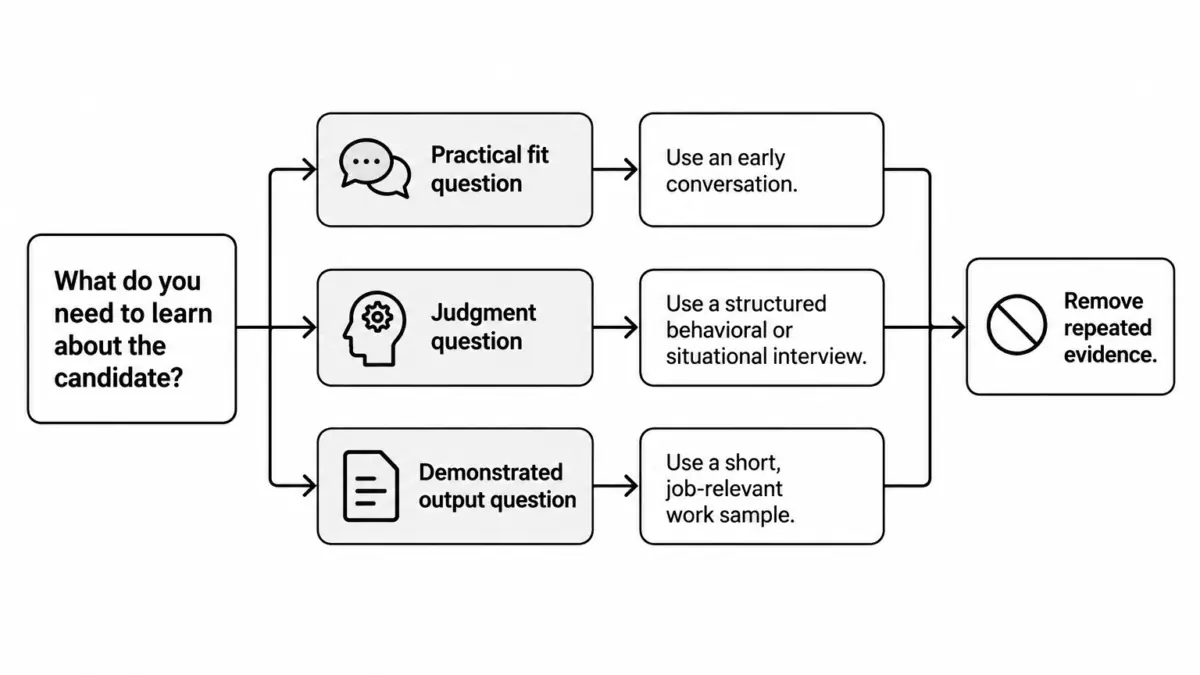
Text version of this visual
- Practical fit question: Use an early conversation for role expectations, availability, location requirements, and candidate interest.
- Judgment question: Use a structured behavioral or situational interview when the team needs to understand how a candidate reasons through relevant conditions.
- Demonstrated output question: Use a short, job-relevant work sample when the capability is difficult to observe through conversation alone.
- Repeated evidence: Remove or redesign stages that measure the same capability without reducing a new uncertainty.
Keep the brief alive after the search begins
A hiring brief is often treated as a launch document. In practice, it should be a comparison point throughout the process. The candidate pool may reveal that a requirement was unnecessarily narrow. Early interviews may show that the team has conflated a learnable skill with an entry requirement. A work sample may prove awkward to score because the panel has not defined what good work looks like.
These are not reasons to quietly alter the standard for the candidate who seems most compelling. They are signals to revisit the brief, document the change, and apply the revised approach consistently going forward. The EEOC’s guidance on employment tests and selection procedures stresses the importance of selection criteria being related to the particular job and of considering alternatives where a procedure unnecessarily excludes candidates. For recruiters, the operational lesson is simple: a criterion should survive the question, “What work does this help us assess?”
That question is particularly valuable when requirements have become inherited rather than examined. A specific credential, a narrow company background, a preferred communication style, or an elaborate take-home assignment may once have seemed reasonable. If no one can connect it to the job’s critical work, it is functioning more as a filtering habit than a hiring signal.
The point of structure is not to remove judgment from hiring. It is to give judgment something more durable than first impression.
The recruiter’s leverage is often earlier than sourcing
Recruiters are sometimes asked to solve an intake problem through search volume. Bring more profiles. Widen the geography. Use another channel. Those actions can be sensible, but they do not repair a role that has not been described in assessable terms.
The more valuable intervention can happen before outreach begins: insist gently on the distinction between a candidate fantasy and a working hypothesis about the job. Ask which problem is most expensive if it remains unsolved. Ask what the person must be able to do without extensive ramp time. Ask what evidence would change the hiring manager’s mind. Then build the process around those answers.
A strong brief will not make hiring frictionless. It may expose that the team wants a broader role than it can support, that two leaders are hiring for different futures, or that a supposedly essential requirement is really a preference. Those are difficult discoveries. They are still better made before a candidate has spent hours trying to satisfy a process that was never clear about what it needed.
The candidate description can come later, and it will usually be better for it. Once the work is clear, the profile has somewhere real to stand.
 About the author Victoire Boucher
Career coach focused on helping women navigate the tech industry. I’ve worked in product and engineering roles before shifting to coaching full-time. Now I write about imposter syndrome, salary negotiation, and how to grow without burning out.