In this article
It all started with a LinkedIn message. You know the one. The impossibly generic, “Dear [First Name], I was so impressed with your profile…” message that feels like it was written by a committee of marketing interns who’ve only ever read corporate mission statements. This one, though, was different. It was too perfect. The grammar was flawless, the keywords from my profile were seamlessly integrated, and the response time to my sarcastic “Oh really?” was… instantaneous. A bot. I was being wooed by a piece of software, and honestly, a small part of me was flattered. A bigger part of me was just tired.
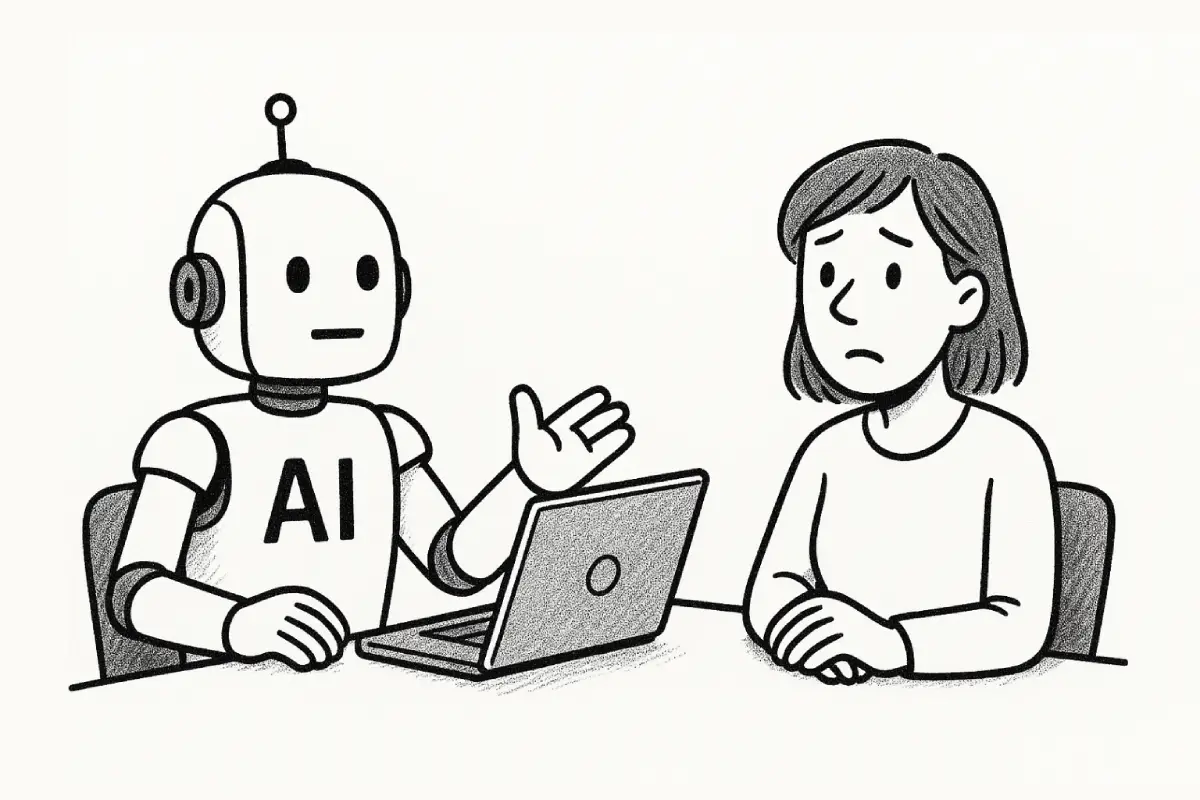
This whole debate—can AI replace recruiters?—it feels like we’re asking the wrong question. It’s not a simple yes or no. It’s not a boxing match between John Henry and the steam-powered hammer. It’s messy. It’s complicated. It’s a bit like asking if a calculator can replace a mathematician. Sure, it can do the arithmetic faster and with fewer errors, but can it dream up a new theorem? Can it feel that little spark of intuitive genius that connects two disparate ideas? Probably not. At least, not yet.
The thing is, we’re all a little bit fed up with recruiting, aren’t we? On the candidate side, it’s a soul-crushing gauntlet of online forms, ghosting, and feedback so vague it’s useless. On the company side, it’s a frantic scramble to find a unicorn in a haystack the size of Texas, sifting through mountains of résumés that all seem to list “proficient in Microsoft Office” as a key skill. It’s a broken system. And when things are broken, we look for a savior. Right now, that savior wears a shiny, data-driven halo and goes by the name of Artificial Intelligence.
The Seductive Promise of the Algorithm
Let’s be brutally honest for a second. A huge chunk of what recruiters have traditionally done is, well, grunt work. Tedious, repetitive, mind-numbing administrative labor. If you’ve ever spent a week trying to coordinate interviews between three candidates and five stakeholders with conflicting calendars, you know a special kind of hell. This is where AI waltzes in, looking like a superhero.
The Great Sourcing Machine
First, there’s sourcing. The old way involved Rolodexes (Google it, kids), industry events with lukewarm coffee, and endless cold calls. The modern way, even before AI got really smart, was keyword searching on LinkedIn until your eyes bled. AI tools take this to a whole new level. They are relentless digital prospectors, scraping not just LinkedIn but GitHub, Behance, academic papers, Twitter—you name it. They build complex Boolean search strings that would make a librarian weep with joy and they do it 24/7 without asking for a coffee break.
They can build a “long list” of a thousand potentially suitable candidates before a human recruiter has even finished their first espresso. It’s a numbers game, and the machine is built to win. It doesn’t get bored. It doesn’t get discouraged. It just… finds. This isn’t just a minor improvement; it’s a quantum leap in efficiency. Companies like SeekOut or hireEZ have built entire platforms on this premise, turning the vast, chaotic expanse of the internet into a searchable, categorized talent pool. It’s impressive, and frankly, it’s a part of the job most human recruiters are more than happy to outsource to their silicon sidekicks.
The Résumé Gauntlet and the ATS Overlords
And then we have the screening process. Oh, the screening. This is where the infamous Applicant Tracking System (ATS) comes into play. For years, the ATS has been the bane of job seekers everywhere—a crude keyword-matching filter that decides your fate based on whether you wrote “project manager” or “project leader.” We’ve all heard the horror stories of perfectly qualified candidates being rejected by a poorly configured ATS before a human ever laid eyes on their application.
But the new generation of AI-powered screening is different. It’s not just matching keywords anymore. It’s using Natural Language Processing (NLP) to understand context. It can (allegedly) tell the difference between someone who managed a team and someone who led a team to incredible success. It can analyze the sentiment of a cover letter, rank candidates based on a weighted scorecard of skills and experience, and even predict which applicants are most likely to be a good long-term fit. It crunches data with a terrifying, relentless precision. The promise is a meritocracy of data, where the best résumé—not the best-connected or the luckiest—gets to the top of the pile. A noble goal, for sure.
“We’re drowning in data. We have more résumés, more applicants, and more open roles than ever before. The idea that a human can manually, and fairly, assess every single one is a fantasy. AI isn’t a replacement; it’s a life raft.” – A (slightly exasperated) Head of Talent Acquisition at a tech startup.
This efficiency is the core of the argument for AI. It strips away the tedious parts of the job, freeing up the human to do… well, what exactly? That’s where the story gets a whole lot more interesting.
As insights from the World Economic Forum and various joint research initiatives suggest, the optimal collaboration between AI and human intelligence in recruitment can significantly boost economic growth by streamlining routine tasks with AI, while preserving human strategic insight and empathy in critical decision-making.
Where the Bots Just Don’t Get It
For all its number-crunching prowess, AI has a blind spot the size of the Grand Canyon. It’s a fundamental misunderstanding of what recruitment, at its core, truly is. It isn’t just about matching skills on a document to a job description. It’s about people. And people are weird, irrational, emotional, and gloriously messy creatures.
The Elusive “Vibe Check”
I’m talking about culture fit. Or “culture add,” as the more progressive folks call it these days. It’s that ineffable quality that determines whether a brilliant engineer will thrive in your chaotic, fast-paced startup or wither in a sea of open-plan desks and forced fun. Can you quantify a sense of humor? Can you algorithmically score a candidate’s humility or their collaborative spirit?
While AI tools can scan for surface-level indicators like ‘team player,’ research from institutions like Berkeley Haas highlights that the subtle complexities of ‘culture fit’ often involve value congruence and perceptual congruence, aspects current AI struggles to genuinely evaluate, underscoring the indispensable human element in assessing genuine team dynamics.
You can try. AI tools will scan for keywords like “team player” or “fast-paced environment.” But that’s just surface-level mimicry. A human recruiter, in a real conversation, can pick up on the subtle cues. The way a candidate’s eyes light up when they talk about a collaborative project. The slight hesitation in their voice when you ask about dealing with difficult feedback. The easy laugh that tells you they won’t take themselves too seriously. This is the stuff that makes or breaks a team.
An AI is like a brilliant but tone-deaf musician. It can play all the right notes, perfectly in time, but it has no soul. It can’t feel the music. It can’t improvise. A good recruiter, on the other hand, is a jazz artist. They listen, they react, they feel the rhythm of the conversation and play along. That’s a skill you can’t code.
The Art of Seducing the Passive Candidate
The best people are often not looking for a job. They’re happy where they are, killing it in their current role. You can’t just send them a job description and expect them to jump. You have to build a relationship. You have to sell them a dream. This is sales, pure and simple. It requires empathy, persuasion, and a whole lot of patience.
Imagine an AI trying to do this.
AI: “Hello, [Candidate Name]. My data indicates you have a 94.7% skill match for our Senior Galactic Overlord position. The compensation package is in the top decile. Are you interested?”
Human: “No, I’m good, thanks.”
AI: “Query not understood. Please rephrase. Are you interested?”
A human recruiter approaches this completely differently. They’ll find a common connection. They’ll compliment a specific piece of work. They’ll ask about career aspirations. They’ll buy them a coffee (or a virtual one, these days). They’ll play the long game, building trust over weeks or even months. They are part career coach, part therapist, part trusted advisor. They are selling an opportunity, not just filling a vacancy. The subtlety, the nuance, the human connection required to pull this off is just… so far beyond the grasp of current technology.
The Empathy Gap
Let’s talk about the tough stuff. Rejecting a candidate. There is no good way to automate empathy. A templated, AI-generated “Thank you for your interest, but…” email is cold and dismissive. It leaves a candidate feeling like a rejected cog in a machine, which, in that case, they are. A human recruiter can soften the blow. They can offer genuine, constructive feedback. They can keep the person in mind for future roles. They can leave the door open. They can treat someone with dignity, even in rejection. This isn’t just about being nice; it’s about brand management. Every rejected candidate is a potential future customer, partner, or even employee. How you treat them matters. An AI, optimized for efficiency, will always struggle with the messy, inefficient, but critically important business of being human.
The same goes for negotiation. An AI can be programmed with salary bands and acceptable ranges. But it can’t understand the human factors. It can’t sense when a candidate is hesitant because of a long commute and then offer an extra day of remote work. It can’t hear the excitement in someone’s voice and realize that a better title is more important to them than an extra two grand. Negotiation is a dance, and bots have two left feet.
The Human Element: Our Secret Weapon?
If AI is handling the sourcing, the scheduling, and the first-pass screening, what’s left for the human recruiter? Everything that matters. The role isn’t disappearing; it’s evolving. It’s being elevated from an administrative function to a deeply strategic one.
Strategic Advisors, Not Paper Pushers
The recruiter of the future—and the best recruiters of today—are talent advisors. They don’t just take a job description from a hiring manager and go find it. They push back. They challenge assumptions.
Hiring Manager: “I need a full-stack developer with 10 years of experience in React, Python, and ancient Sumerian pottery, and they have to be willing to work for minimum wage.”
Old-School Recruiter: “Okay, I’ll see what I can find.” (Finds nothing).
Strategic Recruiter: “Let’s talk about what we’re really trying to build here. What are the must-haves versus the nice-to-haves? Based on market data—which, by the way, my AI assistant just pulled for me—the salary you’re offering is about 40% below average. We either need to adjust the compensation or be more flexible on the ‘ancient Sumerian pottery’ requirement.”
See the difference? One is a passive order-taker. The other is a strategic partner who uses data (often provided by AI!) to influence and guide the hiring process. They are consultants, not clerks. This requires business acumen, confidence, and the ability to manage complex stakeholder relationships. Good luck programming that.
The Network Weavers
A human’s network is not just a list of contacts in a database. It’s a living, breathing ecosystem of relationships built on trust, mutual respect, and shared experiences. A great recruiter knows who’s happy, who’s restless, who’s the secret superstar on a team, and who’s about to quit. They hear the whispers. They know the gossip. They have a spidey-sense for the talent landscape that comes from years of genuine human interaction.
An AI can tell you who has the right skills. A human recruiter can tell you who has the right heart. They can call up a former colleague and say, “Hey, I’ve got a role I think you’d be perfect for. I know you’re not looking, but just hear me out…” That kind of access and influence is priceless. This deep well of social capital is something an AI can only simulate, never truly replicate.
“My best hires have never come from a keyword search. They’ve come from a conversation that started with ‘You’re not going to believe who I had lunch with yesterday.’ That’s the whole game, right there. It’s about knowing people, not just knowing résumés.” – A 25-year veteran of executive search.
This is the human touch in action. It’s the ability to read the room, even a virtual one. It’s the gut feeling that tells you a candidate who looks perfect on paper is hiding a major red flag, or that the person with the weird, non-traditional background has the grit and raw intelligence to be a star.
The Verdict: A Cyborg Future
So, will AI replace recruiters? No. But it will absolutely, 100%, without a doubt, replace bad recruiters.
The recruiters who are just glorified administrators, who hide behind emails, who treat candidates like commodities, and who act as nothing more than a middleman between a job board and a hiring manager—their days are numbered. And frankly, good riddance. They were making the rest of us look bad anyway.
The future of recruiting isn’t a battle of bots vs. humans. It’s a partnership. It’s the “centaur” model, named after the mythological creature that was half-human, half-horse. The AI is the horse—providing the speed, the power, the raw data-processing muscle. The human is the rider—providing the strategy, the wisdom, the empathy, and the direction.
The recruiter of the future will leverage AI to handle 80% of the administrative burden. They’ll have a dashboard that surfaces the top 10 candidates from a pool of 1,000, complete with data-driven insights. But then, the human takes over. They’ll be the ones having the deep, meaningful conversations. They’ll be the ones selling the vision of the company. They’ll be the ones closing the deal.
Their value will no longer be in finding talent—the AI will do that. Their value will be in engaging, assessing, and securing it. The job will become less about administration and more about emotional intelligence, sales, and strategic consulting. It’ll be a harder job, a more skilled job, and, ultimately, a more valuable job.
So, yeah, that bot that messaged me on LinkedIn? It did a decent job of getting my attention. It was efficient. But it couldn’t have a real conversation, it couldn’t understand my sarcasm, and it certainly couldn’t convince me to leave a job I love. To do that, you’d need something more. You’d need a human.
 About the author Matt Semon
Career Writer · AI Hiring Trends · USA I’m Matt, a writer and researcher focused on how hiring is evolving in the age of AI. I’ve been following trends in recruitment, automation, and remote work since 2018. When I’m not writing deep-dive articles for Jobicy, I’m testing AI tools to see how they impact candidates and hiring teams.