In this article
A hybrid meeting can have excellent audio, a wide-angle camera, a reliable video platform, and still produce a lopsided decision. The failure is usually not the technology in isolation. It is that the physical room becomes the default interface for the work: people point at a screen only some can read, resolve an objection in a side exchange, sketch an alternative on a whiteboard, or establish agreement through a glance around the table.
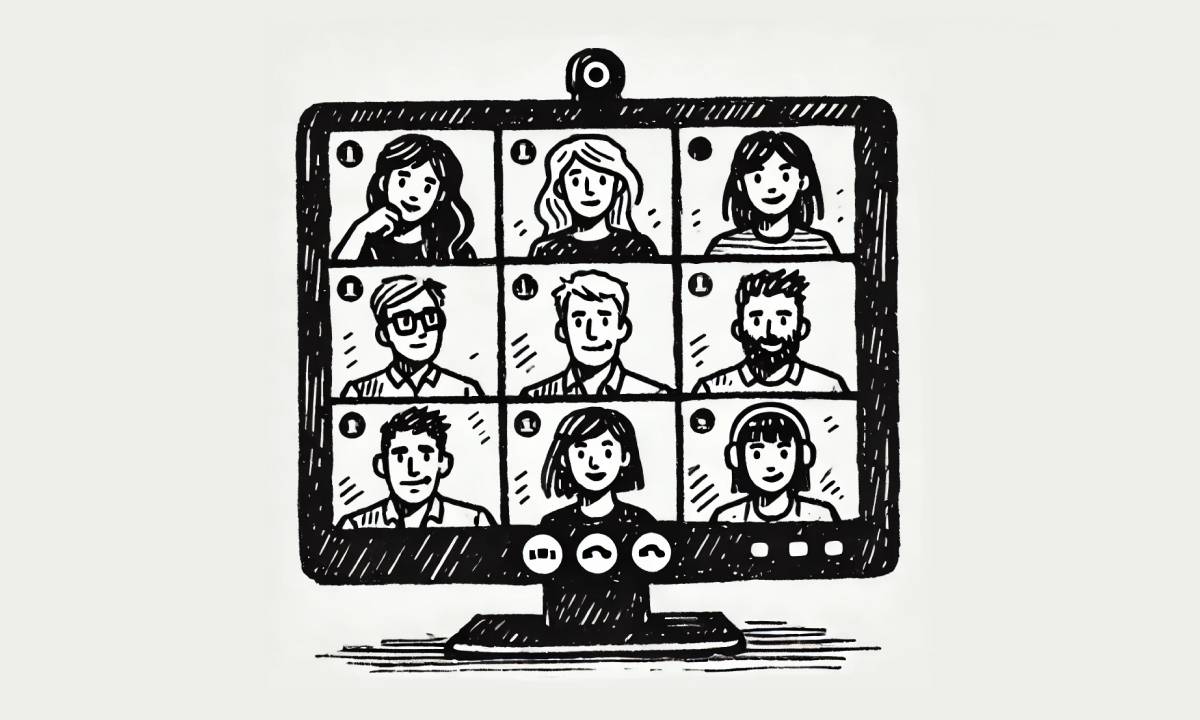
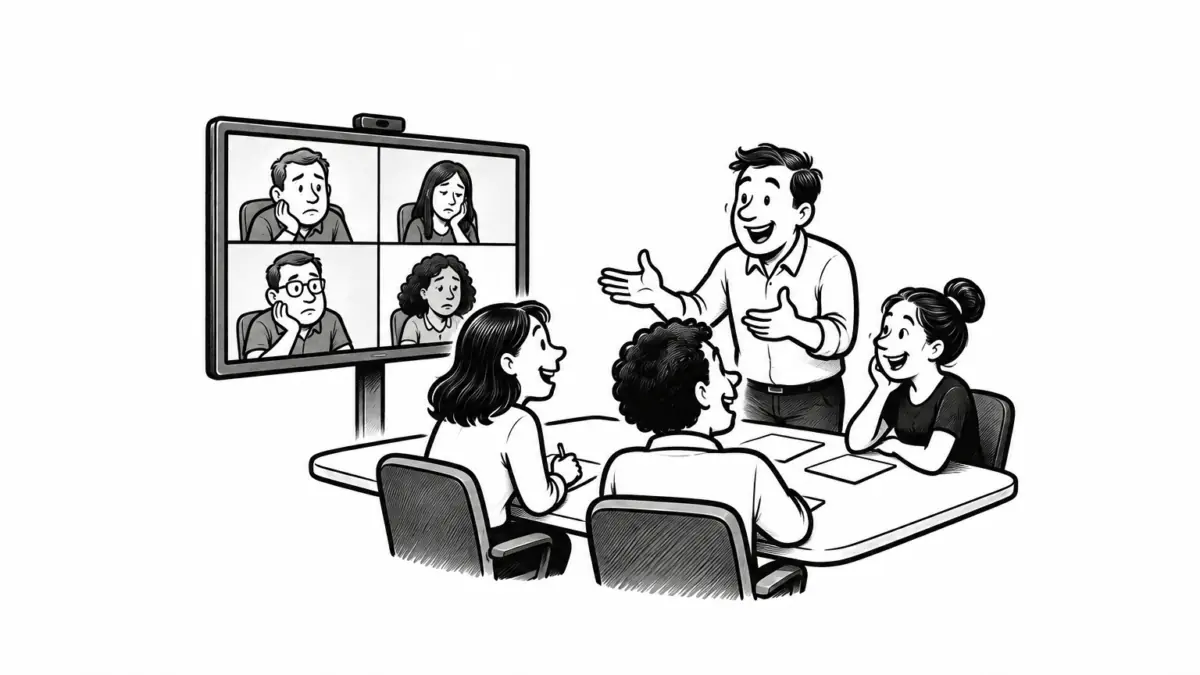
Remote participants may hear most of this. Hearing is not the same as having access to the inputs from which a decision is made. They have less ability to see who is unconvinced, interrupt a fast-moving exchange, inspect the material being discussed, or tell whether an apparent conclusion has actually been recorded. The meeting then creates two levels of participation: one group inhabits the conversation and another monitors it.
This is why the familiar remedy—better etiquette—only goes so far. Asking people in the room to “include remote colleagues” places the burden on individual goodwill while leaving the meeting’s information flow unchanged. Hybrid work needs a more technical standard: if an input can affect a decision, it should enter through a shared channel that every participant can inspect, challenge, and retrieve afterwards.
That standard also helps with a problem that is not unique to hybrid work. Research on work interruptions distinguishes between different kinds of disruption rather than treating every interruption as equivalent; work-based intrusions and multitasking can carry different consequences from deliberate breaks. A study of the interruption landscape during working from home makes the useful point for meeting design: more communication is not automatically better coordination. A room conversation that repeatedly forces remote attendees to ask for context is an interruption pattern built into the meeting itself.
Presence is not participation
Hybrid teams often assess a meeting by attendance: who was in the office, who joined online, and whether everyone’s connection held. That is operationally necessary but analytically weak. Participation depends on whether each person can contribute evidence, understand the current state of the issue, recognize when a decision is being made, and see what follows from it.
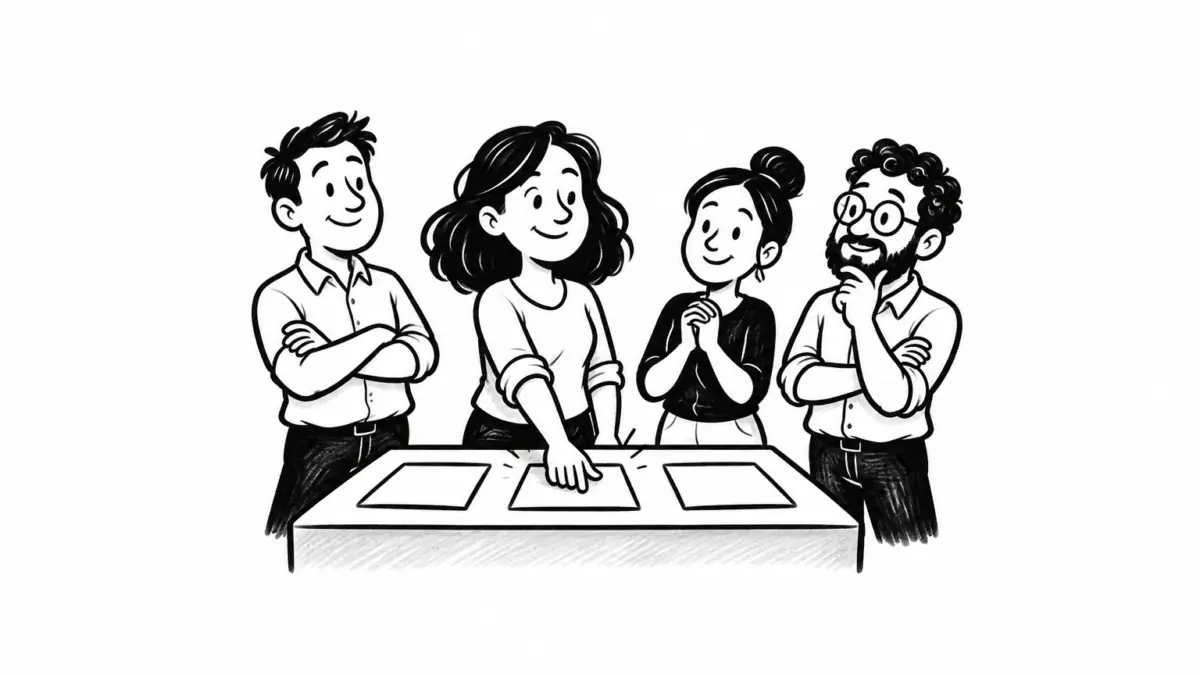
Consider a planning session where six people share a conference room and three join remotely. The group begins with a digital roadmap. That is promising. Then someone in the room opens a laptop to compare customer feedback, two colleagues discuss a dependency quietly, and the facilitator writes a revised sequence on the glass wall. By the time the remote participants are asked for a reaction, the proposal has acquired the force of something already settled. Their choice is no longer between competing options. It is whether to slow down the room by reopening a conclusion.
That is not a confidence problem on the remote side. It is a sequencing problem. The room was allowed to generate and validate material outside the shared workspace, while the online participants were invited back only at the response stage.
| Meeting moment | Weak design | Shared-input design |
|---|---|---|
| Problem framing | The facilitator summarizes a discussion that began before the call. | The problem statement and constraints are visible in a shared document before discussion starts. |
| Evidence review | People in the room refer to paper notes, a wall, or one person’s laptop. | Source material is linked or pasted into a workspace that all participants can inspect. |
| Option development | Nearby colleagues refine an idea through side conversation. | Alternatives are written down as they emerge, with open questions attached to each. |
| Decision | Agreement is inferred from silence or visible nods in the room. | The decision owner states the choice, rationale, dissent, and next action in the shared record. |
| Follow-through | Remote attendees reconstruct the outcome from memory or a recording. | Actions, owners, and deadlines are available without replaying the meeting. |
The difference is not that every conversation must become slow or formal. It is that the team has chosen a common surface for work that matters. Microsoft’s collaboration maturity guidance makes a related distinction: asynchronous collaboration should signpost colleagues to content and actions rather than turn notifications into interruptions, while version history and a single source of truth help preserve the work. Its collaboration model is useful here because it treats access to content, not merely access to calls, as a capability of distributed work.
Move the decision material before the meeting
The most consequential hybrid-meeting choice is often made before anyone joins: where does the initial thinking live? If it begins in the office, remote colleagues arrive at a structural disadvantage even when they are invited on time. If it begins in a shared document, board, ticket, or decision note, the meeting can focus on interpretation and disagreement rather than on catching people up.
This does not mean replacing every discussion with a long memo. It means separating three things that meetings frequently blur together: the information needed to orient the group, the choices that require collective judgment, and the commitments that must survive the meeting. They have different technical requirements.
| Work needed | Best primary surface | What the meeting adds |
|---|---|---|
| Facts, context, and proposed constraints | Shared document or project record | Correction of gaps and clarification of assumptions |
| Competing approaches | Visible option list or collaborative board | Challenge, combination, and prioritization |
| Detailed co-creation | One shared digital canvas, even for people in the room | Rapid iteration with all edits visible |
| Time-sensitive incident response | Live call plus a running incident log | Fast coordination while preserving the current state |
| Final commitment | Decision log or task system | Explicit ownership and confirmation of next steps |
The in-room whiteboard is the most common point of failure. It is not inherently bad; it is simply a local medium. If a whiteboard captures thinking that will influence a decision, somebody must transfer it into the common record while the thinking is still live. Taking a photo after the meeting is weaker. A photograph tells remote colleagues what was written, but not what was rejected, revised, or understood differently as the group talked.
There is a practical test: could a participant who lost their connection for ten minutes re-enter the work from the shared surface without asking the room to narrate the missing interval? If not, the meeting relies too heavily on unrecorded presence.
A hybrid meeting is not equitable because everyone can join; it is equitable when everyone can inspect and alter the inputs to the decision.
Use synchronous time for the parts that need it
Hybrid teams sometimes react to unequal meetings by pushing more work into chat or documents. That can help, but it can also create a different failure: a decision appears to be open for comments indefinitely, while nobody has responsibility for bringing the alternatives to closure.
The better distinction is between work that benefits from simultaneous interaction and work that does not. An organization’s communication norms should identify the mode, roles, cadence, and review point for asynchronous work, rather than treating “async” as an instruction to write more messages. Atlassian’s guidance on working agreements is particularly sound on this point: teams need to decide who creates material, who contributes, who reviews it, and by when.
Use a live hybrid meeting when the group needs to compare interpretations, surface a hard disagreement, negotiate a dependency, or make a decision whose consequences are understood differently across functions. Do not use it merely to read through material that participants could have examined beforehand. Reading together makes the room feel busy; it does not necessarily make the decision better.
| Signal | Likely mechanism | Adjustment |
|---|---|---|
| Remote participants speak mainly when called on. | The room controls turn-taking and topic changes. | Use a named facilitator and a visible speaking queue or written comment channel. |
| People ask, “Can you show that again?” | Critical material exists only on a local screen or wall. | Share the source directly and work from the common version. |
| Decisions are disputed after the call. | Agreement was inferred rather than recorded. | Write the decision, owner, rationale, and unresolved concern before closing. |
| Office days generate more unplanned decisions. | Proximity bypasses the team’s normal intake and record systems. | Capture office conversations that change priority, scope, or ownership. |
| One person continually summarizes for remote colleagues. | The meeting has no designed shared interface. | Assign facilitation and note ownership separately; do not make either an improvised rescue role. |
There is also a narrower reason to protect synchronous time. Fast discussion can reveal ambiguity that written comments leave hidden. Someone may agree with a proposal in a document while carrying a materially different definition of “ready,” “supported,” or “complete.” A well-run meeting makes that ambiguity visible. It should not turn the clarification into an advantage reserved for those who happened to be in the room.
The room becomes a problem when it holds information that the team’s shared system does not.
Office days need an information boundary
Hybrid work becomes unequal when office attendance is treated as a privileged route into decisions. This usually happens without malicious intent. A few colleagues eat lunch together, a question comes up, and a useful answer is found in five minutes. The problem begins when the answer changes a project’s scope, priority, assumptions, or ownership but remains a private fact until somebody notices the discrepancy later.
Teams therefore need an information boundary: a clear rule for which office conversations can remain informal and which must be transferred to the shared system. Not every social exchange requires documentation. Not every exploratory remark needs a ticket. But work that commits another person, changes an agreed direction, introduces a material risk, or answers a question the wider team is likely to ask should be captured where everyone can see it.
The aim is not to make office conversation feel surveilled. It is to stop geography from determining who receives operational context. The American Psychological Association has long noted that remote work requires deliberate arrangements for how communication will continue to flow, alongside boundaries that prevent work from expanding without limit. Its guidance for remote workers and managers remains relevant to hybrid teams because informal visibility is not a communication plan.
Assign roles that match the failure modes
Many hybrid meetings ask the manager or subject-matter expert to do everything: lead the discussion, watch the room, monitor chat, recognize remote hands, update the document, and close with actions. That is not a role; it is a collection of competing attention demands. When the conversation becomes difficult, the shared record and remote channel are usually the first things to disappear.
For recurring meetings with consequential decisions, divide the work. The facilitator manages sequence and turn-taking. The decision owner states what is being decided and what standard will be used. The record owner maintains the visible note. A technical host addresses access or audio problems without making the group wait for an improvised diagnosis. One person can hold more than one role in a small meeting, but the duties should still be explicit.
Equally important, the facilitator should not treat equal airtime as the definition of fairness. A finance lead may need five minutes to explain a constraint; a designer may need to add a short written concern after seeing a revised flow. What matters is that each relevant form of input can affect the work at the point when it is still open.
A recording preserves what was said. A decision record preserves what the team can now do.
Measure the handoff, not the atmosphere
Teams sometimes judge hybrid meetings by feeling: the call was energetic, people appeared engaged, and nobody complained. Those observations matter, but they are poor evidence that participation was equal. A more reliable review asks what happened to the work after the meeting.
Could someone who was absent locate the decision and its rationale? Did owners leave with a clear next move? Did remote participants have access to the materials that shaped the conclusion? Were unresolved objections named rather than smoothed over? Did an office-side conversation later overturn or materially alter the decision without entering the record?
Those questions also prevent an unhelpful binary between office and remote work. The office is valuable for certain forms of relationship-building, sensitive discussion, and rapid collaborative exploration. The remote channel is valuable for traceability, access across schedules, and deliberate contributions that are easy to overlook in a fast room. Hybrid work is not a compromise between two complete systems. It is a third operating model, and it fails when a team assumes that the office can remain the primary system while remote participation supplies only a connection.
A meeting becomes more equitable when the decisive inputs are shared, the current state is visible, and the outcome survives the call. Better cameras can support that arrangement. They cannot substitute for it.
 About the author Ewald Schäfer
HR Technology Specialist · Germany I’m Ewald — a passionate HR tech consultant from Berlin. I write about the intersection of automation, recruitment, and human capital. After leading several HRIS rollouts across Europe, I now focus on advising startups and writing practical content for job seekers and hiring teams alike. With a strong IT background, I bridge the gap between HR and technology: from API integrations and data security to workflow automation and cloud-based HR platforms. My mission is to help organizations not only digitize but truly optimize their people operations.