In this article
Right. Let’s just cut the crap from the jump.
It’s probably 2:14 PM right now, or maybe midnight, and you’ve got a lukewarm cup of coffee or a half-empty glass of water sitting dangerously close to your laptop. Somehow, you’ve spent the last forty-five minutes tumbling down a Wikipedia rabbit hole about the historical applications of asbestos, or maybe you’re just furiously refreshing your ex-coworker’s LinkedIn updates. Why? Because the alternative is clicking back to that tab labeled Resume_Final_v12_ReallyFinal.pdf.
Yeah. I know the feeling. We all do.
Look, I’ve been hacking away at keyboards for over twenty years as a writer, editor, and occasionally, a guy begging for a gig when the industry took one of its cyclical nosedives. I’ve been on both sides of the hiring desk. And I am so aggressively tired of the generic, plastic advice pumped out by “career gurus” on the internet. Treat it like a 9-to-5! Set a dedicated workspace! Eat a protein-heavy breakfast! Please. Whoever writes that sterilized garbage hasn’t actually had to look for a job in the post-2020 algorithmic hellscape.
It’s brutal out there right now. It’s a soul-sucking, ghosting-heavy, Kafkaesque wasteland where you upload a resume only to be forced to manually type out the exact same information into 47 separate little boxes. Avoiding that? That doesn’t make you lazy. It makes you a perfectly rational organism actively trying to dodge psychological pain.
But—and this is the kicker—the rent still comes due. The mortgage doesn’t care about your existential dread. So, we have to figure out how to short-circuit the brain-weasels keeping you from hitting “Submit.”
Let’s get into the mud.
The Anatomy of the ‘Nope’
First off, you need to stop beating yourself up for avoiding the job board. Procrastination, despite what your middle school teachers told you, is rarely about time management. It’s about emotional regulation.
You aren’t putting off applying for that Senior Account Manager role because you can’t read a clock. You’re putting it off because the act of applying forces you to confront a whole messy cocktail of nasty feelings: fear of rejection, imposter syndrome, anxiety about the future, and the sheer, unadulterated boredom of corporate speak.
“Procrastination is an emotion regulation problem, not a time management problem.”
That’s essentially the baseline consensus among psychologists who actually study this stuff. When you finally peel back the layers of your own reluctance, what you usually find isn’t a lack of ambition. It’s a deeply rooted terror that you’re going to put your absolute best self forward, spend three hours tailoring a cover letter, and still be told you’re not good enough by an automated no-reply@company.com email address. Or worse: absolute silence.
Which is… I mean, it’s wild when you think about it. We are biologically wired to run away from things that hurt us. And modern job hunting hurts.
If you want the hard data on why it feels so heavy, take a look at the Harvard Business School report on “Hidden Workers”. It extensively breaks down how Applicant Tracking Systems (ATS) are essentially built to aggressively filter out massive swaths of perfectly capable humans. Reading the analytics on how broken the hiring pipeline is actually made me feel better, weirdly enough. It proved it wasn’t just a “me” problem. The system is legitimately rigged to be exhausting.
The Black Hole of “Fake Work”
Here’s where we usually lie to ourselves.
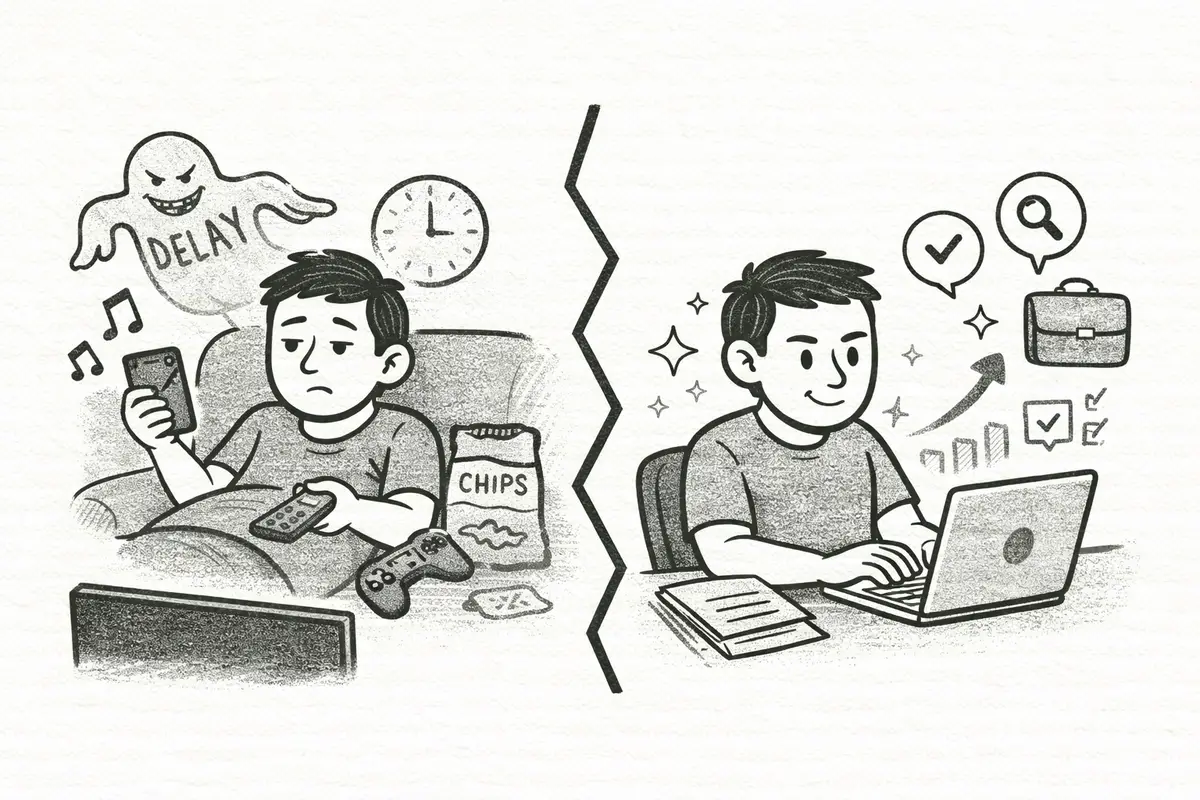
There are two types of procrastination. There’s the honest kind: lying on the couch watching an eight-part true-crime documentary when you should be writing an email.
Then there’s the insidious, dangerous kind: Fake Work.
Fake Work is when you spend three straight hours tweaking the margins on your resume. It’s deciding that you absolutely cannot apply for a job until you’ve completely overhauled your personal portfolio website’s color palette. It’s scrolling through LinkedIn for two hours, passively “liking” posts from thought leaders, and convincing yourself you just did some “hardcore networking.”
Stop it.
I’ve been there. I once spent an entire Tuesday—a Tuesday! The most productive day of the week!—researching whether a serif or sans-serif font subtly communicated “thoughtful leadership” better. (Spoiler: Nobody cares. If they can read it, you’re fine).
Fake Work feels good because it mimics the sensation of productivity without any of the actual risk. If you’re just messing with font sizes, nobody can reject you. You’re safe in your little design bubble. But you’re also completely stagnant.
How to Actually Break the Paralysis
So, how do we fix it? How do we trick our own brains into doing the terrifying thing? You don’t do it by suddenly transforming into a hyper-motivated hustle-bro. You do it by lowering the stakes so aggressively that your brain doesn’t register the threat.
1. The “Garbage Draft” Protocol
I use this in writing all the time, but it works perfectly for cover letters and resume summaries.
The blank page is intimidating. A blinking cursor is basically mocking you. So, your only goal for the first ten minutes is to write absolute garbage. I’m serious. Do not try to write a professional sentence.
Write exactly how you feel.
“Dear Hiring Manager, I want this job because my current boss is a sociopath and I like your dental plan. I am very good at spreadsheets. Please hire me so I can buy groceries.”
Just get words on the screen. The psychological friction of starting is usually 80% of the battle. Once you have a paragraph of absolute nonsense typed out, the editor in your brain—the same one that was paralyzing you earlier—will suddenly wake up, look at the screen, and go, “Whoa, we can’t send that. Let me fix it.” And boom. You’re working. You tricked yourself.
2. Micro-Dosing the Job Search
Forget the advice to spend eight hours a day looking for a job. That’s a fast track to burnout and clinical depression. The average time-to-fill for an open position has been creeping up steadily, hovering around 40-plus days according to various SHRM talent acquisition analytics. You are running a marathon through a swamp. You cannot sprint.
Instead, micro-dose it.
Tell yourself you are only going to look at a job board for exactly 15 minutes. Set a timer. When the timer goes off, you slam the laptop shut and walk away. What happens is, knowing you only have to endure the discomfort for 15 minutes makes it vastly easier to start. And occasionally, you’ll find a groove and ignore the timer. But if you don’t? Fine. You did your 15 minutes.
3. Outsourcing the Emotional Damage
This is a weird trick, but my god, does it work.
Sometimes, hitting “Submit” is the hardest part. You’ve filled out the forms, attached the resume, written the cover letter, but your finger just hovers over the mouse. The “What if?” spiral starts.
What if there’s a typo? What if I’m underqualified? What if I’m overqualified?
Get a friend. Seriously. If you live with someone, call them into the room. If not, get them on FaceTime. Tell them: “I need you to physically click this button for me.” Or, “I need you to watch me click this button so I can’t back out.”
It sounds ridiculous. Sort of pathetic, maybe. But socializing the final step diffuses the anxiety. It turns a moment of isolated dread into a shared, slightly goofy interaction.
Dealing with the Void (And Why You Need a “To-Hell-With-It” Fund)
Let’s talk about the ghosting.
You’re going to apply. You’re going to follow my advice, beat your procrastination, send out five stellar applications, and then… nothing. Crickets. You will be ghosted by companies that demanded three rounds of interviews and a “take-home assignment” that suspiciously looked like free labor.
This is the point where the procrastination will try to violently snap back into place. Your brain will say, “See? I told you this was pointless. Let’s go watch YouTube.”
You have to anticipate the silence. You have to expect it as the default state of the universe.
According to workplace stress reports, including those by the American Psychological Association (APA), a lack of control and uncertainty are primary drivers of chronic stress.
The job search is exactly that: zero control, infinite uncertainty.
To survive it, you have to decouple your self-worth from their response time. Gamify the rejection. Some people keep a spreadsheet where their goal isn’t to get a job, but to collect 100 rejections. Every “No” is a point. Ghosting counts as half a point after three weeks. It flips the script. Instead of dreading the “We regret to inform you” email, you’re like, “Sweet, that’s point number 42, I’m almost halfway to my goal.”
Which, to be completely honest, it’s a whole other mess that we even have to do these mental gymnastics just to survive the modern economy. But we do. We play the hand we’re dealt.
The Sunk Cost of Waiting for Motivation
Here is the absolute hardest truth I’ve learned in twenty years of working, freelancing, and desperately seeking employment:
Motivation is a myth.
If you wait until you feel like applying for a job, you will be waiting until you are evicted. Inspiration is for amateurs; the rest of us just show up and get to work. You don’t need to feel optimistic. You don’t need to feel confident. You just need to be mechanically persistent.
Let the anger drive you if it has to. Spite is a highly underrated productivity tool. Apply for jobs to spite the system. Apply for jobs to spite the recruiter who ghosted you in 2019.
You’re sitting there reading this right now, which means you’re procrastinating. I see you. I know exactly what you’re doing. You’re using my article as Fake Work. You’re telling yourself, “I’m reading about how to be productive, so I’m practically working!”
Nope.
I don’t have a neat, polished little summary paragraph to tie this all up with. Life doesn’t resolve in a clean three-sentence conclusion. The market is a mess, the algorithms are broken, and the whole process is exhausting. But you’re tougher than a malfunctioning Workday portal.
Close this tab. Don’t bookmark it. Don’t read another article.
Go find one role. Write one garbage draft. Send the damn thing out into the void.
Then go take a walk. You’ve earned it.
 About the author Matt Semon
Career Writer · AI Hiring Trends · USA I’m Matt, a writer and researcher focused on how hiring is evolving in the age of AI. I’ve been following trends in recruitment, automation, and remote work since 2018. When I’m not writing deep-dive articles for Jobicy, I’m testing AI tools to see how they impact candidates and hiring teams.