In this article
For years, job seekers have faced the classic entry-level catch-22: you cannot get a job without experience, and you cannot get experience without a job. In the modern job market, this paradox has mutated into a localized version: you cannot get a remote job without prior remote experience.
It is easy to see why recruiters lean on this filter. Managing a distributed team is difficult, and hiring someone who has only ever operated under the physical gaze of a supervisor feels like a gamble. But as remote and hybrid structures have stabilized — encompassing over 80% of remote-capable roles according to a 2026 Gallup poll—the absolute requirement for “prior remote experience” has increasingly become a proxy for something else. What recruiters actually want to avoid is the hand-holding, the communication gaps, and the professional drift that can happen when an employee is left alone with a laptop and a Wi-Fi connection.
If you have spent your entire career commuting to a physical office, your cover letter has one primary job: to exorcise the recruiter’s fear of the unsupervised worker. You do not need a history of working from a spare bedroom to prove you can do this. You need to demonstrate that you already possess the operating system of a high-performing remote professional.
Oddly enough, most people go about this entirely the wrong way.
The Three Deadly Sins of the Zero-Experience Cover Letter
When candidates try to compensate for a lack of remote experience they usually overcorrect. They write cover letters that read less like professional pitches and more like domestic diaries or software manuals. If you want to stand out, you must avoid these three common traps.
Sin #1: The Software Shopping List
I have reviewed hundreds of applications where candidates proudly list every tool they have ever opened. They write paragraphs like this:
“While I have not worked in a formal remote capacity, I am highly proficient in Slack, Zoom, Microsoft Teams, Asana, Notion, Trello, Google Workspace, and Loom.”
This is the equivalent of a chef trying to prove they can run a kitchen by listing the brand of knives they own. Anyone can download Slack; knowing how to install communication software does not mean you know how to communicate.
In a professional remote setting, tool proficiency is assumed. What matters is your philosophy of collaboration. Listing tools without context only highlights your lack of experience, because it suggests you think remote work is defined by the software you use rather than the results you deliver.
Sin #2: The Domestic Over-share
There is a bizarre trend where applicants try to prove their remote readiness by detailing their physical workspace. They assure the hiring manager that they have a “dedicated home office with ergonomic furniture, high-speed fiber-optic internet, and a door that locks to keep out distractions.”
This approach turns remote work into a domestic novelty. Highly mature remote organizations like GitLab or Buffer treat remote work as an operational default, not a lifestyle perk. Bringing up your physical setup in a cover letter signals that you are still fascinated by the logistics of working from home. Keep the focus on your labor, not your furniture. The hiring manager assumes you have a desk; you do not need to describe it.
Sin #3: The “Me” Centric Pitch
The third trap is explaining why you want to work remotely.
“I am looking for a remote role because I want to eliminate my two-hour commute, spend more time with my family, and achieve a better work-life balance.”
While these are perfectly valid human desires, they belong in your private journal, not your cover letter. A cover letter is a document designed to solve the employer’s problem, not yours. When you focus on how remote work will benefit your lifestyle, you inadvertently signal that you view the arrangement as a personal convenience rather than a professional responsibility.
Why “Remote Experience” is a Red Herring
Let us look at a fundamental truth that many career coaches miss: working remotely is not a skill in itself. It is merely an environment.
The skills required to succeed in that environment are entirely transferable from the physical world. They are autonomy, asynchronous communication, written clarity, and proactive problem-solving.
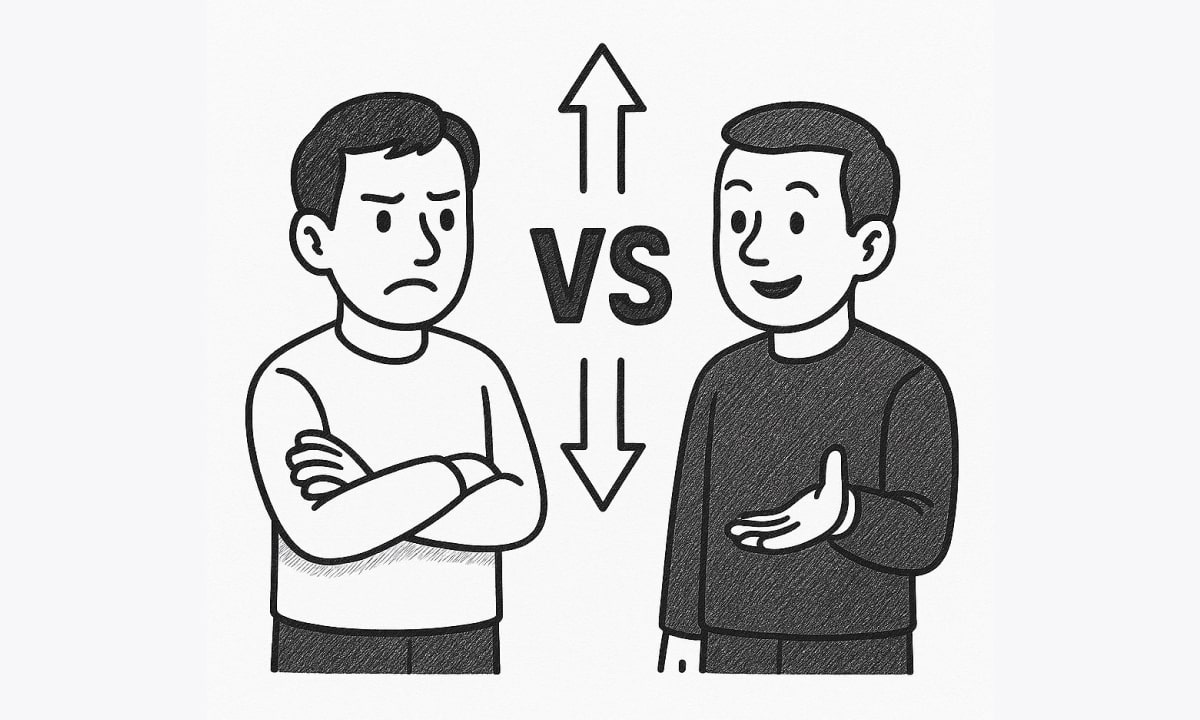
Consider this contrast:
| The In-Office Version | The Remote Translation |
|---|---|
| Asking a manager for feedback on a project by walking to their desk. | Writing a structured, self-contained update with clear options and a recommended path forward. |
| Resolving a bottleneck by calling an emergency meeting. | Documenting the issue in a shared workspace and proposing a solution before the meeting is even scheduled. |
| Waiting for the next shift to receive instructions. | Anticipating blockers and actively seeking out documentation to unblock yourself. |
When you frame your in-office achievements through the lens of the right-hand column, the lack of a “remote” tag on your previous job titles ceases to matter. You are showing that you already work like a remote employee; you just happen to be doing it in an office building.
How to Prove Remote Capability Without the Track Record
To write a cover letter that works, you must shift your narrative from where you worked to how you worked. Here is how to translate your in-office experience into high-trust remote traits.
The Exorcism of the Micro-Manager
The greatest fear of any remote hiring manager is that they will have to micromanage you. They worry you will sit idle when you run out of tasks, or that you will require constant oversight to hit your numbers.
To combat this, your cover letter must tell a story of self-directed execution. I once saw a cover letter from an administrative assistant transitioning to remote project management. She had zero remote experience, but she wrote this:
“In my previous role at a busy physical clinic, my manager was frequently pulled into surgeries for 4-to-6-hour stretches. During these blocks, I operated as the sole decision-maker for patient intake and scheduling conflicts, resolving an average of 15 escalations per day without supervision. I built an internal Wiki to document these decisions so the rest of the staff could operate with the same autonomy.”
This is incredibly effective. It tells the recruiter that she does not freeze when left alone. She does not need a manager hovering over her shoulder to maintain operational momentum. If she can run a physical clinic alone while her boss is in surgery, she can certainly manage her inbox from home.
Elevate Your Written Output
In a remote-first company, writing is the primary medium of work. If you cannot write clearly, you cannot work effectively.
Your cover letter itself is the first and most important test of this skill. If it is bloated, disorganized, or repetitive, you have failed the remote communications test before the recruiter even looks at your resume.
Instead of claiming you are a “great communicator,” show it by highlighting times when your writing solved a business problem.
- Before (Generic) – “I have strong communication skills and am great at keeping everyone on the same page.”
- After (Remote-Ready) – “At my last company, I replaced our daily status meetings with a weekly written digest. By structuring this update around blockers and immediate deliverables, we reduced meeting time by 25% and created a searchable archive of project decisions.”
This rewrite works because it attaches a business outcome to a written asset. It proves you understand that communication is not about talking more; it is about writing better.
Structural Anatomy of the High-Trust Cover Letter
Let us look at how to put these pieces together. A great cover letter does not need to be long. In fact, a shorter, high-impact letter is far more likely to be read. Let us aim for four distinct sections that build a logical case for your candidacy.
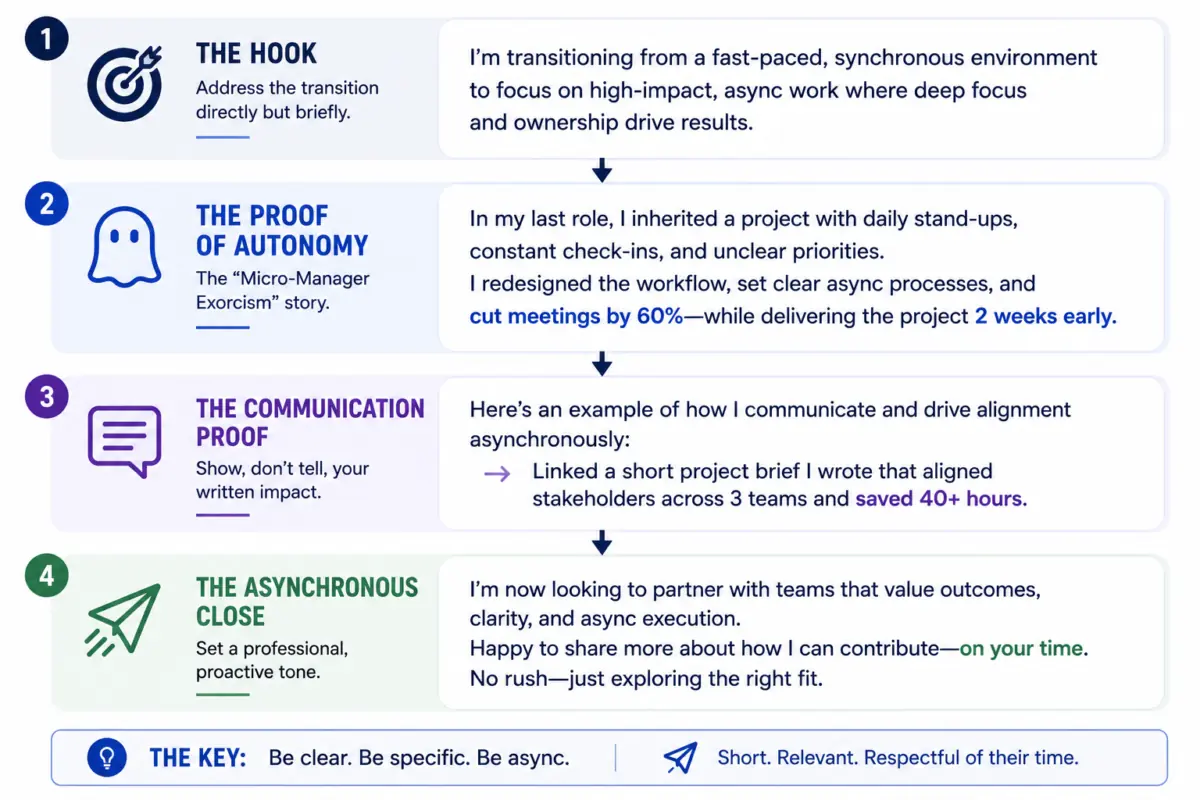
1. The Hook: Addressing the Elephant
Do not try to hide your lack of remote experience. Address it immediately, but frame it as an asset or a natural evolution rather than a deficit.
“While my career has been built in high-growth physical environments, the operational habits I’ve developed—specifically asynchronous project tracking and high-documentation workflows—are built for your remote-first culture.”
This line is powerful because it uses the language of mature remote companies (“asynchronous,” “high-documentation”) without sounding like you are reading from a manual. It shows you understand how they work.
2. The Proof: The Core Narrative
This is where you tell your self-direction story. Focus on a time when you were handed a vague objective and delivered a concrete result with minimal guidance.
“At Apex Systems, I was tasked with auditing our client onboarding process. Operating without an established framework, I interviewed six department heads, identified three major bottlenecks in our hand-off system, and drafted a new 12-step standard operating procedure. This document was adopted company-wide and reduced client onboarding delays by 40%. I am used to operating in environments where guidelines must be built, not just followed.”
3. The Communication Proof
Link your communication style to their operational model. If you are applying to a company that values asynchronous communication (like Doist or GitLab), highlight your ability to document work.
“I view writing as a core professional tool. In my last role, I managed our department’s internal knowledge base, translating complex technical updates into clear, actionable guides for our non-technical staff. This reduced repetitive support tickets by 30% and allowed our engineering team to focus on development without constant interruptions.”
4. The Close: Proactive and Professional
End with an assumption of alignment, rather than a plea for an interview.
“I would love to share how I plan to bring this same self-directed approach to your team. I have attached my resume, but you can also view a quick, three-minute overview of my project portfolio at [Link].”
This closing is excellent because it offers a low-friction way for the recruiter to assess your communication style (via the video or portfolio link) before committing to a live call. It mimics the natural, asynchronous screening process that modern remote teams prefer.
The Asynchronous Nuance: Startups vs. Enterprises
It is worth noting that the approach you take should depend heavily on the size of the company you are targeting.
A venture-backed, 20-person remote startup does not want a highly formal, traditional cover letter. They want to see that you can “ship things” quickly. Indeed, data from Deel’s State of Global Hiring Report confirms that top-funded startups are increasingly looking beyond local borders for specialized talent, valuing fast execution and highly adaptable operators. For these roles, your cover letter should feel more like a direct, high-value email pitch. You might even ignore the traditional structure entirely and lead with a short Loom video showing your work.
A large enterprise remote company (like a major health insurance provider or an established tech giant) will likely run your cover letter through an Applicant Tracking System (ATS). They value compliance, structure, and risk mitigation. For these employers, a structured, well-formatted PDF cover letter that echoes the exact keywords of their job description is still the safest path to a human screening.
There is no single “correct” way to apply, but the underlying principle remains the same: show that you can manage your time, resolve your own problems, and write like an adult.
 About the author Ewald Schäfer
HR Technology Specialist · Germany I’m Ewald — a passionate HR tech consultant from Berlin. I write about the intersection of automation, recruitment, and human capital. After leading several HRIS rollouts across Europe, I now focus on advising startups and writing practical content for job seekers and hiring teams alike. With a strong IT background, I bridge the gap between HR and technology: from API integrations and data security to workflow automation and cloud-based HR platforms. My mission is to help organizations not only digitize but truly optimize their people operations.