
In this article
A senior product designer is offered a first management role after a difficult launch. The team trusts her judgment, two designers would report to her, and her director presents the move as the obvious next step. She wants more influence. She also knows that the parts of her current job she values most—turning unclear customer problems into usable flows, testing alternatives, and making a hard design call—may no longer fill her week.
There is no perfect answer. Declining can feel like stepping away from recognition or future earning power. Accepting can put someone in a role built around hiring, performance conversations, priorities, conflict, staffing, and the quality of other people’s work. The useful question is not, “Am I ready to manage?” Readiness matters, but it is too broad to settle the decision. Ask instead: Do I want the recurring work this role will require, and can this organization make that work possible?
That question protects against two common mistakes. One is treating management as the only serious form of progress. The other is assuming that enjoying coaching, running a workshop, or leading a project tells you enough about being accountable for a team over time. A promotion can be worth taking and still be poorly designed. It can also be the wrong move now without closing the door on leadership later.
The offer is recognition, but it is also a job redesign
The designer’s director says, “You already lead without the title.” There is truth in that. She has mentored newer teammates, represented design in planning meetings, and helped resolve tense discussions with engineering. Yet informal leadership is usually an addition to individual contribution. A management role shifts the center of responsibility. You become responsible for conditions in which other people can do good work, including conditions you do not fully control.
Occupational descriptions make the distinction plain. The task lists for software developers include designing, testing, modifying, and analyzing systems; the descriptions for computer and information systems managers give more weight to coordinating operations, resolving employee problems, evaluating performance, setting priorities, and determining resource needs. These are broad occupational categories, not a forecast of one company’s role. They are still a useful reminder that a management title usually changes the object of your work—from a product, system, or specialized practice to a team’s direction and capacity.
For the designer, the first conversation is not a negotiation over status. It is an audit. She asks her director to describe a normal month after the role has settled: which meetings she will own, which decisions will come to her, what people work is expected, which hands-on responsibilities remain, and what will leave her plate. The answers matter more than assurances that she will “still be close to the work.”
| Question | Individual-contributor answer | People-manager answer | Why it changes the decision |
|---|---|---|---|
| What is the primary output? | Specialized work, decisions, designs, analysis, or delivery. | Clear priorities, capable people, coordinated work, and sound team decisions. | You may still contribute directly, but team output becomes the larger obligation. |
| Where does difficult work arrive? | In a defined problem, document, system, or project. | Through competing needs, unclear ownership, performance concerns, and staffing constraints. | The work is less likely to wait until you have an uninterrupted block of time. |
| What can be delegated? | Pieces of execution, depending on expertise and context. | Many tasks, but not accountability for the team’s direction and decisions. | Delegation reduces your task load; it does not remove responsibility. |
| How is quality improved? | By revising your own craft and solving the next problem well. | By setting expectations, giving feedback, making tradeoffs visible, and developing others. | Improvement often happens through conversation rather than solitary revision. |
Do not ask for a percentage-perfect schedule. Few managers have one. Ask for the recurring categories of work and the tradeoffs they create. If the director cannot name them, the organization may be promoting someone into a role it has not properly scoped.
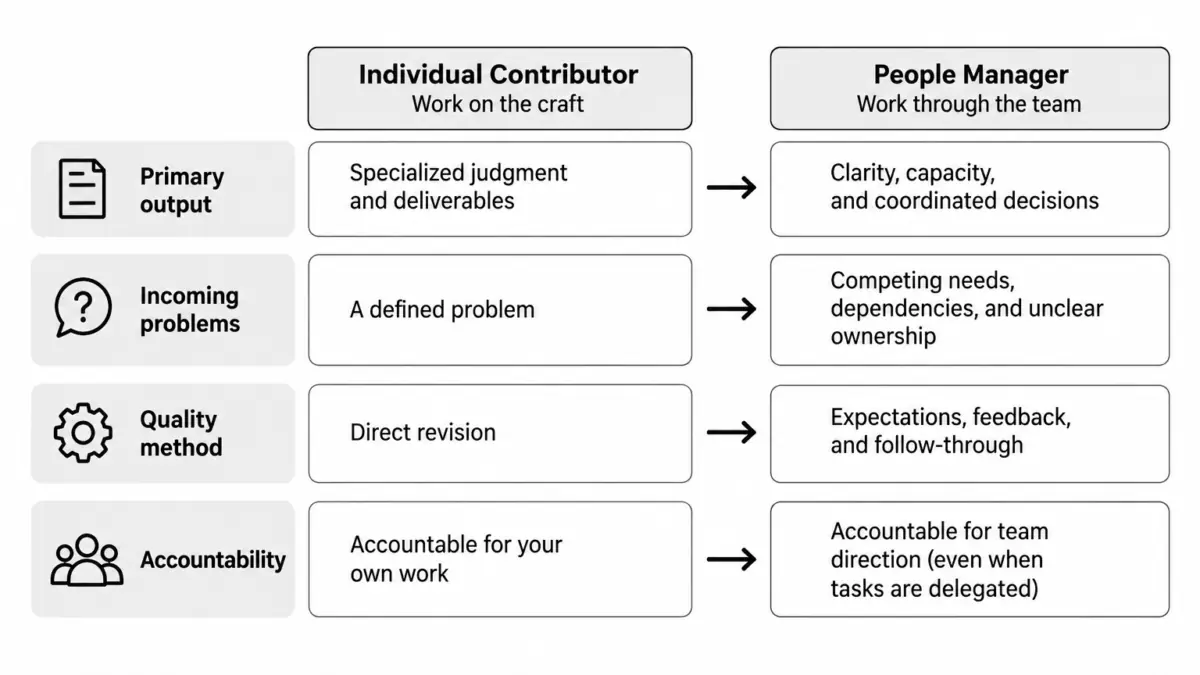
Text version of this visual
- Primary output: Individual contributors produce specialized judgment and deliverables; managers create clarity, capacity, and coordinated decisions.
- Incoming problems: Specialist work arrives as a defined problem; management work often arrives as competing needs, dependencies, and unclear ownership.
- Quality method: Craft quality comes through direct revision; team quality depends on expectations, feedback, and follow-through.
- Accountability: Delegation can redistribute tasks, but accountability for team direction stays with the manager.
Map the work you will lose before you count the work you will gain
The designer makes a list of the work she currently does that gives her energy, builds her specialist credibility, or keeps her connected to users and product decisions. Then she marks which items are essential to retain, which she can reduce, and which she is willing to stop. This is not an exercise in protecting every favorite task. It is a way to see the exchange clearly.
Her initial list reveals a tension. She wants to keep leading discovery for the company’s most complex product area. But the proposed role has five direct reports, an open position to fill, and a team that needs a clearer critique process. Trying to preserve all of her former work would not make the move safer. It would create two partially performed jobs.
A useful audit has three columns: work you must release, work you can keep in a narrower form, and work you need to learn. The middle column deserves special attention. Many first-time managers keep one deliberate craft anchor: attending a customer session each month, reviewing a small number of technical decisions, or owning a bounded initiative. That anchor can maintain context. It becomes a problem when it turns into a second full workload or overrides the people doing the work.
The following numbers are illustrative, not a recommended allocation. They show why “I’ll manage and continue doing nearly all of my old role” often fails when the role has real people responsibilities.
| Work category | Current senior individual contributor | Proposed manager | Question to settle |
|---|---|---|---|
| Direct specialist work | Large, planned blocks | Bounded contribution or periodic review | What direct work remains valuable without making the team wait for you? |
| Planning and prioritization | Contribute to decisions | Prepare, decide, and explain tradeoffs | Who owns the final call when functions disagree? |
| One-on-ones and feedback | Occasional mentoring | Recurring preparation and follow-through | What feedback, growth, or performance issues already need attention? |
| Staffing and team operations | Interview participation when needed | Hiring, onboarding, role design, and workload decisions | What support exists for these responsibilities? |
| Cross-functional alignment | Represent a specialty | Resolve dependencies and protect team capacity | Which requests can you decline or redirect? |
If your list says that you would resent giving up the specialist work, take that seriously. Resentment is not proof that you lack ambition. It may be evidence that the next useful move is a staff-level, principal-level, or program-lead path—or a role with narrower management scope. The decision becomes clearer when you compare real recurring work instead of comparing titles.
A management promotion is a change in recurring obligations, not a reward you must accept unchanged.
- Direct craft work10 hours in a 40-hour week
- People conversations9 hours in a 40-hour week
- Planning and priorities8 hours in a 40-hour week
- Cross-functional coordination7 hours in a 40-hour week
- Operations and staffing6 hours in a 40-hour week
Separate the management role from the larger individual-contributor role
The director offers an alternative: the designer could remain an individual contributor but take ownership of a broader product area and coach two peers informally. That is not a consolation prize. It is a different role design, and it should be evaluated on its own merits.
The larger individual-contributor path fits when the organization needs deeper specialty judgment, cross-team technical or product leadership, and someone who can solve problems that do not belong to one team. It is not “management without the hard parts.” It may involve just as much ambiguity, influence, and organizational pressure. The difference is where accountability sits: on the quality and reach of your own judgment rather than on the sustained management of other people.
This distinction matters particularly where organizations have historically treated management as the only route to greater authority. That structure can press talented people—often including women and people from underrepresented groups who are already asked to do extra relational work—toward management before they have a genuine choice. Being good at making a team function does not obligate anyone to turn that unpaid contribution into a permanent management job without proper scope, support, and recognition.
| If your strongest pull is toward… | The role to examine first | Evidence to look for |
|---|---|---|
| Developing people over repeated cycles of feedback, context, and decisions | People management | You want responsibility for team capacity, not only the enjoyable parts of mentoring. |
| Solving the hardest domain problems and setting practice standards | Broader individual-contributor role | The company can describe authority, scope, and advancement without a direct-report requirement. |
| Leading a time-bounded change across functions | Program, initiative, or temporary team lead | The mandate, decision rights, endpoint, and return path are defined. |
| Testing management without abandoning your specialty overnight | Acting manager or limited-scope manager arrangement | The trial has written responsibilities, support, and a real review date. |
A longitudinal study of people moving into their first leadership position found a more complicated picture than simple upward progress: the transition brought short-term tensions, alongside later gains in self-concept. The study’s findings on first-time leadership transitions do not tell you which path to take, and they cannot predict your experience. They do support treating the transition as a period that needs structure rather than a test of whether you can absorb everything alone.
- Priority decisions8 requests
- Team questions7 requests
- Stakeholder escalations5 requests
- Hiring or staffing items4 requests
- Personal work requests3 requests
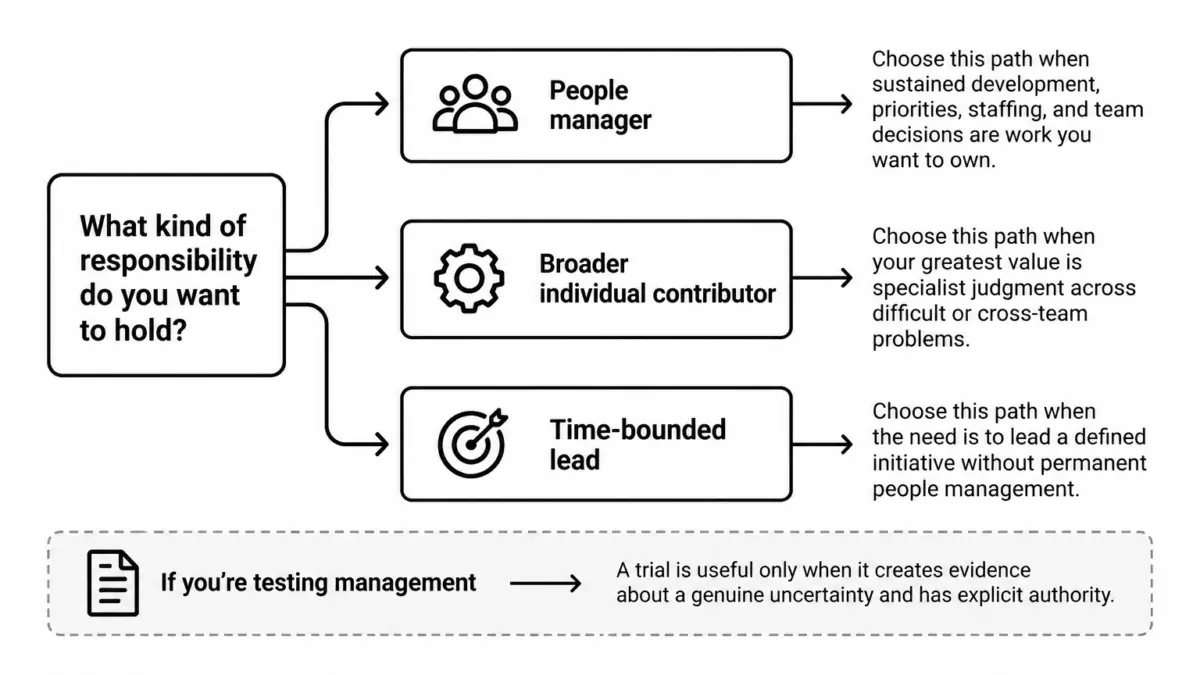
Text version of this visual
- People manager: Choose this path when sustained development, priorities, staffing, and team decisions are work you want to own.
- Broader individual contributor: Choose this path when your greatest value is specialist judgment across difficult or cross-team problems.
- Time-bounded lead: Choose this path when the need is to lead a defined initiative without permanent people management.
- Test condition: A trial is useful only when it creates evidence about a genuine uncertainty and has explicit authority.
Ask for the first 90 days before you give an answer
The designer now has enough information to make the conversation specific. She tells her director that she is interested, but needs to understand the operating conditions. She asks for the direct-report count, the open headcount plan, the expected balance of hands-on work, decision rights with product and engineering, and who will support her with performance, compensation, and hiring processes.
She also asks what success looks like after 90 days. A poor answer is, “You’ll know it when you get there.” A better answer names a few visible outcomes: each team member has clear priorities, the director has a reliable view of capacity and risks, one persistent delivery issue has an owner and a plan, and the manager has protected time to learn the company’s people practices. The goal is not to pretend that a new manager can repair every inherited issue in three months. It is to establish what work comes first and what work does not.
| Ask | A useful answer contains | A warning sign |
|---|---|---|
| What will leave my current role? | Named projects, transfer dates, and a person accountable for the handoff. | “Keep doing most of it until we hire someone.” |
| What people issues need attention now? | A candid description of team strengths, workload concerns, open roles, and unresolved expectations. | “Nothing major,” followed by vague references to morale or communication. |
| Which decisions will I own? | Examples involving priorities, staffing, quality standards, and cross-functional disagreements. | Responsibility without authority to set priorities or protect capacity. |
| Who helps when I encounter a performance or compensation issue? | A named manager, people partner, or peer manager with an agreed escalation route. | An expectation that you will learn only through a high-stakes live situation. |
| What is the review point if the scope is wrong? | A date, participants, and possible adjustments to team size, duties, or role design. | “Let’s see how it goes” with no scheduled discussion. |
There is a practical reason to ask for support rather than merely request fewer tasks. A recent meta-analysis on job crafting found different patterns across approaches: increasing structural and social resources was positively associated with engagement, while simply reducing hindering demands did not show the same relationship. That review of job-crafting dimensions is not a management-transition blueprint. It does offer a useful prompt: ask what authority, information, peer access, and developmental support you need, not only what pressure can be removed.
A trial earns its value when it produces new evidence about the work, not when it proves you can carry two jobs.
- Understand team context6 planned attention points
- Clarify priorities5 planned attention points
- Build operating routines4 planned attention points
- Address one delivery constraint3 planned attention points
- Retain craft connection2 planned attention points
- List the current work that will transfer, stop, or remain deliberately bounded.
- Ask for the number of direct reports, open roles, and inherited team issues.
- Name the decisions you will own and the decisions that remain with your manager.
- Agree on a source of practical support for performance, hiring, and compensation questions.
- Put a 30-, 60-, or 90-day scope review on the calendar before accepting.
- Keep one craft connection only if its boundaries are explicit and the team benefits from it.
Use a trial only if it changes the evidence
The designer’s director proposes that she manage the team “informally” for a quarter before the promotion is finalized. She should not agree to a shadow period that gives her manager accountabilities without a title, authority, compensation discussion, training, or review. That arrangement may teach the company that it can get management work for free while leaving her exposed if something goes wrong.
A useful trial answers a question that cannot be answered from conversation alone. Perhaps the real uncertainty is whether she wants to spend part of each week in recurring one-on-ones and feedback. Perhaps it is whether product and engineering will respect the role’s decision rights. A bounded trial can test either question if the scope is narrow, the authority is explicit, and the end date produces a real decision.
For example, she might lead a two-person design pod for eight weeks while retaining a reduced individual-contributor workload. Her director would continue handling formal performance actions and compensation decisions, while she owns priorities, development conversations, and the team’s design review process. At the end, they assess the work itself—not whether she managed to work late enough to cover both jobs.
- Trial management duties14 hours in a 40-hour week
- Reduced specialist work16 hours in a 40-hour week
- Team planning and coordination6 hours in a 40-hour week
- Learning and manager support4 hours in a 40-hour week
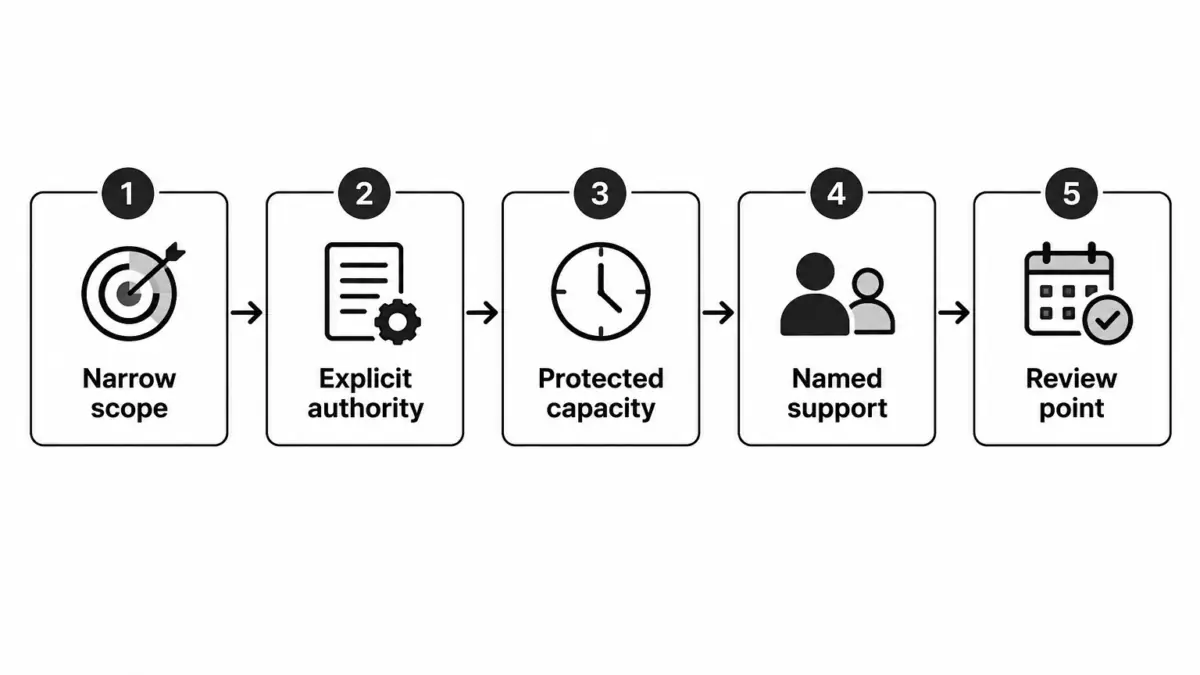
Text version of this visual
- Narrow scope: Limit the team, project, or responsibilities being tested.
- Explicit authority: State which priorities and team routines the trial manager can decide.
- Protected capacity: Reduce former delivery work so management duties do not simply move into evenings.
- Named support: Keep formal performance and compensation decisions with an experienced manager unless authority is formally transferred.
- Review point: Set a date and criteria for choosing among permanent management, a revised role, or a return to individual contribution.
Make the decision from evidence, not from the fear of closing a door
At the end of the discussion, the designer accepts the role with three conditions: a staged handoff of her current product work, a written 90-day plan, and a scheduled scope review. That is not a demand for certainty. It is an agreement to notice early if the role has become impossible to do well.
Another experienced professional could reach a different answer. If the organization cannot describe an individual-contributor growth path, cannot remove the old workload, and expects a new manager to solve long-standing team problems without support, declining may be the sounder move. You can say: “I’m interested in growing my organizational impact. Based on the current scope, I would be taking on people accountability while retaining too much of my existing delivery work. I’d like to discuss either a properly staged management transition or a broader individual-contributor role with defined decision rights.”
A promotion may be a good opportunity and still need redesign. Before you say yes, ask yourself: Which difficult Tuesday do I want more of six months from now—the one spent deep in the work, or the one spent helping other people do their best work? Use the answer to guide the questions you ask, the boundaries you set, and the version of progress you choose.
- Clear ownership5 items to review
- Protected handoff time4 items to review
- Decision authority used3 items to review
- Unresolved workload conflicts2 items to review
- Support gaps needing action2 items to review
 About the author Victoire Boucher
Career coach focused on helping women navigate the tech industry. I’ve worked in product and engineering roles before shifting to coaching full-time. Now I write about imposter syndrome, salary negotiation, and how to grow without burning out.