In this article
“Can you join?” is a small sentence with a large blank space behind it.
It may mean: read this proposal beforehand, bring a recommendation, approve a choice, explain a risk, listen for context, or simply keep an hour free in case someone needs you. A calendar invitation often carries all of that work without saying so. The person receiving it has to infer the assignment from a title such as “Project sync” or “Quick catch-up,” then decide how much preparation is sensible.
That ambiguity is easy to overlook because invitations look administrative. In practice, they are a piece of workplace writing. They tell people what kind of attention is being requested, whether their presence changes the outcome, and what will remain once the call ends.
Meeting research makes the basic point plainly: the stated purpose should be reflected in the invitation and should shape the agenda, participants, and structure of the meeting. A review of meeting-planning practices also notes that an agenda helps people prepare and contribute, rather than arriving to discover the work in real time. For individual contributors, that is useful both when you organize meetings and when you are invited to one.
A better invitation will not make every meeting necessary. It does make the request legible. That is a modest standard, but it changes the culture around calendars: attendance becomes a considered contribution, not an unexplained sign of availability.
Calendar language quietly redistributes work
Consider the difference between these two titles:
Roadmap discussion
and
Choose the support scope for the April release
The first names a broad topic. The second names a decision, a subject, and a boundary. A recipient can now tell whether they have relevant information, whether they need to review the scope document, and whether declining would leave a gap.
This is not a demand for rigid, overproduced meetings. Some calls are genuinely exploratory. Some are useful because people need to think together before anyone can frame the precise question. But an invitation can say that: “Working session to identify the two open questions before the vendor briefing.” The point is to name the work honestly, including when the work is still finding the problem.
The wording matters especially in distributed teams. People cannot reliably pick up intent from a hallway conversation, a whiteboard left in a room, or the mood of the person who booked the call. Microsoft’s guidance on hybrid meetings describes shared content, chat, captions, and a meeting recap as ways to give participants comparable access to the conversation and its record. Those features help, but they work best when the invitation has already made clear what the meeting is for and how people can take part.
| Invitation wording | Unanswered question | Clearer wording |
|---|---|---|
| Catch-up | Is this social, informational, or a decision? | Review the handoff risks before Friday’s launch |
| Project sync | What part of the project needs my input? | Resolve ownership for the onboarding emails |
| Quick question | Could this be handled in writing? | Choose between two reporting definitions |
| Strategy meeting | Am I expected to listen, advise, or decide? | Stress-test the proposed market sequence |
Notice that the clearer versions are not longer for the sake of it. They use a verb: review, resolve, choose, stress-test. Verbs reveal the expected act. “Discussion” can still be appropriate, but it often leaves the actual purpose unnamed.
An invitation is not neutral scheduling. It tells another person what kind of attention their work requires.
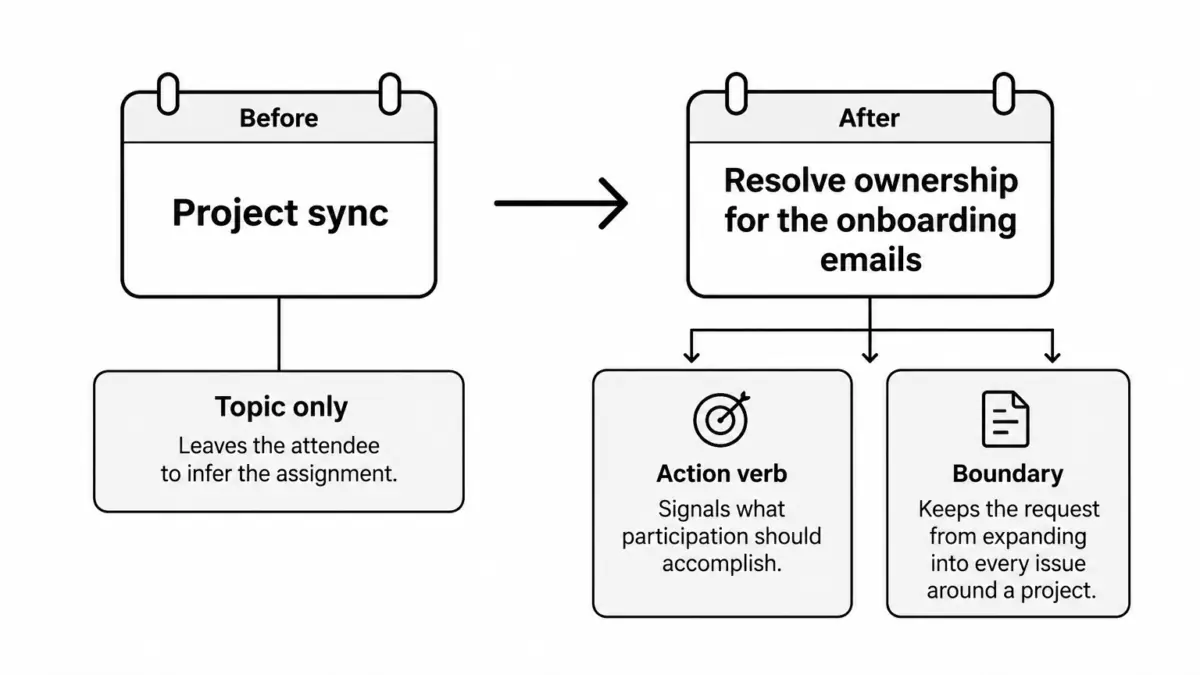
Text version of this visual
- Topic only: A label such as “Project sync” leaves the attendee to infer the assignment.
- Action verb: A verb such as resolve, choose, or review signals what participation should accomplish.
- Boundary: A named subject keeps the request from expanding into every issue around a project.
Write the outcome before the agenda
A list of topics is not yet a useful invitation. “Budget, timeline, risks” tells attendees what may be mentioned; it does not tell them what should be different by the end of the call. Start instead with one outcome sentence.
For example: “By the end of this meeting, we need a named owner for the customer migration plan and agreement on the first review date.” That sentence does several jobs at once. It shows that a decision is expected, gives the meeting a stopping point, and makes it possible for an invitee to see why a particular person is present.
There is evidence behind the apparently simple habit of goal clarity. In a study of top-management groups processing agenda items, goal clarity and focused communication were positively related to team effectiveness; speaking up when a goal was unclear was associated with more focused communication. The study does not mean every ordinary team meeting needs executive-level formality. It does support a practical norm: when the goal is unclear, asking for it is part of doing the work well.
| Meeting type | Useful outcome sentence | What attendees should bring |
|---|---|---|
| Decision | Choose one option and record the reason. | Relevant evidence and a recommendation. |
| Working session | Leave with a draft that can be reviewed asynchronously. | Source material and proposed wording. |
| Problem review | Identify the next test and its owner. | What is known, unknown, and blocked. |
| Information sharing | Ensure affected people understand the change and where it is documented. | Questions that need an answer. |
Once the outcome is written, the agenda gets easier to edit. Keep only the items that move the group toward it. If an item is useful but does not need a live answer, link it as background material. If it needs separate discussion, give it a separate invitation rather than hiding a second meeting inside the first.
For a 25-minute meeting, a complete invitation may be only four lines:
Purpose: Decide whether the launch email should use the new pricing language.
Decision needed: Approve version A, approve version B, or name what must change before approval.
Preparation: Read the two drafts and add comments by Tuesday afternoon.
Record: Decision and next owner will be added to the launch page.
This is not elegant corporate prose. It is enough information to prevent people from spending the first ten minutes asking what they are there to do.
A meeting title should reduce guessing before it tries to sound tidy.
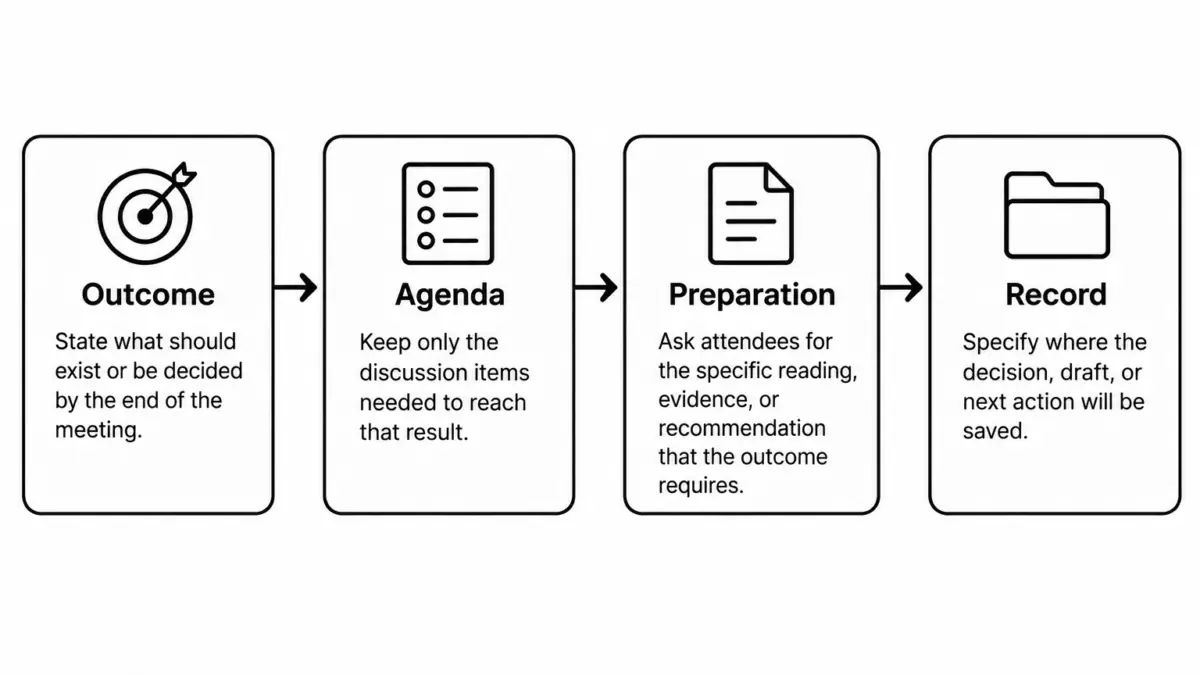
Text version of this visual
- Outcome: State what should exist or be decided by the end of the meeting.
- Agenda: Keep only the discussion items needed to reach that result.
- Preparation: Ask attendees for the specific reading, evidence, or recommendation that the outcome requires.
- Record: Specify where the decision, draft, or next action will be saved.
Give every attendee a reason to be there
A crowded invitation can look collaborative while quietly asking most people to become passive observers. That does not only waste time. It also blurs whose expertise is necessary, who can make the decision, and who needs the outcome later.
Use three roles instead of a single undifferentiated attendee list: people who decide, people who contribute, and people who need to know. They can all be important, but they do not all need the same thing.
| Role | Why they are involved | Best invitation treatment |
|---|---|---|
| Decider | Can approve, reject, or resolve a tradeoff. | Name the decision and confirm the timing works. |
| Contributor | Has information, expertise, or affected work to bring forward. | Name the question for them and the preparation needed. |
| Informed reader | Needs the result but does not need to shape it live. | Send the decision record rather than a calendar hold. |
Someone may move between these roles from one meeting to another. A designer might be a contributor in a requirements review, a decider on an interaction detail, and an informed reader on a commercial approval. Naming the role avoids the vague compliment of “having everyone in the loop,” which often means asking people to protect time without a defined contribution.
Atlassian’s page-led meeting guidance is useful here because it treats the shared page as both the preparation space and the durable record: it recommends stating the purpose and scope, then placing the decision and rationale where later readers can find them. The specific tool is less important than the principle of using one shared page to prepare, decide, and preserve the outcome.
| If the answer is yes | Invitation choice |
|---|---|
| They hold information the group needs to act. | Invite them as a contributor and state the question. |
| The outcome cannot proceed without their approval. | Invite them as a decider and name the decision. |
| They need to change their work after the decision. | Send them the record unless discussion would materially improve the decision. |
| You mainly want them to witness the conversation. | Ask whether a written update would meet that need instead. |
The last row can feel uncomfortable. Meetings sometimes serve a real social purpose: alignment, relationship building, recognition, or shared context. If that is the purpose, say so. “Monthly team forum: share progress and surface cross-team dependencies” is clearer than presenting a relationship-building meeting as a decision session that happens to have no decision.
Attendance is a contribution only when the contribution is clear.
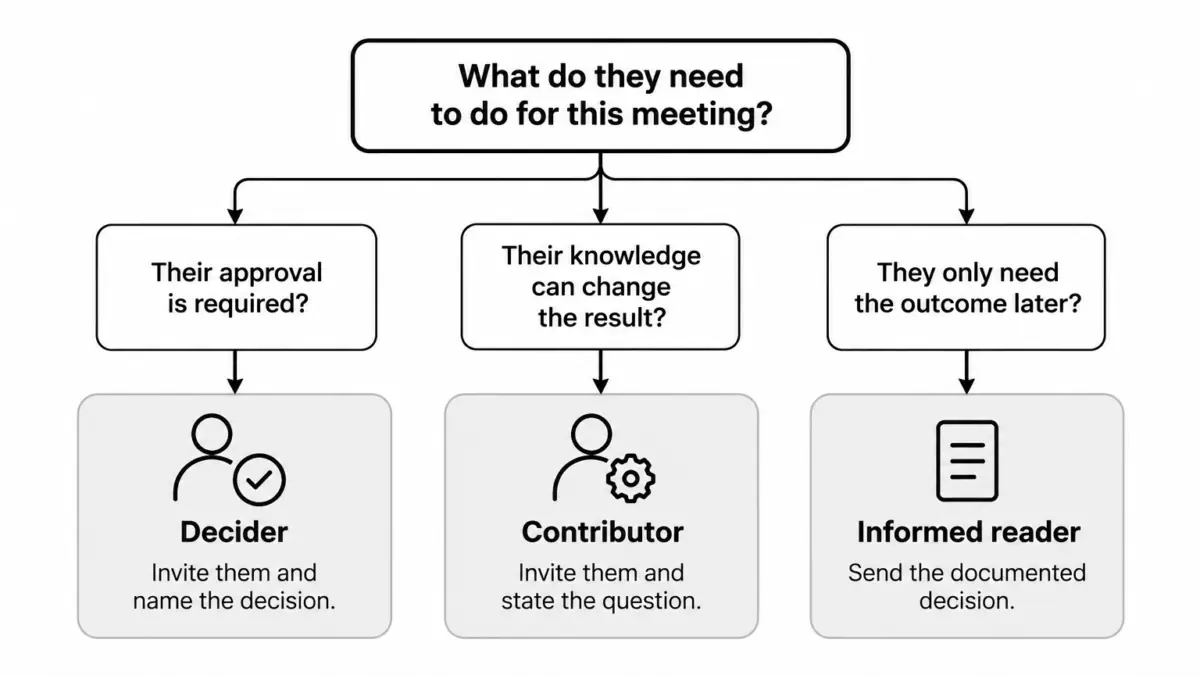
Text version of this visual
- Decider: Include when their approval or tradeoff judgment is required.
- Contributor: Include when their knowledge, concern, or working material can improve the result.
- Informed reader: Send the documented outcome when live discussion would not change their work or the decision.
Make the record part of the invitation
A meeting ends twice. It ends when people leave the call, and it ends when someone later needs to know what happened. If the only answer is “I think we agreed that…,” the conversation has not become usable work.
The invitation can establish a small record from the start. Link the document. Name where the decision will be written. Say whether the organizer will send a summary or whether attendees should add comments to the shared page. This is particularly helpful when someone cannot attend: they can judge whether to send input beforehand, ask a colleague to represent a concern, or read the result afterward.
Research on organizational meeting orientation argues that meeting quality is shaped not only by one facilitator’s habits but also by the larger practices an organization normalizes. In its exploratory studies, employees’ perceptions of those practices were associated with meeting effectiveness, satisfaction, engagement, and intent to quit. The useful takeaway for an individual contributor is smaller and more immediate: a clear invitation and a usable record are repeatable behaviors that help turn meeting quality into a shared norm rather than one person’s private skill.
You do not need authority over everyone’s calendar to use this standard. When you create a meeting, write the purpose, outcome, preparation, and record. When you receive one with none of those elements, ask a direct question before accepting: “What decision or output do you want from this time, and is there anything you’d like me to review first?”
That question is not fussy. It is an edit. It turns “Can you join?” into a work request someone can understand and answer.
The useful record is the one a colleague can understand without having been on the call.
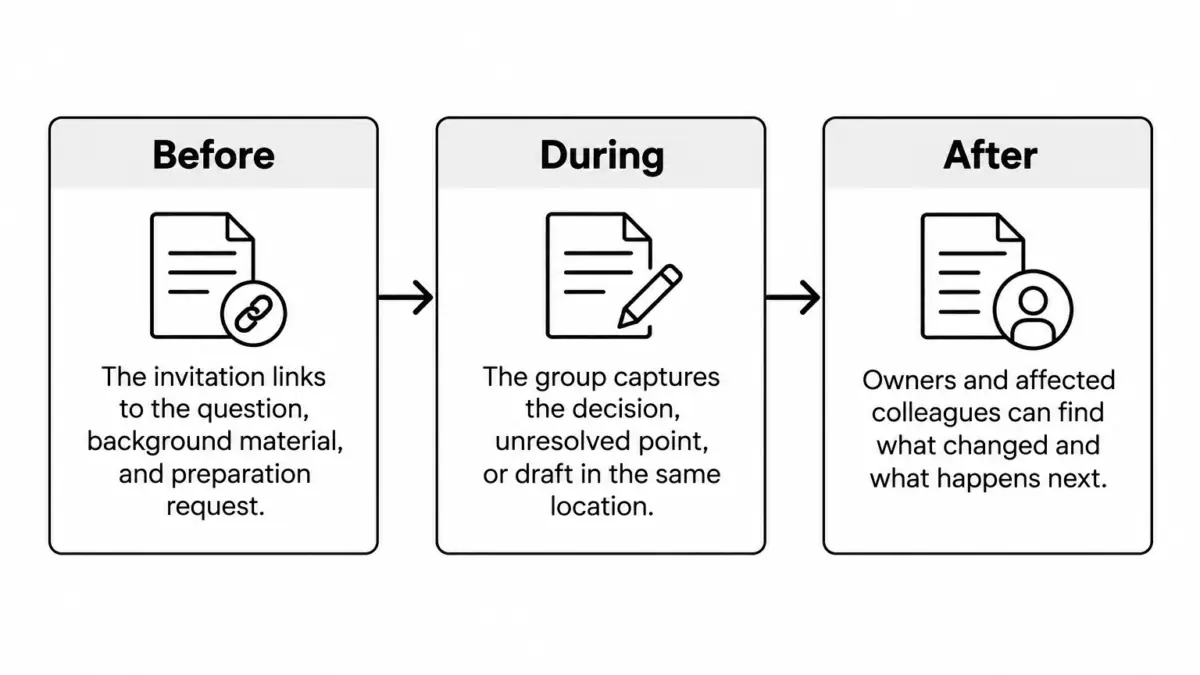
Text version of this visual
- Before: The invitation links to the question, background material, and preparation request.
- During: The group captures the decision, unresolved point, or draft in the same location.
- After: Owners and affected colleagues can find what changed and what happens next.
 About the author Ines Martínez
Digital Nomad & Resume Strategist · Spain/Mexico ¡Hola! I am a digital nomad and resume nerd who’s helped over 500 professionals craft winning CVs. My background is in UX writing, but I fell in love with career coaching while traveling across Latin America. I write practical guides and templates that actually help people get hired.