In this article
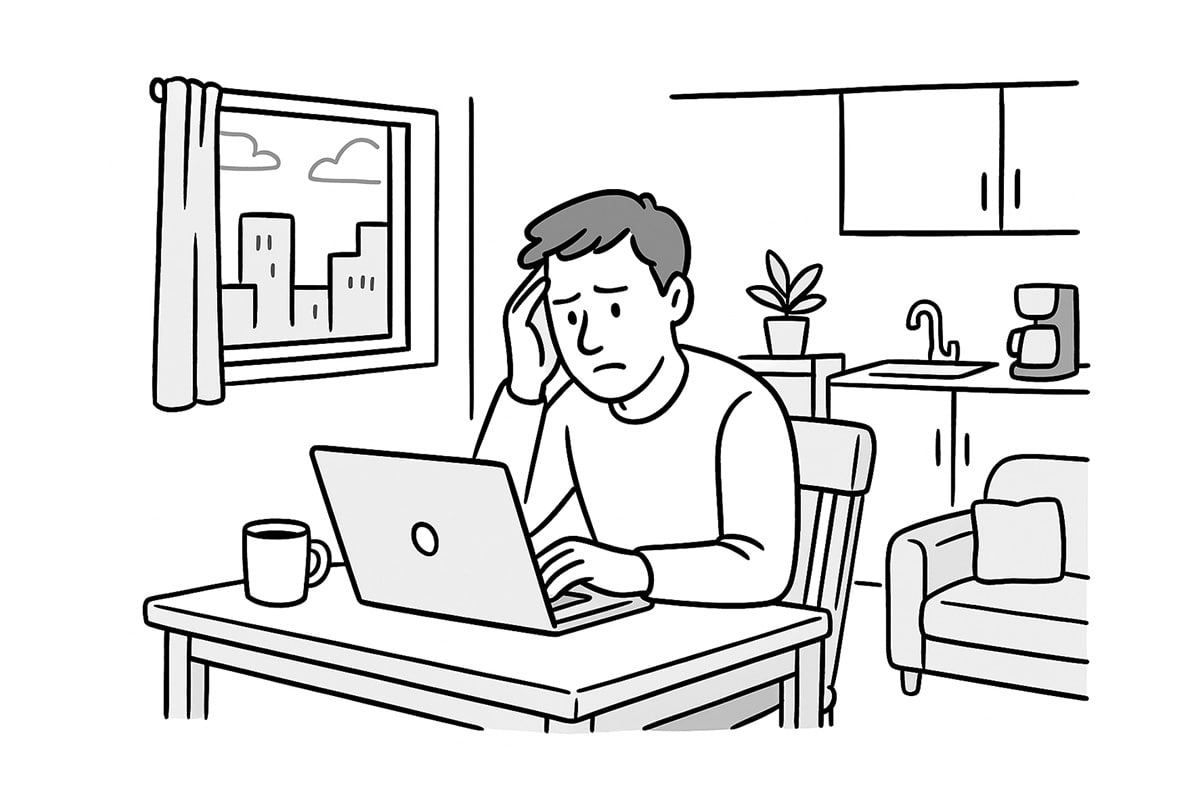
You finish a difficult section of a proposal, a budget review, or an implementation plan, and a message arrives that needs an answer. You switch away for what feels like five minutes. When you return, the document is still open, the cursor is roughly where you left it, and yet the real work has changed: Which option had you ruled out? What was the unanswered question? Were you about to revise the recommendation, or check one source before doing so?
Experienced professionals often absorb this recovery cost as part of being responsive. The calendar looks full, messages are answered, and the work eventually gets finished. What disappears is the repeated reconstruction of context: rereading material, reopening old threads, retracing a decision, or making a safe but weaker move because the original reasoning is no longer clear.
A restart note is a short record left at the moment a piece of work is suspended. It is not a task list, meeting note, or personal diary. Its job is narrower: to help you recover the state of a specific task without rebuilding it from scratch. This 10-day experiment tests whether such notes reduce recovery effort in your own work—and, just as important, which kinds of work do not need them.
What the experiment is actually testing
Do not begin by assuming every interruption is wasteful. Some are useful changes of priority; others are brief pauses between simple steps. The question is whether an interruption causes you to lose a task state that matters: your current judgment, an unresolved dependency, a tentative conclusion, or the next action that only makes sense in light of what came before.
Researchers use resumption lag to describe the time required to return to an interrupted task. In one laboratory study, people who were prevented from resuming immediately made fewer resumption errors, a useful warning against treating a fast return as the same thing as a correct return. The setting is not ordinary knowledge work, but the trade-off is familiar: rushing back can preserve apparent speed while skipping reconstruction of the problem state. See the study on speed, accuracy, and recovery after task interruption.
Your experiment should therefore measure more than minutes. It should test three practical questions:
- Can you identify the next useful action without rereading a trail of documents and messages?
- Do you reopen an issue you had already resolved, or miss an issue you had intended to check?
- Does the note take less effort than the context reconstruction it replaces?
The figures in the charts in this article are illustrative, not research data. They show what a useful pattern might look like in one person’s records, not a benchmark you need to meet.
A restart cue earns its place when it reduces reconstruction, not when it merely records activity.
- Baseline: finding the right context14 minutes of recovery work
- Baseline: rebuilding the reasoning22 minutes of recovery work
- With restart notes: finding context6 minutes of recovery work
- With restart notes: rebuilding reasoning9 minutes of recovery work
Make the restart note a state record, not a diary
A weak note reports activity: “Worked on pricing deck” or “Continue proposal.” It tells future-you what the project was, but not where thinking stopped. A useful note records the smallest set of cues needed to restart competent work.
Use the same location where you will resume: a comment at the top of a draft, a private line in the relevant task, a note attached to the project folder, or a designated field in your work tracker. Do not create a second archive that requires its own search. The note is an interface between two moments of work, not another knowledge-management project.
| Format | What it preserves | Best use | Common failure |
|---|---|---|---|
| Next-action marker | The immediate physical move | Routine work with a clear sequence | It omits why that move is the right one. |
| Decision-state note | The active choice, evidence, and remaining uncertainty | Analysis, drafting, planning, and review | It becomes a long explanation of work already finished. |
| Dependency marker | Who or what must change before work can continue | Cross-functional work, approvals, and external inputs | Ownership is named without a clear return trigger. |
For high-context work, start with five prompts. Keep the answers brief enough that you can write them while the task is still mentally available:
- Current object: What exact file, ticket, decision, or section am I in?
- Current state: What have I established, rejected, or drafted?
- Open question: What is uncertain or needs verification?
- Next action: What should I do first on return?
- Return condition: What source, person, or event will confirm the next move?
For example: “Vendor comparison, recommendation section. Option B is lower risk if support can confirm data-export timing. Do not rewrite the summary yet. Next: check the contract exhibit and ask Maya whether the export is included. Return when her answer or the exhibit changes the claim.” That is enough to restore the task’s logic. It is not an account of the whole afternoon.
External cues can reduce the need to keep an intended action actively in mind. In an experiment on prospective memory, reminders and clock checking shifted some of that monitoring burden into the environment. A restart note is not the same intervention, but it applies the same practical idea: use a reliable cue rather than asking memory to preserve every unfinished intention. See the research on externalizing time-based reminders.
Record the unanswered question before recording the work already completed.
- Two prompts15 seconds per note
- Five prompts30 seconds per note
- Unstructured paragraph75 seconds per note
Run the ten days in three phases
Pick one work category with repeated interruption risk. Good candidates include drafting complex recommendations, reviewing a queue with exceptions, preparing for stakeholder decisions, troubleshooting an operational issue, or returning to a project after meetings. Avoid trying to cover every task you touch. A broad rollout will teach you only that writing too many notes is annoying.
Days 1–3: establish a baseline
Do your usual work. Each time you return to the chosen task after an interruption of roughly five minutes or more, capture four observations in a simple log: the task type, what interrupted it, minutes until the first useful action, and whether you had to reconstruct reasoning from another place. “First useful action” means a substantive edit, a decision, a source check, or a message that moves the work forward—not merely opening the correct tab.
Do not attempt perfect timing. If an interruption began at 2:07 and you became productive again around 2:15, record eight minutes. The goal is to see patterns in your own workflow, not to produce a time-and-motion study.
Days 4–8: use one note format consistently
Before accepting a non-urgent interruption, write a restart note capped at 30 seconds. If the interruption is truly immediate, write the note as soon as you have handled it. The cap matters because a preservation method that routinely delays necessary responses will not survive normal work.
For urgent incidents, customer escalation, live facilitation, or time-sensitive approval, reduce the record to one line: “Paused at [object]; next decision is [question].” The aim is not to create a ceremony around urgent work. It is to leave a retrieval cue when the task cannot remain in active attention.
Days 9–10: remove one prompt
Review the notes you actually used. If you never consult the “current state” line but repeatedly need the source link, remove the former and make the latter explicit. If your notes are becoming miniature project updates, keep only the open question and next action. Treat the template as a small workflow design problem: each field must earn its place by preventing a specific kind of reconstruction.
A systematic review of laboratory studies found that interventions intended to reduce interruption costs generally improved primary-task accuracy and reduced resumption lag, while effects varied by task and intervention type. That variation is the reason to run a narrow personal test rather than adopt a universal format. Read the review of interventions for interruption-related task performance for the underlying distinction.
Resumption time begins after the interruption ends, not when the correct tab reopens.
- Choose one recurring, high-context category of work rather than every task you perform.
- Log three baseline days without changing your normal interruption habits.
- For five days, write a restart note of no more than 30 seconds before non-urgent switches.
- Record time to the first useful action when you return, along with any reconstruction or rework.
- On the final two days, remove one prompt that did not help you resume work.
- Keep, redesign, or stop the routine by task category rather than applying one verdict to all work.
Measure recovery at the point work becomes useful again
During the pilot, record the same four baseline observations and add two more: whether the note answered the first question you had on return, and whether you discovered rework or a mistaken assumption later. Do not score every return as success or failure. Look for failure modes.
A restart note may shorten the first few minutes yet create a false sense of certainty if it preserves a conclusion without preserving the evidence behind it. Conversely, a note may take 20 seconds to write and save only two minutes, but still prevent a costly omission in a sensitive review. Time is one signal; quality of re-entry is another.
There is a useful operational distinction here. A task list records that something remains. A restart note records the particular state from which it should continue. When a task involves approvals, handoffs, or changing source material, that state often includes ownership and version information. “Awaiting finance” is vague. “Awaiting finance approval on version 3; if approved, send the existing draft to legal without changing the payment schedule” preserves an executable handoff to yourself.
High-reliability fields have long used physical and procedural cues to protect interrupted sequences. NASA’s Aviation Safety Reporting System describes the practice of marking a suspended checklist position and using an identify-ask-decide sequence after an interruption. Office work does not carry the same stakes, but the mechanism is applicable: preserve where work stopped before a new demand competes for attention. See NASA’s discussion of interruption management.
External memory helps only when the cue appears in the place where the work will resume.
Decide which work deserves a restart note
At the end of day 10, sort your records by task type rather than averaging everything together. A restart note is most likely to help where context is expensive to rebuild: complex analysis, writing that depends on a line of argument, exception handling, investigation, and decisions with several conditions. It may be unnecessary for a familiar administrative sequence, a short queue item with a stable next step, or work that a shared system already resumes cleanly.
Use this decision rule: keep the practice for a task category if, across several returns, the note reliably gets you to the next useful action or prevents you from reopening settled work—and if writing it fits inside the interruption you actually face. Redesign it if you are recording history instead of a live decision. Stop using it for categories where you consistently ignore the note because the work state is already obvious.
Be particularly skeptical of notes that live only in a private document when the task itself belongs in a shared system. A private cue can help you restart, but it will not repair unclear ownership for the team. If another person may need to continue the work, put the dependency, source version, and next owner in the task record where they can act on it.
Research in simulated air-traffic-control work found that longer retention intervals increased the risk of forgetting deferred work, while environmental cues and offloading could support performance. Your work is different, but the design question is comparable: how long will this intention need to survive, and what trusted cue will still be visible when you return? The study of prospective memory in a dynamic work setting offers a useful boundary for thinking about deferred tasks.
Next week, choose one high-context task category and use a two-line restart note for five working days: “Open question” and “Next action.” Do not change your notifications, calendar, or project tool yet. At the end of the week, read only the moments when you returned after an interruption. If the two lines repeatedly restore the work without a search through messages and documents, add one field for the missing context. If they do not, remove the routine rather than turning it into another obligation.
Do not standardize a note format before you know which interruption pattern it solves.
- Complex analysis6 resumptions supported by a note
- Argument-driven drafting5 resumptions supported by a note
- Approval dependencies4 resumptions supported by a note
- Routine queue work1 resumptions supported by a note
 About the author Ewald Schäfer
HR Technology Specialist · Germany I’m Ewald — a passionate HR tech consultant from Berlin. I write about the intersection of automation, recruitment, and human capital. After leading several HRIS rollouts across Europe, I now focus on advising startups and writing practical content for job seekers and hiring teams alike. With a strong IT background, I bridge the gap between HR and technology: from API integrations and data security to workflow automation and cloud-based HR platforms. My mission is to help organizations not only digitize but truly optimize their people operations.