In this article
Look, I get it. We were all sold a bill of goods about the “new normal.”
Remember 2021? The vaccines were rolling out, the sun was shining, and every LinkedIn “thought leader” with a ring light and a podcast was preaching the gospel of Hybrid Work. It was supposed to be the Goldilocks zone. Not too hot (burning out in the office five days a week), not too cold (slowly going feral in your pajama bottoms at home). Just right. The Best of Both Worlds™.
But here we are, a few years down the road, and honestly? It feels less like a revolution and more like a chaotic compromise that nobody actually likes.
I’m walking into my office on a Tuesday—which, by some unwritten decree, is the new Monday—and the vibe is just… weird. Half the desks are empty. The other half are occupied by people shouting at laptops because the conference room tech is busted again. There’s a distinct smell of stale coffee and resentment.
So, let’s cut the corporate jargon and talk about why this hybrid experiment is threatening to turn into a logistical and cultural nightmare.
The “Structured Chaos” Paradox
The biggest lie we tell ourselves is that hybrid work equals flexibility.
It doesn’t. Not really.
True flexibility is autonomy. It’s looking at your workload and deciding, “I need deep focus today, I’m staying home,” or “I need to brainstorm with Sarah and Mike, I’ll head in.”
“Hybrid is often just rigid inflexibility wearing a cool hat.”
What most companies have actually implemented is a rigid schedule that makes zero sense. “You must be in on Tuesdays, Wednesdays, and Thursdays.” Why? Because HR said so. Because the CEO gets lonely in his corner office. Because we’re paying for the lease, dammit, and someone better use the ergonomic chairs.
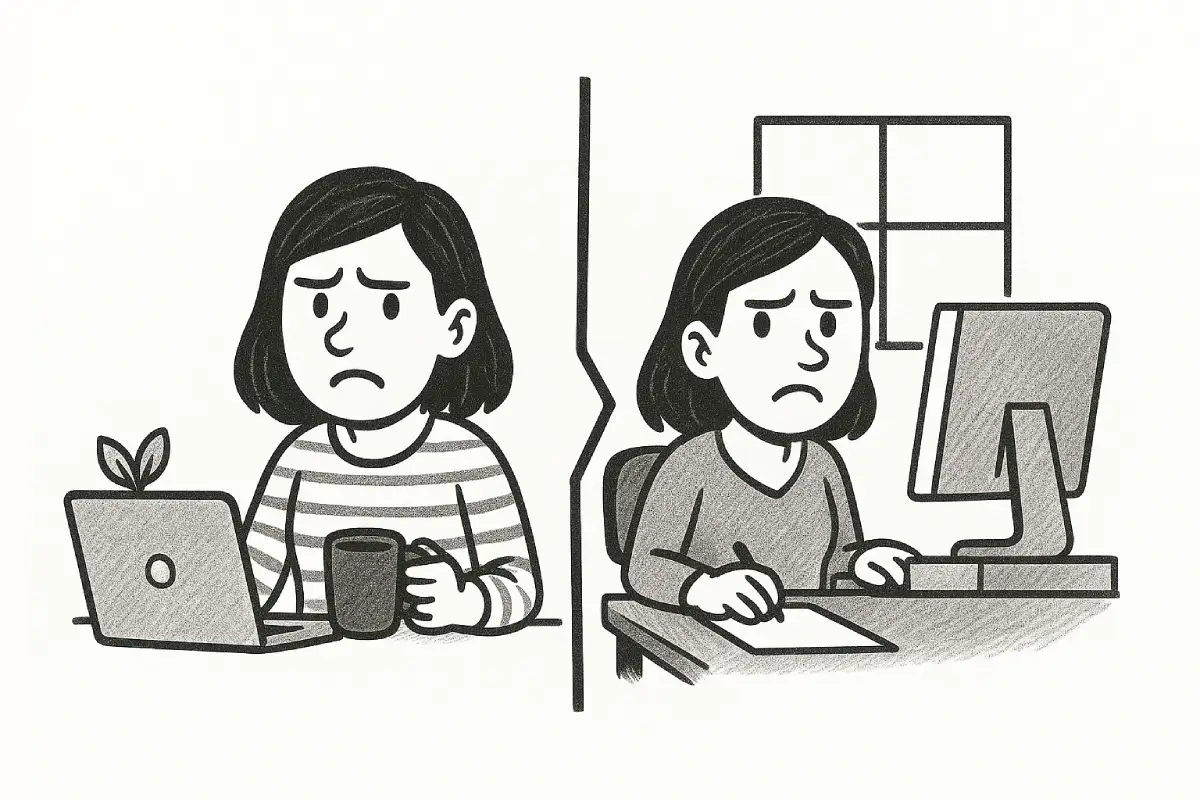
This creates a scenario where you spend an hour commuting—fighting traffic that is somehow worse than pre-pandemic levels—just to arrive at the office, put on noise-canceling headphones, and sit on Zoom calls with people who are also in the office, but on a different floor. Or worse, with people who are at home because their “mandated days” are different from yours.
Make it make sense.
I was talking to a buddy of mine, a senior dev at a mid-sized tech firm in Seattle. He told me, “I go in, I sit at a hot desk that hasn’t been wiped down since the Bush administration, and I code. I don’t talk to anyone because my team is distributed. Then I drive home. I lose two hours of my life for ‘culture.’”
That’s not culture. That’s attendance.
According to a report by Gallup regarding the future of hybrid work, the friction comes from the lack of coordination. When people show up and their team isn’t there, the value proposition of the commute hits zero. Actually, it hits negative numbers because now you’re annoyed.
The Proximity Bias Trap (or: Out of Sight, Out of Mind)
Here is the ugly truth that managers whisper about but rarely put in an email: If I see you, I like you more.
It’s just human nature. We are primal creatures. We value physical presence. When I’m scrambling to find someone to lead a new project and I look up and see Dave walking past my door to get a bagel, guess who’s getting the project? Dave.
Is Dave the best person for the job? Maybe. Maybe Dave is an idiot. But Dave is here.
This is called proximity bias, and in a hybrid setup, it’s going to create a two-tier caste system.
- The In-Crowd: The folks who come in 4-5 days a week. They get the face time, the casual hallway mentorship, the post-work drinks where the real decisions happen.
- The Ghosts: The folks who stick to the minimum mandated days or work fully remote. They become names on a screen. Avatars.
If you think this won’t impact promotions and raises, you’re dreaming. A study highlighted by the Harvard Business Review pointed out exactly this risk. It’s insidious because it’s not malicious. It’s just cognitive laziness. It’s easier to trust the person you shared a joke with in the elevator than the person who is just a static image on Microsoft Teams.
I’ve seen it happen in my own career. Back in the day, the guy who stayed late got the nod. Now, the guy who actually shows up gets the nod. It’s unfair, it’s biased, and it’s going to lead to a massive diversity issue, especially since data suggests women and caregivers prioritize remote flexibility more than men.
The Hot Desking Hellscape
Can we talk about “hot desking” for a second? Or “hotel-ing”? Or whatever euphemism your Facilities Manager is using this week?
It sucks.
There. I said it.
Human beings are territorial. We like our stuff. We like our dual-monitor setup adjusted to the exact millimeter height that prevents neck spasms. We like having a drawer where we can stash a bag of almonds and that one specific pen that writes really well.
Hybrid work killed the personal desk. Now, you have to book a seat through an app that crashes half the time. You show up, and someone is in your booked spot. You don’t want to be that guy who kicks them out, so you wander the floor like a lost spirit looking for a docking station that actually works.
And the hygiene. My god, the hygiene.
You don’t know who sat there yesterday. You don’t know if they covered their mouth when they sneezed. You are typing on a keyboard that is a biological weapon.
It strips away the sense of belonging. The office isn’t “your” place anymore. It’s a transit lounge. It’s an airport terminal where you have to answer emails. When you treat employees like transients, don’t be surprised when their loyalty becomes transient too.
The “Always On” Nightmare
You’d think hybrid work would give us better work-life balance.
Narrator voice: It did not.
Instead, it shattered the boundaries between “work” and “home” until they became a meaningless gray sludge.
In the old days (and by old days, I mean 2019), leaving the office was a ritual. You packed your bag. You walked out the door. The commute was a decompression chamber. By the time you got home, you had shifted gears.
Now? Because you can work from anywhere, you are expected to work everywhere.
Did you decide to work from home on Friday? Great. That means you can hop on a call at 7:00 AM because “you don’t have to commute.” It means answering Slacks at 8:00 PM because “you took an hour off to walk the dog.”
The guilt is real. Remote workers often overcompensate because they’re terrified of being seen as lazy. They log on earlier and stay on later just to prove they are working. This is “productivity theater,” and it is exhausting.
We’ve traded the commute for chronic anxiety. Fair trade? I don’t think so.
The Erosion of Social Capital
I’m going to sound like an old man yelling at a cloud here, but stick with me.
Work is hard. What makes it bearable—sometimes even fun—is the people. It’s the shared trauma of a bad client. It’s the stupid inside jokes. It’s the spontaneity of grabbing a burger on a Wednesday.
Hybrid work dilutes this.
When you only see your colleagues sporadically, relationships stay transactional. “I need this file.” “Did you update the Jira ticket?” “Approved.”
You lose the connective tissue. You lose the social capital.
I remember a job I had in my 30s. The work was brutal. The pay was mediocre. But the team? We were tight. We covered for each other. We knew who was going through a divorce, whose kid was sick, who was hungover. That empathy made the machine run smoother.
In a hybrid world, where half the team is a pixelated square, that empathy evaporates. It’s harder to interpret tone in a text-based environment. A curt email from Brenda isn’t “just Brenda being Brenda because she hasn’t had her coffee”; it’s interpreted as passive-aggressive hostility.
We are building organizations that are efficient, perhaps, but emotionally hollow. And when the going gets tough—and it always does—hollow structures collapse.
According to research from Microsoft’s Work Trend Index, rebuilding this social capital is the biggest challenge leaders face. But you can’t mandate friendship. You can’t schedule “spontaneous collision” from 2:00 PM to 2:30 PM.
So, What’s the Fix?
I don’t have a silver bullet. If I did, I’d be charging $50k for keynotes instead of writing this article.
But I know this: The current version of hybrid work—this lukewarm, messy middle ground—isn’t sustainable. It’s burning people out on both ends of the spectrum.
Companies need to make a choice.
Either go Remote-First, where the default is digital and the office is essentially a retreat center for quarterly gatherings. Stop pretending the office is the hub.
Or, make the office Earn the Commute. If you want me in, make it worth it. And I don’t mean free kombucha on tap. I mean, ensure that when I’m there, my team is there. Structure the days so they are for collaboration, not quiet typing. Redesign the space so I’m not fighting for a desk.
Maybe the “Worst of Both Worlds” is just a growing pain. Maybe we’ll figure it out.
But right now? It feels like we’re trying to ride two horses with one ass, and we’re just ending up in the mud.
It’s messy. It’s frustrating. And honestly, I miss having my own damn stapler.
 About the author Matt Semon
Career Writer · AI Hiring Trends · USA I’m Matt, a writer and researcher focused on how hiring is evolving in the age of AI. I’ve been following trends in recruitment, automation, and remote work since 2018. When I’m not writing deep-dive articles for Jobicy, I’m testing AI tools to see how they impact candidates and hiring teams.