In this article
The “work from anywhere” promise has soured into a tactical chess match. When an interviewer asks, “Why do you want this job?” they are rarely looking for a professional mission statement, and they certainly do not care about your desire to work in your pajamas. In a saturated talent pool where thousands of applicants can execute the core tasks of a digital role, this question is a diagnostic tool designed to test your operational alignment.
For the remote professional, the stakes are uniquely high. Without the physical signals of an office—the shared coffee breaks, the ambient energy of a bullpen—trust must be established entirely through strategic resonance.
Most candidates fail because they treat this question as an invitation to discuss their own career aspirations. To win the role, you must invert the framework. You need to prove that your specific operational style is the precise antidote to the company’s current distributed pain points.
The Distributed Dilution Trap: Moving Beyond the “Flexibility” Cliche
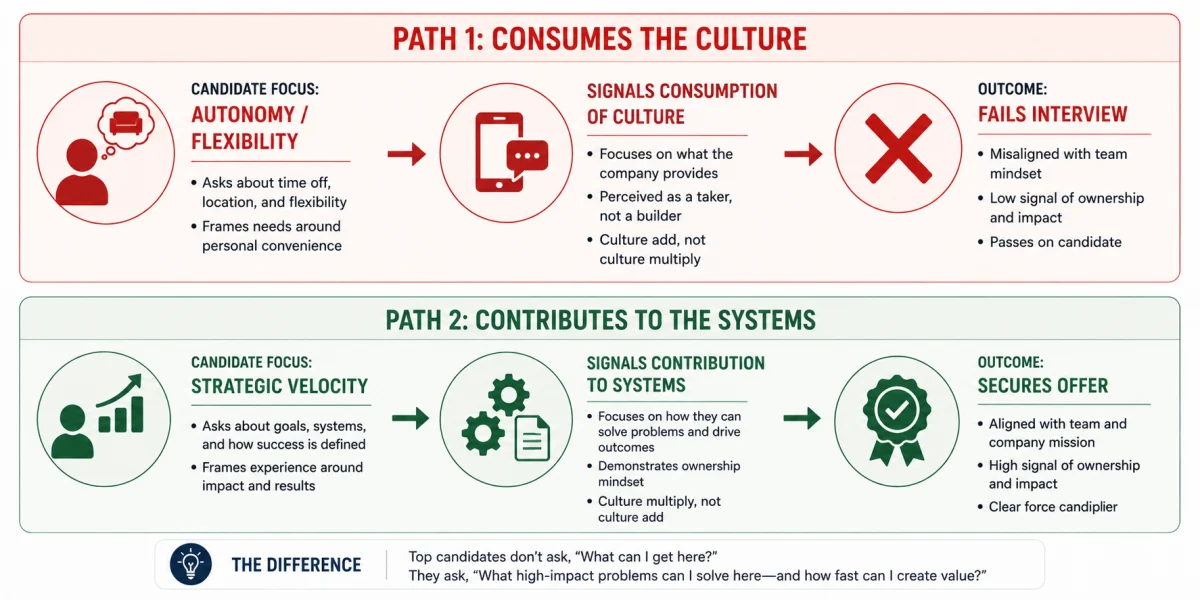
The quickest way to tank a remote interview is to mention autonomy, flexibility, or work-life balance. Employers already know distributed work offers these perks; they do not need you to mirror their own benefits package back to them. When you focus on how the setup benefits you, you inadvertently signal that you view the company as a lifestyle sponsor rather than a commercial enterprise.
High-performing distributed organizations suffer from a specific tax: the Distributed Dilution Trap. This is the gradual erosion of strategic clarity, velocity, and cultural cohesion that occurs when teams are separated by time zones and screens. When an interviewer asks why you want to join, they are testing whether you will exacerbate this dilution or actively fight it.
Consider the hidden operational costs of an underperforming remote team. Misaligned priorities lead to duplicated work, asynchronous communication bottlenecks stall product launches, and isolation drives turnover.
Your answer must position you as a net-positive asset to their remote infrastructure. You are not looking for a job that lets you work from a beach; you are seeking a specific architectural challenge that matches your operational toolkit.
Framework 1: The Asynchronous Architecture Alignment
The most sophisticated answer you can give centers on the alignment of operational mechanics. Every remote company sits somewhere on the spectrum between synchronous chaos (endless Zoom meetings and Slack firefighting) and strict asynchronous maturity (deep documentation and high individual ownership).
To build a compelling narrative, identify where the target company sits on this spectrum—and why your working style makes you an amplifier of their specific model.
Case Study: The Documentation-First Engineering Lead
Imagine interviewing at a company known for its radical asynchronous culture, like GitLab or Todoist. A surface-level candidate might say they love the idea of asynchronous work because it gives them deep focus time. An elite candidate addresses the operational reality:
“I want this role because your commitment to a documentation-first culture is the only way to scale a product without engineering bloat. In my last role, we shaved 15% off our sprint delivery cycles simply by shifting our architecture reviews from live meetings to structured Notion RFCs. I’m looking for an environment where documentation isn’t an afterthought—it’s the core API of the team. Your public handbook shows you’ve solved the alignment problem, and I want to apply my experience managing cross-timezone technical debt to that specific framework.”
Why This Works
This response succeeds because it connects a personal preference (documentation) directly to a commercial outcome (shaving 15% off sprint cycles and reducing engineering bloat). It shows you understand that remote work requires a different flavor of discipline, and you possess it.
Actionable Blueprint: Crafting Your Async Pitch
- Identify the Tooling Ecosystem: Look at their job description for clues. Do they heavily emphasize Linear, Notion, async video, or GitHub issues?
- Diagnose the Communication Style: Read their engineering blogs or executive LinkedIn posts. Are they struggling with meeting fatigue, or are they fiercely protective of deep work?
- Quantify Your Systemic Impact: Frame your past success around how you managed information flow, not just how you checked off tasks.
Framework 2: The Core Commercial Leverage Point
Remote companies do not hire to fill a seat; they hire to solve an isolation-induced bottleneck. When teams are distributed, visibility into inefficiencies drops. If a project is stalling, it takes longer for leadership to notice.
Your response should demonstrate that you have analyzed their business model from the outside and identified the exact lever this role controls. You must connect your desire for the job to a specific commercial challenge the company is facing.
The Strategic Value Chain
To find this lever, map the company’s business model against the realities of a distributed team:
| Remote Vulnerability | The Job’s Commercial Lever | Your Stated Motivator |
| Siloed Departments | Cross-functional Product Manager | Unifying product and growth metrics across isolated, global teams. |
| Customer Churn | Enterprise Customer Success | Building remote trust with high-value accounts without on-site visits. |
| Slow Code Deployment | Devops Engineer | Automating CI/CD pipelines to remove manual bottlenecks for global devs. |
Case Study: The Growth Marketer Fixing the Feedback Loop
If you are interviewing for a growth marketing role at a B2B SaaS company, a standard answer focuses on their product quality. An elite answer focuses on the operational friction of scaling that product remotely:
“Your recent shift from mid-market to enterprise SaaS requires a completely different feedback loop between product and marketing—one that easily breaks down when teams are distributed. I want this job because your team has managed to maintain a weekly release cadence despite being entirely remote. That tells me your data infrastructure is clean. I want to plug my growth experimentation framework into a team that can iterate based on data rather than waiting for a synchronous alignment meeting.”
This approach shifts the conversation from “Why do you like us?” to “Here is how I will integrate into your money-making machine without causing friction.”
Framework 3: The Cultural Operationalization Match
Culture in a remote company is not defined by values listed on a website. It is defined by how the company handles conflict, how it rewards performance, and how it mitigates isolation. When an interviewer asks why you want to work there, they are listening for clues about your psychological compatibility with a screen-mediated culture.
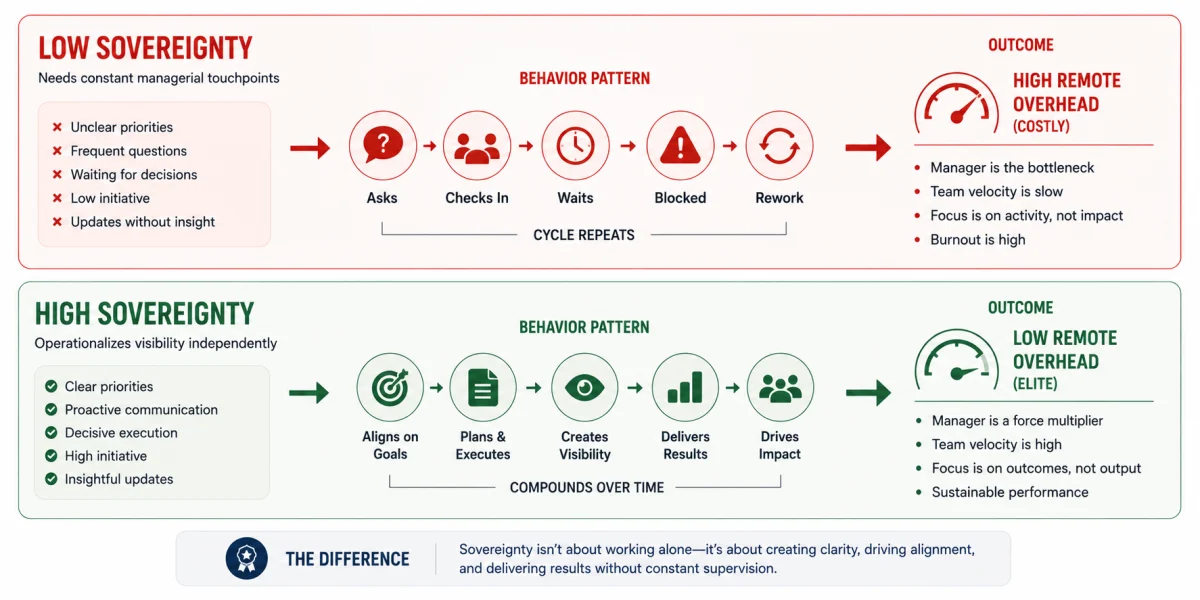
Many remote workers struggle with visibility; they expect their work to speak for itself, only to find themselves passed over for promotions because they did not know how to “manage up” digitally. Your answer should signal that you are an expert at navigating the social fabric of a distributed workplace.
Showing Your Sovereign Mindset
You want to prove you have a sovereign mindset—the ability to self-start, self-correct, and maintain high psychological safety without daily managerial reassurance.
Case Study: The Customer Success Director Countering Isolation
When interviewing for a leadership role, show that you know how to build culture through operational systems, not forced virtual happy hours:
“I’m drawn to this team because of how you approach operational transparency. In a distributed environment, it’s easy for customer success teams to feel isolated from the core product loop, leading to burnout. I noticed your VP of Product recently published a public post about your internal ‘failure post-mortems.’ I want to work in an organization where mistakes are operationalized into learning data rather than hidden behind private Slack DMs. That level of psychological safety is rare in remote setups, and it’s the exact environment where I can drive retention.”
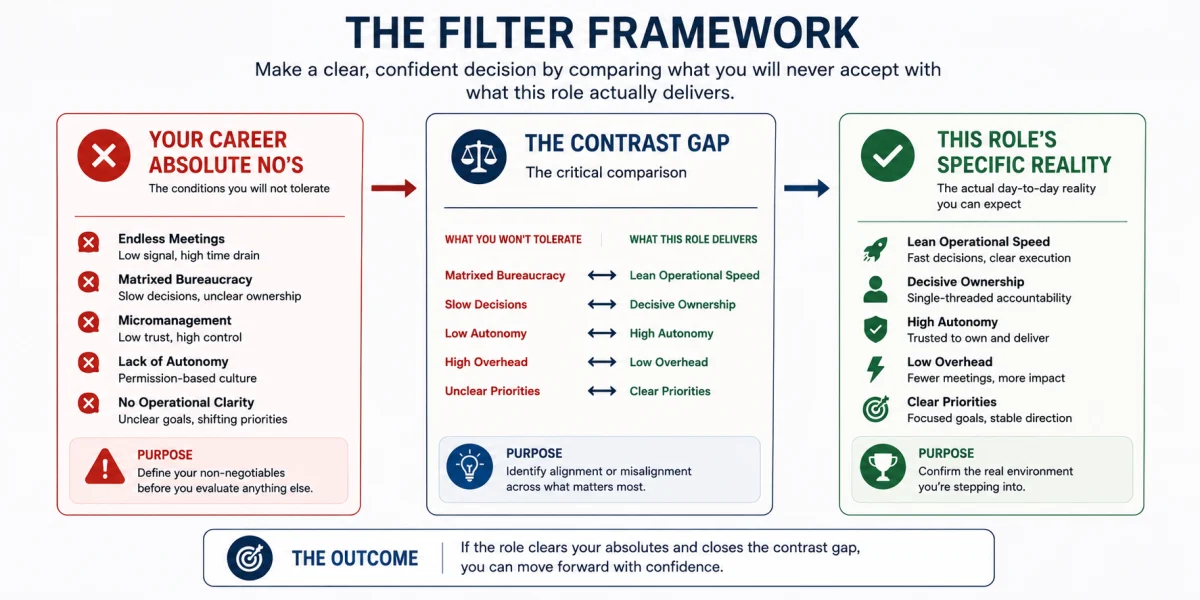
The Counter-Intuitive Truth: Why You Should Mention What You Don’t Want
To establish ultimate credibility, introduce a strategic trade-off. An interview is a negotiation of fit, and a candidate who claims a role is perfect in every single way lacks credibility. By explicitly stating what types of environments you are avoiding, you validate the sincerity of why you want this specific job.
This strategy uses the psychological principle of contrast. When you define the negative space of your career, the positive space (the job you are interviewing for) becomes incredibly sharp.
Scripting the Strategic Trade-Off
Here is how you can weave a contrast statement into your response:
“To be direct, I turned down two interviews this month at larger, highly matrixed organizations. While they offered great stability, their remote models are highly bureaucratic—requiring three layers of sign-off just to run an A/B test. I’m looking for this specific role because your lean structure allows for rapid execution, provided the employee owns their domain. I thrive when accountability is high and guardrails are clear, rather than when I’m managed by consensus.”
By doing this, you instantly separate yourself from the desperate job-seeker. You become a deliberate buyer matching with a deliberate seller.
Turnkey Responses for Key Remote Roles
Let’s translate these frameworks into concrete, role-specific templates you can adapt. Notice the complete absence of fluff; each response focuses on systems, velocity, and execution.
1. Product & Project Management Roles
Focus on: Cross-functional alignment, eliminating meeting bloat, and ticket velocity.
“I want this role because your product roadmap requires an exceptional level of cross-functional documentation to succeed across three continents. In my last position, I managed a product launch where the design team was in London and the dev team was in Tokyo. We completely eliminated status meetings by building an automated Jira-to-Slack dashboard that highlighted blockers before they hit the critical path. I’m looking to bring that exact playbook to your upcoming enterprise platform rewrite, where asynchronous alignment will make or break your Q4 launch date.”
2. Engineering & Technical Roles
Focus on: Developer velocity, clean code reviews, and minimizing context-switching.
“Your engineering team’s focus on small, decoupled pull requests is what drew me to this position. In many remote engineering organizations, developers spend half their day wrestling with massive merge conflicts because the architecture isn’t optimized for isolated work. My focus is entirely on maintaining high developer velocity without sacrificing code quality. I want this job because your CI/CD pipeline infrastructure is built to empower individual contributors to ship code independently, which aligns perfectly with how I write and test software.”
3. Sales, Marketing, & Growth Roles
Focus on: Data transparency, pipeline ownership, and cross-timezone collaboration.
“I’m targeting this growth role because your marketing engine relies heavily on product-led growth data rather than top-down executive intuition. Working remotely, a growth marketer can waste weeks chasing the wrong metrics if they don’t have direct, unmitigated access to user behavior analytics. Your emphasis on open data access across the organization means I can spin up landing page variants and analyze funnel drops without waiting for a weekly synchronous data dump. That operational speed is exactly what I need to hit the pipeline targets you’ve set for this territory.”
4. Operations & Customer Support Roles
Focus on: Knowledge base scalability, ticket deflection, and burnout mitigation.
“I want this job because your support team is facing a classic scaling inflection point—your customer base is growing faster than your headcount, and your team is spread across multiple time zones. Having managed a distributed tier-1 support team through a 200% customer spike, I know that the solution isn’t working longer hours; it’s building a hyper-efficient, internal knowledge base that allows agents to find answers in under 30 seconds without pinging a channel. I want to scale your internal documentation systems so your global agents can resolve tickets autonomously.”
A Tactical Checklist for Your Next Interview
Before you log into your next video call, run your “Why do you want this job?” answer through this diagnostic filter. If it fails even one of these points, rewrite it.
- The Ctrl+F Test: Could your answer be given verbatim by a candidate interviewing at a completely different remote company? If yes, it is too generic. Inject specific details about their product, engineering blog, or public handbook.
- The Output-to-Input Ratio: Does your answer spend more time discussing what you will give the company (systems, velocity, revenue) than what the company will give you (flexibility, career growth)?
- The Async Check: Does your response acknowledge the operational complexity of distributed work, or does it pretend that remote work is effortless?
- The Brevity Filter: Can you deliver the core argument in under 90 seconds? In a video interview, attention spans are short; get to your commercial leverage point quickly.
The elite remote worker does not ask for permission to fit into a company’s culture. By answering this question through the lens of operational architecture, strategic velocity, and commercial leverage, you prove that you are already sitting at the desk before the offer letter is even generated.
 About the author Joshua Ward
Startup Recruiter · Talent Advisor · UK Hey, I’m Josh — a recruiter-turned-writer based in London. I’ve helped build early teams at over 25 startups in the past 7 years, mostly in SaaS and fintech. Now I share insights about how small companies hire, what hiring managers really look for, and how to stand out in a noisy job market.