In this article
At 10:47 on a Tuesday morning, a woman I’ll call Maya—she is a composite of several people I have known, coached and watched learn the hard way—locked herself in a restroom stall at the headquarters of the company she had wanted to join for years, opened the notes app on her phone and typed: “How soon is too soon to quit a dream job?”
Six weeks earlier, she had posted the happy announcement. New role. Famous brand. Big mission. A title that made relatives finally stop asking whether her previous work was “a real job.” The comments filled with fire emojis, tiny rockets and strangers saying, “You’re living the dream!”
Now she was hiding from her manager between meetings.
Plot twist.
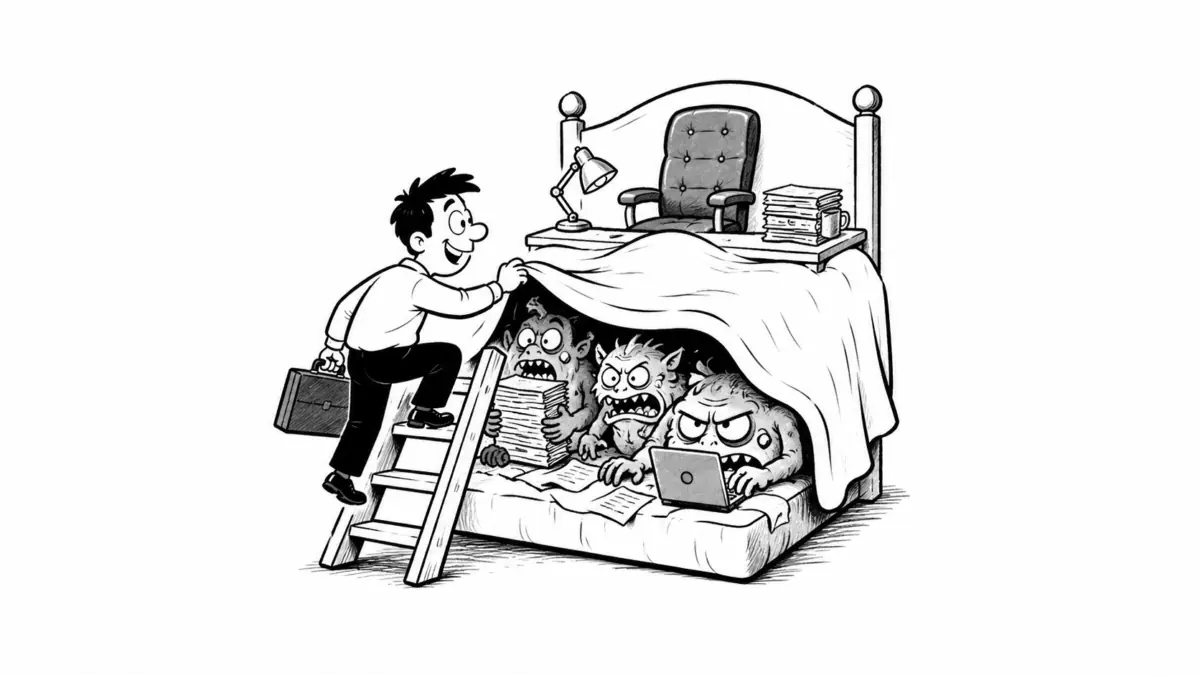
The work itself was not what broke the spell. The spell dissolved through smaller things: messages at 6:20 a.m., goals rewritten after the work was finished, public praise followed by private contempt, Sunday anxiety that arrived on Saturday afternoon. Nothing looked dramatic enough to explain at dinner. Together, though, the pieces formed a complete little nightmare—tastefully branded, naturally.
Have you ever wanted a job so badly that you stopped evaluating it? That is what we need to talk about.
We Fall in Love With the Trailer
A dream job usually begins as a montage. You imagine the announcement, the office or perfect home setup, the impressive projects, the answer you will give when someone asks what you do. Your imaginary workday contains meaningful conversations, deep focus and a flattering amount of natural light.
It rarely contains the 4:45 p.m. meeting called “quick sync.”
This is not because you are naive. Human beings are spectacular story-building machines. Give us a prestigious logo and three paragraphs about changing the world, and we will furnish an entire future around them. We confuse what the job symbolizes with what the job requires.
The symbol might be creativity, influence, security, public service, status or finally proving your old boss wrong (a noble calling, apparently). The reality is made of verbs: writing, fixing, persuading, waiting, reporting, presenting, apologizing, documenting and asking Greg whether he has reviewed the spreadsheet.
You dream about the noun. You have to live the verbs.
That gap—between the cinematic identity and the daily behavior—is where dream jobs go feral.
Prestige is a powerful anesthetic
Prestige can persuade intelligent people to tolerate conditions they would reject anywhere else. A famous employer pays partly in reflected glory; a glamorous industry pays partly in access; a mission-driven organization pays partly in moral meaning. Sometimes the cash is excellent too. Sometimes the “privilege” of being there is quietly deducted from it.
I call this the passion tax. The employer assumes that because many people want the role, the person who gets it should accept unreasonable hours, vague boundaries or lower pay with grateful little jazz hands.
And for a while, it works. You tell yourself the pressure means the work matters. You call exhaustion “a steep learning curve.” You interpret chaos as speed and disrespect as high standards. I mean, seriously—if the company has a beautiful careers page and a podcast, surely the problem cannot be structural?
It can.
The Job Description Was Not a Contract With Reality
Job descriptions are aspirational documents. At their most innocent, they are written before the hiring manager fully understands the role. At their least innocent, they are perfume sprayed over a small organizational fire.
“Fast-paced environment” may mean energized colleagues making quick decisions. It may also mean nobody plans, priorities change hourly and your reward for surviving one emergency is a fresher emergency.
“High ownership” can mean autonomy. Or it can mean responsibility without authority, resources or air cover.
“We are like a family” might describe genuine loyalty. It might mean boundaries are treated as betrayal and Dad has scheduled an all-hands for Sunday.
You cannot decode a job from phrases alone. You have to investigate how the team behaves when work becomes inconvenient—because eventually it will.
The manager matters more than the mural
Maya had loved the company’s mission. She had barely investigated the person who would control her priorities, feedback, workload and access to advancement.
That is a common mistake. Candidates spend hours researching products and ten minutes evaluating the manager. Yet Gallup’s State of the Global Workplace 2026 found that global employee engagement fell to 20% in 2025, with the decline in manager engagement accounting for much of the recent slump. Managers are not a small detail attached to the dream. They are often the weather system inside it.
A strong manager can make imperfect work developmental, clear and humane. A poor manager can turn fascinating work into a daily scavenger hunt for approval.
During the interview, notice what your future manager does when you ask about mistakes, disagreement or workload. Do they answer with an example? Do they blame former employees? Do they speak about the team as adults or as troublesome appliances? A leader reveals a great deal when describing people who are not in the room.
Listen closely.
The Dream Can Become an Infinite Workday
The first late message rarely feels sinister. You are new. You want to help. You answer quickly, receive a grateful emoji and experience the tiny dopamine sparkle of being needed.
Then the exception develops a routine.
Microsoft’s 2025 analysis, Breaking Down the Infinite Workday, found that work was spreading across early mornings, evenings and fragmented days. Its broader 2025 data showed employees interrupted by meetings, messages or email every two minutes during core hours, with activity increasing outside the traditional workday. Technology did not invent poor boundaries, of course. It simply gave them excellent distribution.
The dangerous part is not one busy month. Ambitious work sometimes demands a sprint. The dangerous part is a system that labels every week exceptional and then acts surprised when people can no longer sprint.
Here is the test: Does urgency have a cause and an end date, or is urgency the company’s operating system?
If everything is urgent, leadership has outsourced prioritization to your nervous system.
A dream job can still be badly designed
You may love the subject and hate the container. This distinction saved me from some truly silly career conclusions.
People often leave a badly designed role and decide they chose the wrong field. Maybe. But perhaps they chose the right craft inside the wrong company, reporting to the wrong person, under a workload assembled by caffeinated raccoons.
Separate the elements:
- Do you dislike the actual work, or the volume of it?
- Do you dislike collaboration, or one colleague’s behavior?
- Do you dislike leadership, or this manager?
- Do you dislike remote work, or remote work without documentation and boundaries?
- Do you dislike the mission, or being asked to sacrifice yourself for it?
Do not abandon an entire profession before identifying the broken component.
Meaning Is Wonderful—and Dangerous
Meaningful work can energize you through difficult periods. It can also make exploitation feel morally complicated.
If your organization serves patients, students, vulnerable communities, the climate, the arts or another emotionally resonant cause, leaving may feel like abandoning the people who benefit. The institution knows this. Good institutions protect staff because the mission depends on them. Bad ones use the mission as a crowbar.
Deloitte’s 2025 Gen Z and Millennial Survey highlights the importance younger workers place on meaning, mentorship, well-being and financial security. That combination matters. Meaning without money creates fragility. Meaning without well-being creates burnout. Meaning without ethical management becomes a very elegant trap.
A noble mission does not cancel an unhealthy workplace. It makes healthy leadership more important.
Ask yourself a brutal question: Would I consider these conditions acceptable if the organization made industrial fasteners?
If the answer is no, purpose may be covering the bill.
Your Identity Has Merged With Your Email Signature
The scarier the dream job becomes, the harder it can be to leave. Why? Because quitting no longer feels like changing employment. It feels like losing the character you spent years becoming.
You are not merely a designer; you are a designer there. Not simply a journalist, researcher, engineer or strategist, but one carrying a name people recognize. The identity is warm and shiny. It fits beautifully. Then one day you notice it has no zipper.
This is where sunk costs start giving speeches. You competed for the role. You moved cities. You told everybody. You bought the jacket. Leaving after four months would be embarrassing.
But staying for four years to avoid explaining four months is worse mathematics.
PwC’s Global Workforce Hopes and Fears Survey 2025 found a workforce containing both satisfaction and strain: 70% of respondents felt satisfied with work at least weekly, while nearly half reported fatigue and only 53% felt strongly optimistic about the future of their roles. A prestigious title does not exempt anyone from that tension. You can be grateful for an opportunity and honest about its cost at the same time.
Two truths. One chair.
How to Audition the Job Before It Auditions You
You cannot eliminate risk. Companies change, managers leave and roles mutate. But you can stop treating the interview as a pageant in which only you must impress.
Your goal is to collect behavioral evidence.
Ask questions that require stories
Weak question: “How would you describe the culture?”
Predictable answer: “Collaborative, innovative and definitely not haunted.”
Ask this instead:
- “Tell me about the last time the team missed a deadline. What happened next?”
- “What has caused strong people to struggle in this role?”
- “Which priority was removed when the team received a major new project?”
- “How do you handle messages outside normal working hours?”
- “What feedback did the team give you as a manager, and what did you change?”
- “Why did the previous person leave?”
- “What would surprise me after three months here?”
Specific questions force the company out of brochure mode. Watch for concrete examples, evasive fog and suspiciously flawless answers. Healthy teams have problems; they can describe how they handle them. Only cults and careers pages claim perfection.
Request the ordinary Tuesday
Ask the hiring manager to walk you through a typical week. What percentage is meetings? How much work is planned versus reactive? Who approves decisions? What creates pressure? How often do priorities change?
Dream jobs are imagined at the highlight level and experienced at the calendar level. See the calendar.
If possible, speak privately with a future peer. Ask what they wish they had known before joining. People may hesitate to criticize their employer, but their pauses are often extremely articulate.
Score the offer before the excitement votes
Create a simple scorecard and rate each category from one to five:
- Daily tasks
- Manager quality
- Workload and boundaries
- Compensation and security
- Learning and progression
- Values in practice
- Flexibility and location
- Team trust
- Role clarity
- Effect on your life outside work
Choose your non-negotiables before the offer arrives. Once the congratulatory email lands, your brain becomes an enthusiastic defense attorney for accepting it.
Randstad’s Workmonitor 2025 found that work-life balance edged ahead of pay as a motivator, while 44% of respondents said they had left a job they considered toxic. This is not evidence that pay has become unimportant—rent remains stubbornly committed to money. It is evidence that people increasingly understand compensation cannot repair every form of damage.
Maybe the Job Is Fine and Fear Is Doing Karaoke
Not every uncomfortable beginning signals a nightmare. New roles stretch identity. Competence temporarily disappears. You ask basic questions, misread acronyms and spend twenty minutes looking for a document everyone calls “the hub.” Growth can feel terrible before it feels expansive.
So how do you distinguish a steep learning curve from a structural problem?
Look for response.
In a healthy challenge, questions produce clarity. Feedback becomes more specific. Your competence grows. The workload may remain demanding, but support and control increase.
In an unhealthy system, questions produce blame. Expectations stay mobile. Success earns more chaos. You become more vigilant but not more capable.
The American Psychological Association’s 2025 Work in America survey found that job insecurity significantly affected stress for 54% of US workers. Anxiety is not always proof that the job itself is toxic; economic uncertainty can turn every mistake into an imagined termination. That is precisely why you need evidence rather than vibes alone.
Track patterns for four weeks:
- What happened?
- How often?
- Who controlled it?
- What did you try?
- Did the situation improve?
- What effect did it have on sleep, health and relationships?
One awful day is a story. Repeated behavior is a system.
If You Are Already Living the Nightmare
First, stop asking whether the role is bad enough to justify leaving. That question has no finish line. You will always find someone enduring worse conditions while posting inspirational quotes about resilience.
Ask whether the job is workable and what would need to change.
Run one boundary experiment
Choose a specific issue you can influence. Clarify priorities in writing. Turn off routine notifications after a stated hour. Request a weekly one-to-one. Ask which deliverable should move when new work appears.
Then observe the reaction. A boundary does more than protect time; it reveals culture. Reasonable leaders negotiate. Unhealthy systems punish the fact that you asked.
Build an exit without theatrical gestures
You do not need to resign in a blaze of truth during the Monday meeting. Quietly calculate your financial runway. Update your résumé while achievements are fresh. Reconnect with people before you need something. Collect work samples you are legally allowed to keep. Apply selectively.
And please, do not wait until exhaustion has reduced your decision-making capacity to three browser tabs and a sigh.
Leaving is not failure. Sometimes it is the first competent decision the role allows you to make.
Retire the Dream Job
I no longer love the phrase “dream job.” It asks one employer to carry too much psychological furniture: identity, meaning, community, growth, money, status and proof that your life is moving correctly. That is a heavy load for any payroll system.
I prefer a good job for this season.
A good job may be ambitious without consuming you. It may be prestigious or invisible. It may fund the life you love rather than become the life you display. It has trade-offs you can name, a manager you can trust most of the time, work that uses enough of your strengths and boundaries that survive contact with Wednesday.
Maya eventually left. The embarrassing conversation she feared lasted roughly eleven minutes. The relief lasted longer.
Her next role looked less impressive in announcements and much better at 10:47 on a Tuesday morning—which, when you think about it, is where a career actually happens.
So chase interesting work. Want the title. Celebrate the offer. But before you call any job a dream, ask one less glamorous question:
What will this job ask me to become when nobody is watching?
 About the author Ines Martínez
Digital Nomad & Resume Strategist · Spain/Mexico ¡Hola! I am a digital nomad and resume nerd who’s helped over 500 professionals craft winning CVs. My background is in UX writing, but I fell in love with career coaching while traveling across Latin America. I write practical guides and templates that actually help people get hired.