In this article
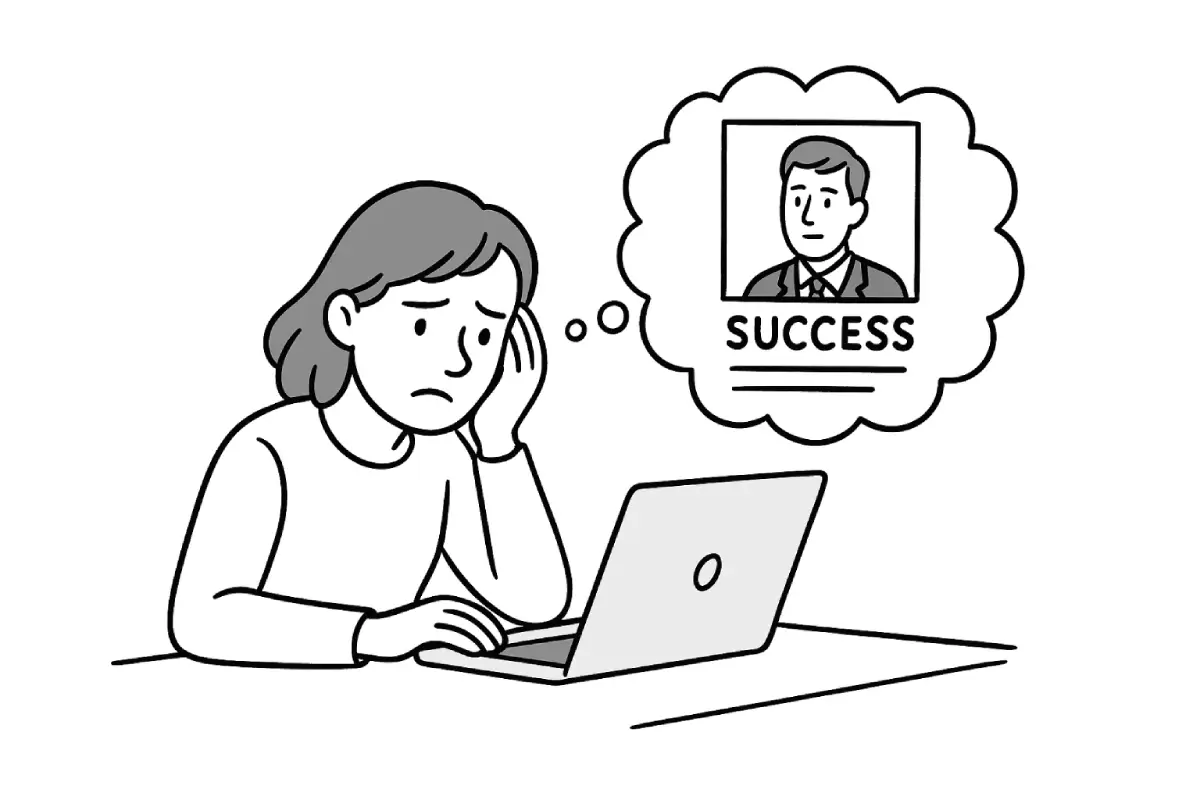
The certificate arrives with digital confetti.
Your name sits beneath a university logo, or perhaps the logo of a technology company whose market capitalization exceeds the GDP of a respectable country. You download the PDF. You add it to LinkedIn. For ten minutes, the future appears administratively settled.
Then you apply for a job.
Nothing happens.
Employers do not hate online learning. The problem is simpler and less flattering: completing a course shows that you completed a course. It does not necessarily show that you can do the work.
The distinction is brutal. It is also useful.
A certificate records an educational event. Evidence records a capability. Employers hire for the second.
Running Jobicy means watching people translate themselves into the cramped dialect of hiring: titles, keywords, bullet points, badges. Online courses usually appear as ornaments. A small private Louvre of completed modules.
The employer, meanwhile, has a live problem.
The two sides rarely meet.
The Great Completion Illusion
Online education has perfected the psychology of progress. Lessons acquire checkmarks. Bars fill from left to right. Streaks reward attendance. The interface whispers that movement and mastery are close relatives.
Sometimes they are.
Sometimes you watched six hours of video at 1.5 speed while answering Slack messages and eating lunch.
The platform cannot know the difference. It can verify that you clicked, submitted, or passed an assessment. That has value. Yet the certificate hides the course’s difficulty, the depth of your attention, the outside work, and what you remember three weeks later.
It is a signal with a wide error margin.
The market knows this. It also wants the signal.
Coursera’s 2025 Micro-Credentials Impact Report, based on responses from more than 2,000 students and employers across six regions, reports that 96% of employers believe micro-credentials strengthen a job application. Ninety percent said they would consider paying credential holders a higher starting salary.
Those figures deserve attention. They also deserve an eyebrow.
Coursera sells micro-credentials. Its report is useful industry research, not a tablet carried down from Mount Sinai. The intellectually lazy response is either to repeat the percentages as gospel or dismiss them because the source has commercial interests. A better reading is narrower: employers appear increasingly receptive to recognized, job-aligned credentials, but receptivity is not unconditional trust.
That last word matters.
Employers Face a Verification Problem
Hiring has always relied on proxies: degrees, titles, famous companies, years of experience. Each offers information; each can deceive. Ten years of experience may mean ten years of growth—or one year repeated ten times with admirable stamina.
Skills-based hiring emerged, in part, because employers grew tired of worshipping these proxies while complaining about talent shortages. The OECD’s 2025 report on skills-first labor markets describes a shift toward evaluating what people can do rather than relying solely on degrees or employment histories. The World Economic Forum’s Future of Jobs Report 2025 adds urgency: employers expect 39% of workers’ core skills to change by 2030.
A five-year-old pedigree cannot answer a six-month-old technical problem.
Online courses fit this world neatly. They are faster than degrees, narrower in scope, and often tied to current tools. But their abundance creates a new verification burden. If millions of people can earn similar certificates, what separates the person who understood the material from the person who merely completed it?
Work does.
The Evidence Ladder
Not all proof carries equal weight. Seven certificates do not merge into one strong signal. This is credential confetti. It brightens the page and obscures the floor.
Consider the evidence ladder:
- Enrollment: You started.
- Completion: You finished.
- Assessment: You passed a test or graded assignment.
- Artifact: You built something that can be inspected.
- Application: You used the skill under real constraints.
- Outcome: The work changed a measurable result.
- External validation: A client, manager, user, reviewer, or public audience tested the work.
The certificate sits near the lower half. Your task is not to discard it. Your task is to climb.
Do not ask the certificate to carry evidence it was never designed to hold. Build the missing evidence yourself.
Convert the Course Into a Case
The conversion requires five moves. None involves collecting another badge.
1. Choose a problem an employer recognizes
Course projects often live in educational terrariums: clean data, explicit instructions, predictable outputs. Real work arrives with missing fields, contradictory requests, limited access, and a stakeholder who changes the deadline because someone important has booked a flight.
Start with a problem that resembles the target job.
If you studied data analytics, do not build another dashboard from the course’s sample retail file. Find a public dataset with gaps. Form a question. Explain your assumptions. Show how you cleaned the data and why the answer matters.
If you studied UX design, do not redesign a famous app merely because its logo will look handsome in your portfolio. Find a small service with a broken flow. Interview users. Map the friction. Test a revision.
If you studied project management, build a launch plan for a real community project, volunteer campaign, or small business initiative. Record scope changes. Track risk. Admit what slipped.
Employers recognize reality by its dents.
2. Produce an inspectable artifact
“Completed a Python course” asks for faith.
A repository asks for inspection.
Choose an artifact that fits the skill:
- a GitHub repository with a clear README;
- a dashboard with source notes and definitions;
- a campaign brief with audience, budget, assets, and results;
- a financial model with assumptions and scenario controls;
- a research memo that explains method and limitations;
- a process map with before-and-after steps;
- a recorded presentation with the supporting deck;
- a case study showing drafts, feedback, and revisions.
The hiring manager should understand the problem, your role, the method, and the result without conducting an archaeological excavation. A folder is storage. A case study is an argument.
3. Document the constraints
Write down:
- what information you lacked;
- which assumptions you made;
- what alternatives you rejected;
- which trade-offs shaped the decision;
- what failed during the first attempt;
- what you would change with more time or data.
Professional work makes the reasoning visible.
Anyone can display a clean chart. A competent analyst explains why the chart excludes three months of corrupted data and how that choice changes the conclusion. Anyone can post a polished interface. A competent designer explains which user behavior forced the second iteration.
The scar is part of the evidence.
4. Introduce external friction
Self-assessment is a lenient court. Ask someone else to test the work: a practitioner, user, nonprofit, small business owner, open-source maintainer, or peer who can object with precision.
External friction might include:
- a code review;
- user testing with five participants;
- feedback from a working specialist;
- a public pull request;
- a volunteer client’s acceptance;
- an independent benchmark;
- a presentation followed by hostile questions—the useful kind.
Record the feedback. Revise the artifact. State what changed.
Trust grows when evidence survives contact with another mind.
5. Attach an outcome
The outcome need not be revenue. Early-career candidates sometimes invent heroic percentages because career advice has taught them that every bullet must contain a number, preferably one large enough to alarm the finance department.
Do not manufacture precision.
Use outcomes you can defend:
- reduced a process from 14 steps to nine;
- found 312 duplicate records in a public dataset;
- improved task completion in user testing from three of five participants to five of five;
- gained 28 active users;
- merged a contribution into an open-source project;
- delivered a volunteer campaign on schedule;
- cut report preparation from two hours to 25 minutes.
If the project produced no external result, report scope: records analyzed, interviews completed, scenarios modeled, test cases passed. Scope is weaker than impact, but honesty is stronger than fiction.
Make the Evidence Visible
Evidence locked in a laptop has little labor-market value.
A randomized study by Stanford researchers Susan Athey and Emil Palikot examined more than 800,000 learners who had completed technology or business courses. In the updated 2025 paper on non-traditional credentials, a feature that encouraged and simplified credential sharing increased visibility; among LinkedIn-matched learners, the intervention also improved reported employment outcomes, with larger effects among people who began with lower employability.
This finding is more subtle than “post certificates and get hired.” The intervention made a signal easier to see. Visibility helped. Yet a visible credential still needs context.
On your résumé, replace this:
Google Data Analytics Certificate, 2026
With this:
Google Data Analytics Certificate, 2026 — Applied SQL and Tableau to analyze 180,000 public transit records; built a delay dashboard, documented missing-data rules, and presented three scheduling recommendations.
The first line names the education. The second connects it to work.
On LinkedIn, add the credential to Licenses & Certifications, then feature the artifact separately. In a portfolio, write a short case study. In an interview, prepare a two-minute account of the problem, the false start, the decision, and the result.
One course can generate four assets:
- a credential;
- a project;
- a résumé bullet;
- an interview story.
Most learners stop after the cheapest one.
Borrow Standards, Not Prestige
Some credentials carry more weight because the issuer is known, the assessment is controlled, or the skill maps closely to a profession. Even then, recognition is not proof of range. It shows that you met the exam’s standard. Useful. Limited.
For less recognized courses, borrow credibility from transparent standards:
- state the assessment method;
- link to the syllabus;
- name the tools used;
- publish the rubric;
- show version history;
- disclose collaborators;
- distinguish course instructions from your own decisions.
Transparency is the poor candidate’s prestige. It works surprisingly well.
Stop Collecting. Start Converting.
The online learning market benefits when you remain slightly unfinished. There is always an advanced course, a specialization, a professional certificate, then another certificate explaining the framework introduced in the first certificate. Sisyphus had a boulder. We have subscription renewals.
Learning, of course, should continue. The OECD’s Skills Outlook 2025 makes a serious case for lifelong skill development in economies shaped by technological change and unequal access to opportunity. But learning and purchasing instruction are not synonyms.
Before enrolling again, ask:
- Which employer problem will this help me solve?
- What artifact will exist when I finish?
- Who will inspect or use it?
- Which outcome can I record?
- Where will the evidence appear?
If you cannot answer, perhaps you need the course for curiosity. That is a legitimate reason. Not every act of education must kneel before employability.
Just do not confuse private enrichment with professional proof.
What Employers Actually Trust
NACE’s Job Outlook 2026 research asked employers how candidates should demonstrate skills during skills-based hiring. Their leading advice was plain: share examples of situations in which you used skills to solve problems. Employers also stressed experiential learning and the ability to connect coursework with professional capabilities.
There it is. Not a war between courses and experience, but a bridge.
The course gives you vocabulary, structure, and a controlled place to fail. The project turns knowledge into behavior. External review tests the behavior. The outcome gives the employer something to judge.
Certificates can open a door. They cannot walk through it.
So the next time digital confetti falls across your screen, enjoy it. Then close the celebration, open a blank document, and ask the only question the labor market eventually asks of every form of education:
What can you show me now that you could not show me before?
 About the author Yuri Ko
Hi 👋🏼 I’m Yuri, founder of Jobicy — a global platform for remote jobs and digital careers. I’ve spent years building hiring tools, career resources, and supporting distributed teams. My mission is to make remote work accessible, transparent, and human-centered. Through my articles and products, I share honest, actionable insights to help people grow their careers and help companies succeed in the modern work environment.