
In this article
A company offers unlimited vacation, but nobody can explain how employees take two uninterrupted weeks away. Another promotes a wellness subscription while expecting answers late at night. A third celebrates its employee discount, which becomes useful only after employees spend their own money.
These examples describe possible arrangements, not claims about specific employers. What connects them is more useful than the familiar joke about pizza parties: A bad job perk does not merely fail to impress. It distracts from a working condition, financial cost, or missing protection that matters more.
The question is not whether free lunches, social events, branded gifts, or meditation apps are inherently ridiculous. Some employees genuinely enjoy them. The question is whether a benefit improves your actual working life or simply gives the employer an attractive answer when someone asks what employees receive.
A long benefits list can hide a short list of usable benefits
The first problem is that “offered” and “usable” are different things.
In its March 2025 employee benefits data, the U.S. Bureau of Labor Statistics reported that 72% of private-industry workers had access to employer-sponsored medical care plans, while 45% participated.
That difference does not mean every nonparticipant rejected a bad plan. Workers may have coverage elsewhere or decide a particular option does not fit their circumstances. But it does show why the sentence “we offer health insurance” leaves important questions unanswered.
The BLS definitions of access and participation distinguish between a benefit being available and an employee actually enrolling or using it. A plan can exist while its premiums, eligibility conditions, waiting periods, coverage limitations, or practical administration make it less valuable to a particular worker.
This distinction applies beyond insurance. An education budget that nobody can get approved, flexible working hours that managers quietly discourage, and paid leave that collapses whenever deadlines arrive can all appear impressive in a recruitment document.
Their value depends on what happens after someone tries to use them.
The worst perks usually replace something more important
The problem is not a specific object. A company-paid lunch can be a thoughtful convenience when compensation is fair, work is manageable, and participation is optional. The same lunch becomes a poor substitute when it appears instead of adequate staffing, dependable breaks, or a meaningful response to employee concerns.
Consider the difference:
| Advertised perk | What might make it genuinely useful | What makes it a poor substitute |
|---|---|---|
| Free meals | They reduce an existing expense without extending the workday. | They become the reward for repeated overwork or discourage people from leaving. |
| Unlimited paid time off | Managers approve reasonable requests, arrange coverage, and take leave themselves. | No minimum exists, requests meet resistance, and employees cannot explain what is normal. |
| Wellness subscriptions | They supplement reasonable workloads, protected time, and accessible support. | They shift responsibility for chronic overload onto individual employees. |
| Employee discounts | They reduce the cost of something the employee already intended to buy. | They require unnecessary spending or mainly promote the employer’s products. |
| Professional development | Training connects to useful skills, includes time to learn, and has a transparent budget. | Access depends on vague approval or creates another unpaid obligation outside work. |
| Flexible schedules | Employees can actually influence when and where they work. | The employer can change shifts or demand availability while employees receive little control. |
| Team events | Attendance is optional, inclusive, and considerate of people’s schedules. | Social participation becomes an informal condition for visibility, belonging, or advancement. |
| Recognition programs | Appreciation accompanies fair pay, clear expectations, and meaningful opportunities. | Digital badges and applause replace compensation, staffing, or substantive feedback. |
None of these examples proves a particular employer behaves badly. They are assessment criteria. The same benefit can be excellent, useless, or actively inconvenient depending on how it operates.
Unlimited vacation is only generous when employees can actually leave
An unlimited vacation policy sounds better than a fixed allowance because the headline contains no upper limit. The missing information is whether the policy provides a reliable lower floor.
Without a stated minimum, the practical allowance may depend on manager approval, team staffing, project deadlines, and whether employees feel safe disconnecting. A written policy can look expansive while its everyday use remains narrow.
For context, BLS data on paid vacation allowances report an average of 11 vacation days after one year of service and 15 after five years for private-industry workers with qualifying vacation benefits, using March 2025 data. Those figures are U.S. benchmarks, not legal minimums and not a measure of how much leave a specific employee ultimately takes.
When an employer advertises unlimited time off, ask questions that move beyond the slogan:
- How many vacation days did people on this team actually take last year?
- What is the process for approving two consecutive weeks away?
- Who covers essential work while someone is out?
- Are employees expected to check messages during vacation?
- Do managers take time off themselves?
- Is there a recommended minimum, and what happens when someone consistently takes less?
The counterexample matters: Unlimited leave can work well when a team plans coverage, managers model taking time away, and employees face no penalty for using it. A fixed allowance can be worse if it is too small or difficult to access. The useful comparison is actual time away, not the policy’s marketing language.
A wellness app cannot redesign an unreasonable job
Wellness programs are not automatically empty. Counseling resources, exercise reimbursements, or meditation tools can be helpful when they are accessible, private, optional, and paired with sensible working conditions.
They become inadequate when an employer offers individual coping tools while leaving the underlying source of strain untouched.
The National Institute for Occupational Safety and Health’s workplace hierarchy of controls prioritizes removing harmful working conditions, improving organizational practices, and redesigning work before relying on education or individual behavior-change programs.
Its example for work-related stress begins with addressing root causes such as excessive demands and giving workers greater flexibility and control. Individual resilience training and employee assistance programs appear later in the sequence.
That ordering changes how to evaluate an employer’s promise. A subscription to a breathing app may be worthwhile. It is not equivalent to enough staff, clear priorities, realistic deadlines, or permission to stop working at the end of the day.
Ask what the employer changed about the job itself, not only what it purchased for employees to manage the job.
Flexibility is weak when only the employer controls it
“Flexible” can mean the freedom to schedule work around caregiving, appointments, transportation, or periods of uninterrupted concentration. It can also mean the employer wants someone available whenever staffing needs change.
Those arrangements are not interchangeable.
For remote employees, the distinction can be especially sharp. Working from home may remove a commute without improving schedule control if the employee must attend meetings across multiple time zones, respond immediately throughout the day, or remain available outside agreed hours.
An office-based worker with dependable scheduling and control over start times may have more practical flexibility than a remote worker whose calendar is managed minute by minute.
Clarify the operating details before assigning value to the perk:
- Who sets the schedule?
- How much advance notice do changes require?
- Are there mandatory overlap hours?
- Can employees decline meetings outside their normal workday?
- Is remote work written into the agreement or left to managerial discretion?
- Does “work from anywhere” actually mean anywhere, or only approved locations?
Location, employment classification, customer requirements, and local rules can all change the answer. A promise that depends on conditions nobody will explain is not yet a benefit you can reasonably count on.
Some perks become less useful precisely when workers need them most
Benefits can look universal in a company presentation while applying unevenly across the workforce.
In March 2025 BLS comparisons of private-industry workers, healthcare benefits were available to 87% of full-time employees and 27% of part-time employees. Paid sick leave access was 88% for full-time employees and 56% for part-time employees.
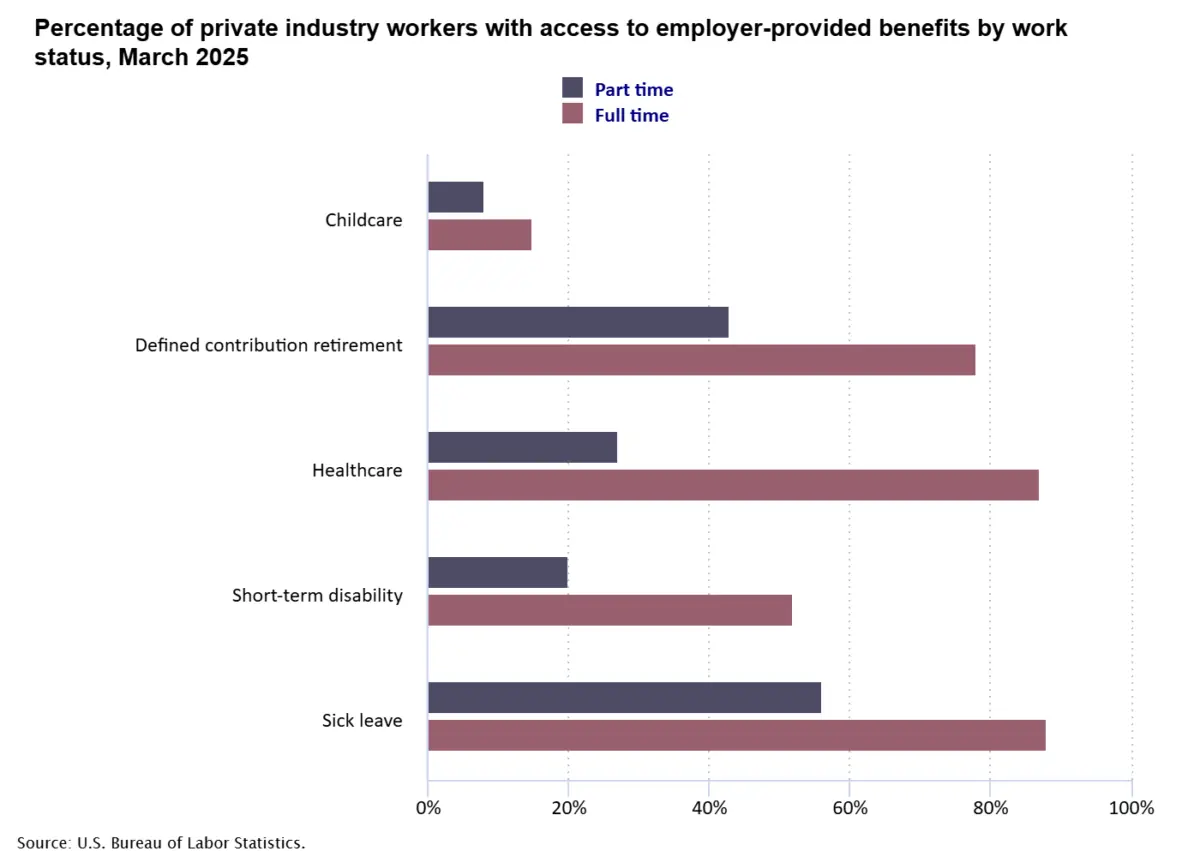
Those are U.S. survey estimates, not predictions about an individual employer. They illustrate why eligibility matters as much as the list of available programs.
A perk may also lose value because of practical exclusions:
- An office gym does little for a remote employee in another country.
- An evening social event may be inaccessible to someone with caregiving responsibilities.
- A commuter subsidy may be irrelevant to an employee working from home.
- A home-office allowance may provide little help if it excludes necessary equipment.
- A learning budget may be unusable when it requires approval that never arrives.
- A company discount may be irrelevant if the products are outside an employee’s normal budget.
This does not make every narrowly targeted benefit unfair or useless. It means the worker needs to know whether the offer applies to their role, location, employment status, and actual circumstances.
The employer’s cost is not automatically your benefit
An employer may spend a meaningful amount on benefits while individual employees receive very different value from the package.
The BLS report on employer compensation costs for March 2026 estimated that benefits represented 30.1% of average total compensation costs for U.S. private-industry workers. That measure describes employer expenditure, not the cash value an individual employee can withdraw or the usefulness of every benefit to a particular household.
A retirement contribution you can receive, a healthcare plan you can afford to use, or paid leave you can actually take may be valuable. A benefit with a large advertised price can be less meaningful if you are ineligible, cannot use it, or would never have purchased it independently.
Composite scenario: One employer advertises a generous annual wellness allowance, an office lunch program, and frequent social events. Another offers fewer visible extras but provides a clear medical-plan summary, predictable working hours, documented paid leave, and an employer retirement contribution.
The first offer may still be better if its salary is higher and the employee values those extras. But for a remote worker managing caregiving duties, the second package may produce more practical security even though it looks less entertaining in a recruitment presentation.
The comparison changes with geography, household needs, existing insurance, financial position, schedule constraints, and whether a benefit is guaranteed. There is no universal ranking that makes a free lunch worthless or a retirement plan equally valuable to everyone.
For a broader comparison, use a structured framework for evaluating job offers instead of counting the number of perks listed.
What this changes for you when evaluating a job offer
Treat every advertised benefit as a claim that needs four answers: Who can use it, what does it cost, who controls access, and what happens when someone actually tries?
Before accepting an offer, ask for the written details of the benefits that matter most to your situation:
- Confirm eligibility for your employment classification, hours, location, and start date.
- Identify required employee contributions, reimbursement limits, approval conditions, and waiting periods.
- Ask how the team uses vacation, remote work, flexible scheduling, and training in practice.
- Clarify which benefits are contractual, which are discretionary, and which the employer can change.
- Compare guaranteed pay and meaningful protections before assigning value to optional extras.
- Check whether using a benefit creates an additional obligation, such as after-hours participation or unnecessary purchases.
You can ask without sounding adversarial:
“The benefits package sounds promising. Could you share the written details on eligibility, employee costs, time-off expectations, and how the team typically uses the flexible-work policy? I’m trying to understand which benefits would apply to my role in practice.”
If you already work at the company, make the issue specific rather than dismissing every perk:
“The wellness allowance is appreciated, but the bigger issue for our team is unpredictable evening work. Could we discuss clearer coverage expectations and a more consistent end to the workday?”
Employers face budget limits, and not every small company can offer the same package as a large organization. A modest perk can still be thoughtful when its purpose is honest and the basics are handled responsibly.
For managers reviewing their own programs, the better question is whether pay and benefits reflect what employees actually need, rather than what produces the most impressive recruiting slide.
The worst perk is not necessarily the cheapest, strangest, or most visible one. It is the one that asks you to mistake a decorative extra for pay, usable time, meaningful flexibility, or genuine protection. Before assigning it any value, ask what would change in an ordinary working week if the perk disappeared. If the honest answer is “almost nothing,” examine what the employer is hoping you will overlook.
 About the author Matt Semon
Career Writer · AI Hiring Trends · USA I’m Matt, a writer and researcher focused on how hiring is evolving in the age of AI. I’ve been following trends in recruitment, automation, and remote work since 2018. When I’m not writing deep-dive articles for Jobicy, I’m testing AI tools to see how they impact candidates and hiring teams.