
In this article
The mechanics of the modern remote job hunt have fundamentally broken down. What used to be a straightforward negotiation between a professional and a hiring manager has transformed into a high-stakes asymmetrical battlefield.
Savvy knowledge workers know to look for misspelled emails or requests for upfront check deposits. However, criminal syndicates have quietly evolved past these crude methods, shifting toward a highly sophisticated corporate theater designed to deceive experienced mid-career professionals.
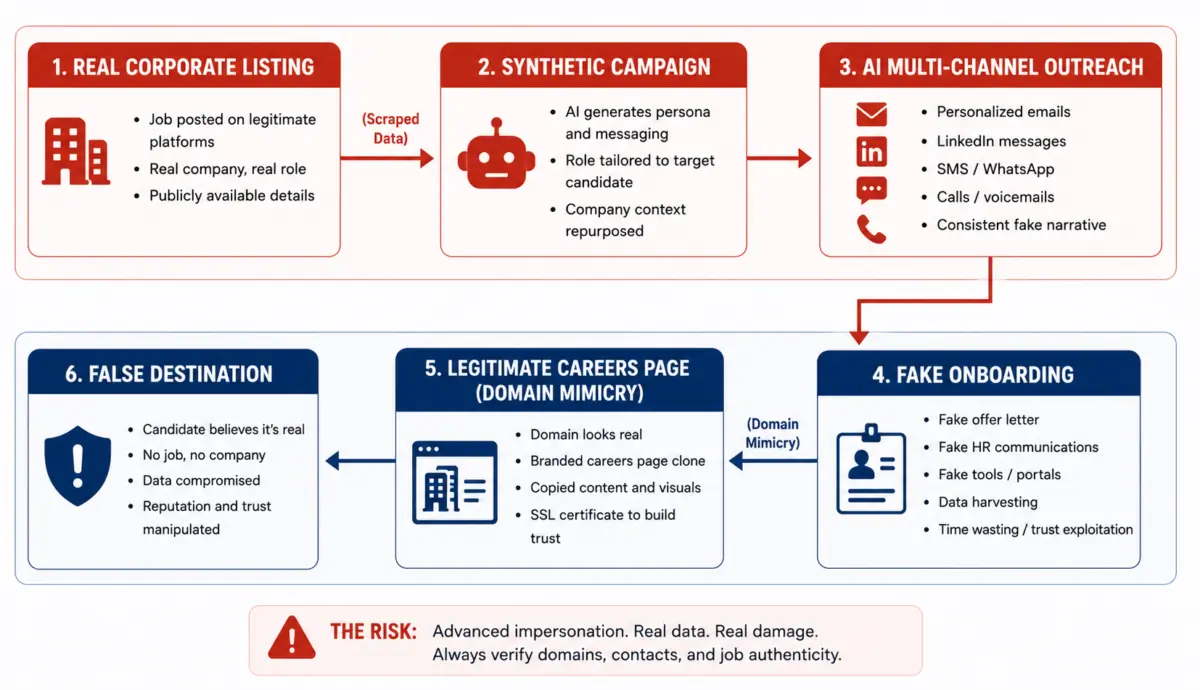
This evolution is driven by automated data harvesting and open-source corporate intelligence. Syndicates no longer target low-wage, entry-level workers with generic “work from home” data entry ads. Instead, they scrape real active listings from elite technology, financial, and healthcare firms to construct incredibly accurate mirror campaigns.
A report by Heimdal Security analyzing over 2,600 job scams revealed that the finance industry represents 35.45% of targeted job scams, closely followed by the IT sector at 30.43%. Surprisingly, managerial roles are targeted most frequently at 35%, highlighting how malicious actors prioritize high-value targets over entry-level positions.
The scam begins when a candidate receives a highly personalized LinkedIn message or email from an enterprise recruiter whose name matches an actual employee at a major corporation. The message references precise details from the candidate’s portfolio, GitHub repository, or recent professional updates.
The domain used by the recruiter is a near-perfect optical match to the real company. It might use a subtle typosquatting variation, an alternate top-level domain like .co or .work, or a clever subdomain architecture.
The Core Vectors of Enterprise Fraud
To navigate this landscape safely, you need to understand the mechanics of the three most dangerous enterprise-grade remote employment frauds currently targeting skilled knowledge workers.
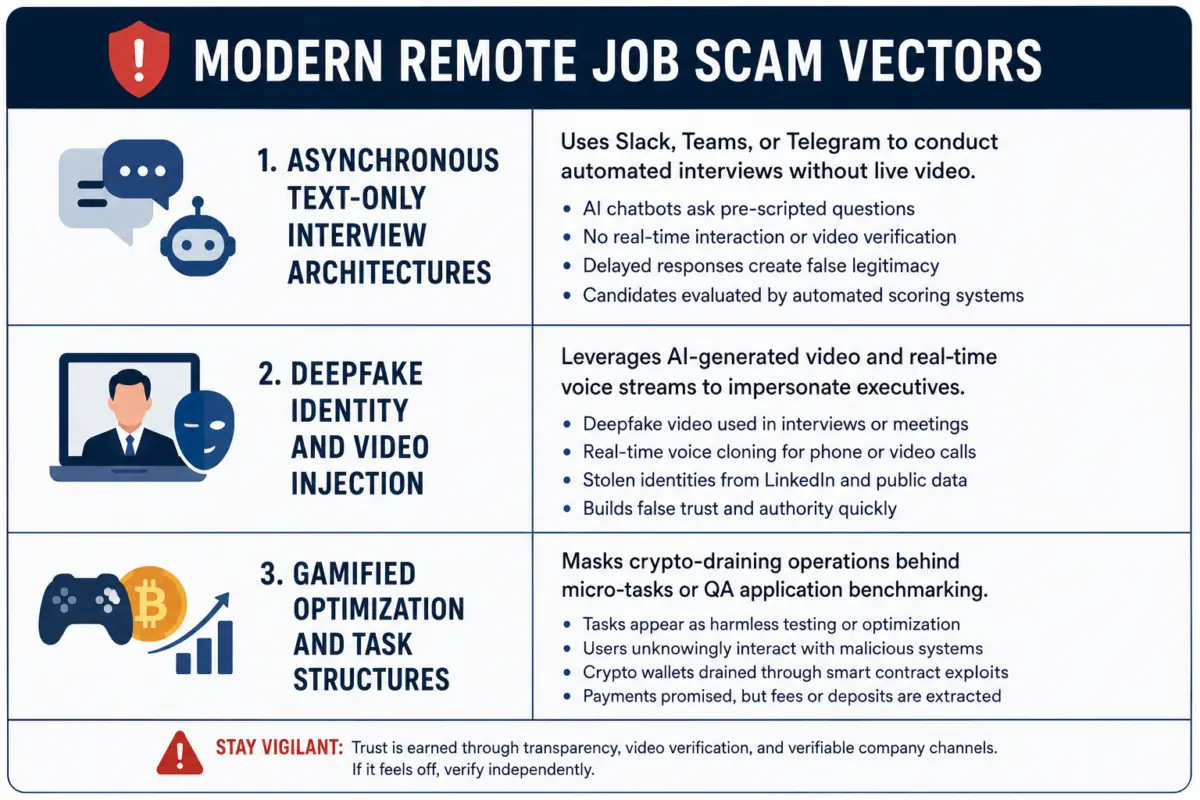
1. Asynchronous Text-Only Interview Architectures
Malicious operations increasingly isolate candidates by routing the entire hiring conversation through text-based platforms. They typically insist on using Slack, Microsoft Teams, or Signal, claiming corporate security policies or regional time-zone mismatches prevent a live face-to-face sync.
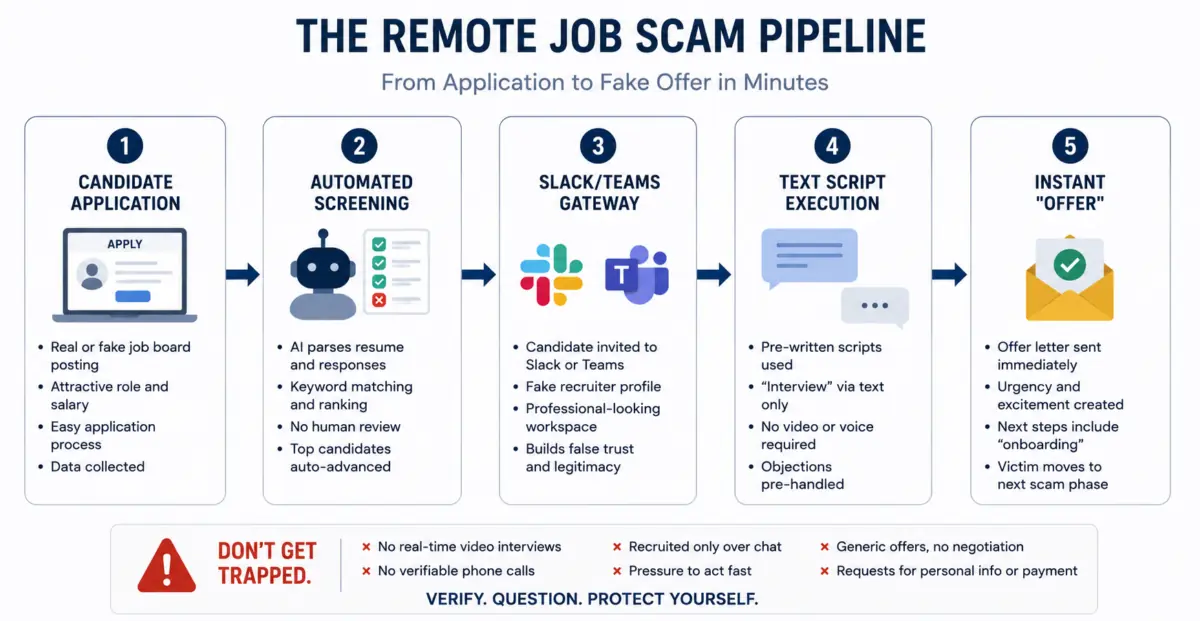
The operation uses a carefully designed sequence of highly technical, pre-scripted questions that look identical to a legitimate take-home evaluation. The candidate spends hours crafting exhaustive architectural overviews or code samples, which builds cognitive investment and creates a false sense of security.
The trap snaps shut once the candidate receives an unusually rapid, formal offer letter complete with forged corporate seals and authentic executive signatures. The new hire is then introduced to an automated onboarding portal.
Before the first official onboarding meeting occurs, the portal requires the candidate to input their direct deposit details, a photo of their passport, and a Social Security number.
Real-World Indicator: Legitimate organizations rarely skip face-to-face video syncs for specialized knowledge work roles. If an interview pipeline operates entirely through text or an automated messaging workspace, treat the opportunity as highly suspect.
2. Deepfake Identity and Video Injection
The widespread availability of high-fidelity generative video tools has made real-time identity spoofing accessible to any criminal enterprise. Fraud syndicates regularly scrape public video keynotes, podcast interviews, and social media clips of real corporate executives to build highly accurate synthetic identities.
The FBI Internet Crime Complaint Center (IC3) Annual Report highlights a major increase in cyber-enabled fraud losses, noting that AI-related complaints account for nearly $900 million in damages. Scammers frequently deploy fake social profiles, voice clones, and believable videos to pressure victims into compliant behavior.
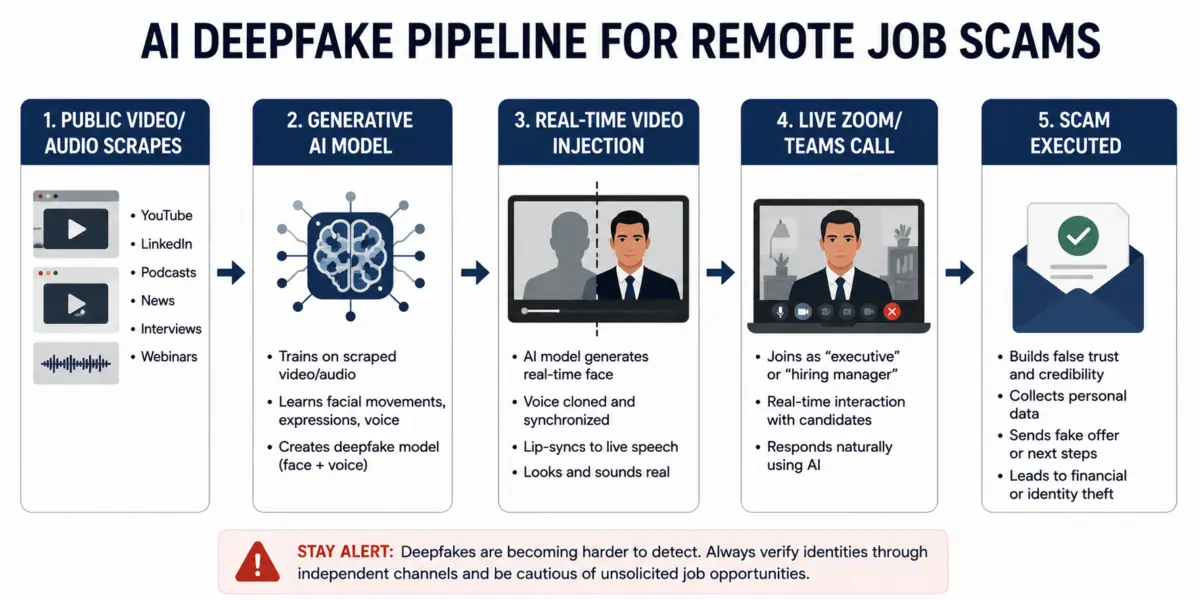
During a brief 10-minute video screening on Zoom or Teams, the scammer uses an AI video injection tool to overlay the real executive’s face and voice onto their own. The video stream may look slightly laggy, or the recruiter might blame a poor connection for occasional visual artifacts, blinking anomalies, or minor audio sync issues.
The interview is kept intentionally brief to minimize the risk of technical glitches breaking the illusion. The fake interviewer quickly passes the candidate along to a text-based “HR Coordinator” to finalize the hiring process, leaving the candidate completely convinced they just spoke with a real company leader.
3. Gamified Optimization and Task Structures
The fastest-growing segment of remote employment fraud completely bypasses standard corporate roles, leaning into decentralized app optimization and product-boosting schemes instead. These are often structured to look like legitimate remote QA engineering, software testing, or data curation positions.
According to a Federal Trade Commission data spotlight on job fraud, reported losses to employment scams topped $220 million in the first half of 2024 alone. This rapid increase was largely driven by gamified task scams, where malicious actors use crypto payments to run highly addictive “pay-to-get-paid” systems.
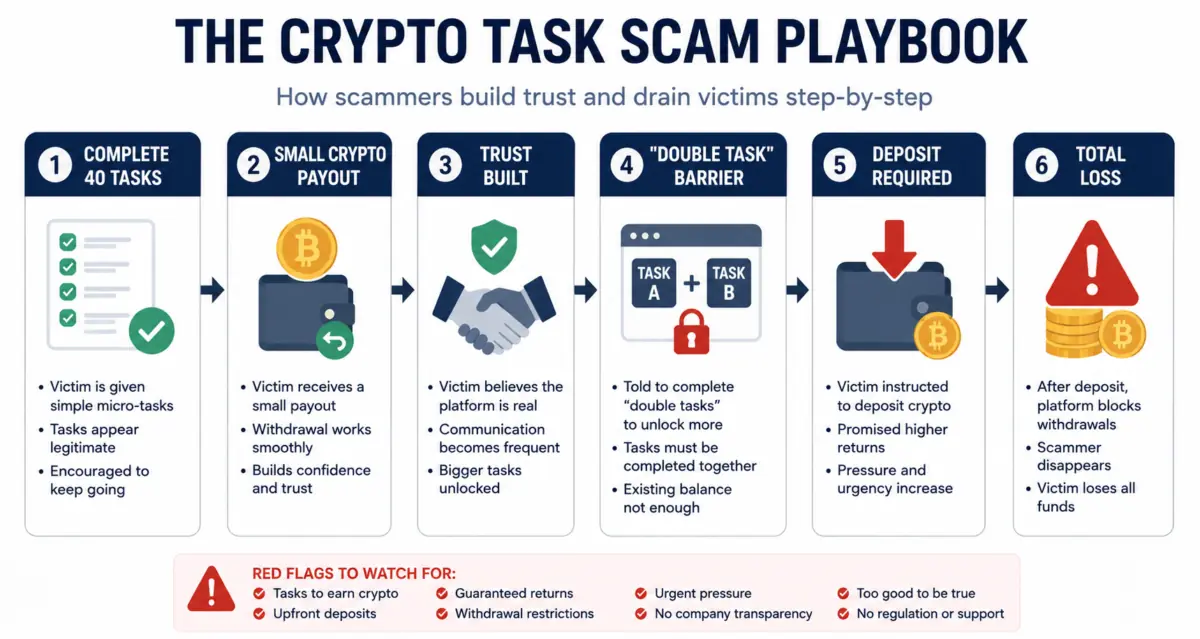
The candidate logs into a highly polished, custom-built web dashboard. Their assignments look straightforward: optimize app store rankings, run automated software benchmarks, or review structured product data in sets of 40 tasks.
To make the system feel real, early assignments yield small payouts in cryptocurrency or stablecoins that the user can actually withdraw to their personal wallet.
Once trust is established, the platform introduces a “double task” or a higher tier of system access. To unlock this next set of lucrative assignments, the worker must deposit their own funds into the platform, with the promise of receiving an immediate refund along with a large commission.
As soon as a significant deposit is made, the account is frozen under the guise of an “audit error,” and the scammers vanish with the funds.
Defensive Strategies for High-Value Job Seekers
Relying on standard verification tips like checking a company’s BBB rating is no longer enough. Protecting your identity and finances requires an active, technically rigorous verification protocol.
Verify Digital Infrastructure via DNS Data
Every legitimate corporate enterprise runs a tightly managed web infrastructure. You can easily spot domain spoofing by auditing public Domain Name System (DNS) records using free web tools like CentralOps or MXToolbox.
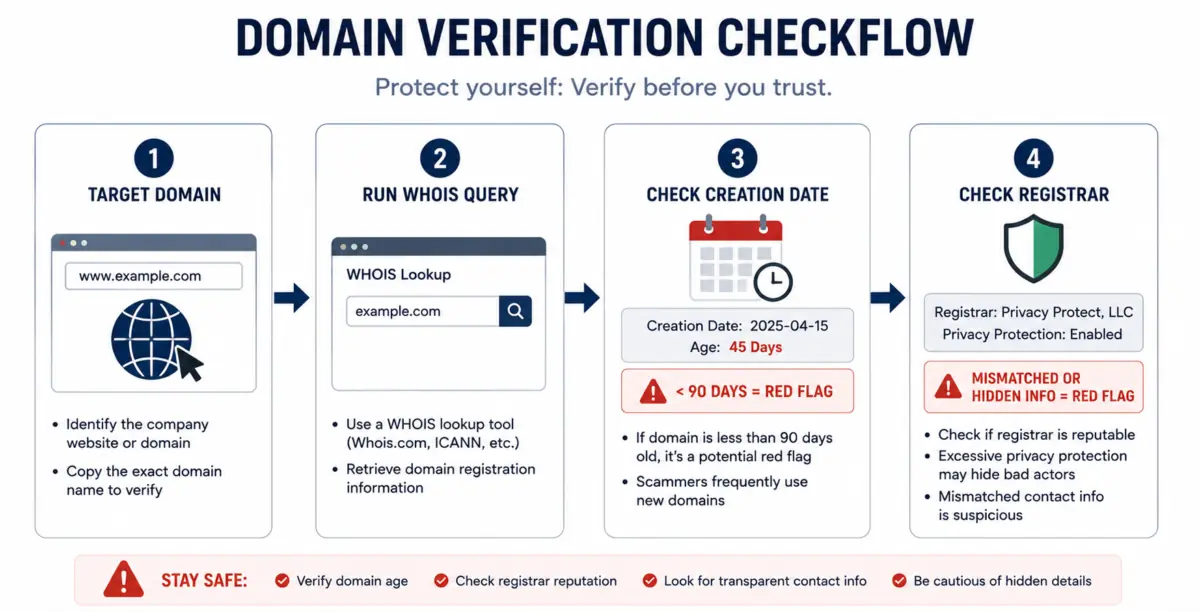
When you receive an email from an unexpected recruiter, copy the domain name after the @ symbol and run a quick WHOIS search to analyze its core registry data:
- Domain Creation Date: A multi-billion dollar enterprise will have a domain that was registered years or decades ago. If the domain was created within the last 90 days, it is almost certainly a disposable domain set up for a phishing campaign.
- Registrar and Security Certificates: Cross-check the domain registrar against the company’s primary corporate website. If the main site uses an enterprise security provider like Cloudflare but the recruiter’s domain is hosted on a cheap, anonymous consumer platform, exercise extreme caution.
- Mail Exchanger (MX) Records: Look closely at the domain’s MX records. Fraudulent domains often lack properly configured Sender Policy Framework (SPF) or DomainKeys Identified Mail (DKIM) signatures, causing emails to bypass enterprise security protocols.
Implement a Strict Off-Platform Verification Process
Never assume that an inbound message on LinkedIn, InMail, or Telegram is authentic, even if it appears to come from a verified profile. High-value professional accounts are compromised daily through session hijacking and credential stuffing attacks.
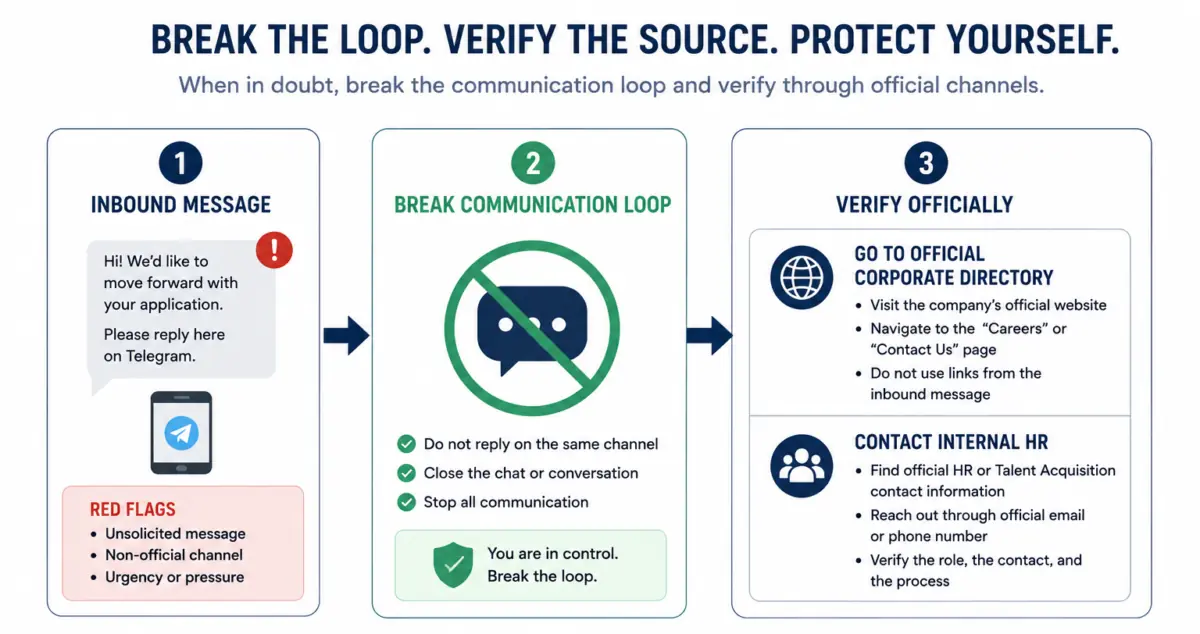
If an opportunity catches your eye, break the communication loop immediately. Do not click any links or use the contact info provided in the message.
Instead, open a clean browser tab, find the company’s official corporate directory, and route an inquiry directly to their internal HR or talent acquisition team.
Ask the internal team to verify whether the specific individual reaching out to you is an active employee, and confirm that the tracking ID for the job listing matches an open role in their applicant tracking system (ATS).
Audit Corporate Software and Onboarding Requirements
A genuine enterprise remote position will never require an incoming professional to purchase standard corporate tech out of pocket, nor will they send a check to fund an upfront equipment buy.
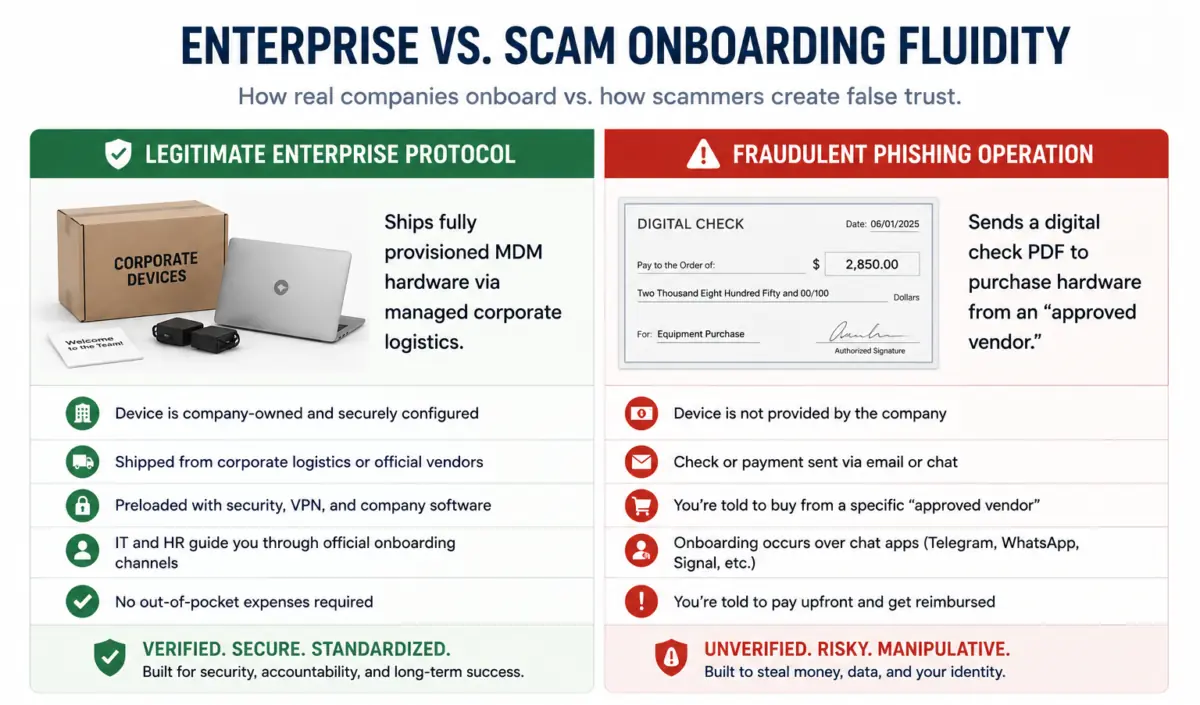
Legitimate distributed organizations use secure, enterprise-grade provisioning workflows. They handle logistics internally, shipping pre-configured, corporate-owned laptops equipped with Mobile Device Management (MDM) software like Jamf or Kandji directly to your address.
If an onboarding workflow sends you a digital check PDF to print out and deposit via your smartphone to buy gear from an “approved vendor,” stop immediately. This is a classic check fraud scheme. The bank will initially credit your account, but the check will bounce several days later, leaving you fully liable for any money wired to the fake vendor.
For verified opportunities, you can use specialized marketplaces like the Jobicy remote job board to find curated, legitimate remote positions that clear enterprise vetting standards before publication.
Tactical Red Flags
Keep this clear reference guide handy to quickly evaluate any remote job offers you receive:
- Communication Channels: The hiring manager insists on keeping all communications within text-only platforms like Telegram, Signal, or WhatsApp, and repeatedly avoids live video interviews.
- Domain Irregularities: The recruiter’s email address uses a subtle variation of the real company name (e.g.,
name@company-careers-hr.cominstead ofname@company.com). - Financial Requests: The onboarding process requires you to pay upfront fees for training, insurance, software licenses, or specialized tech equipment, with the promise of a future reimbursement.
- Unusual Urgency: The hiring team applies high-pressure tactics, demanding that you sign an employment agreement within hours to secure the position.
- Vague Responsibilities: The job description uses broad buzzwords like “data optimization” or “task boosting” without clearly explaining your daily responsibilities or performance metrics.
Restoring Balance to the Remote Talent Marketplace
The explosion of modern remote work has brought incredible career flexibility, but it has also allowed highly organized fraud networks to thrive. By understanding how these groups use domain mimicry, deepfakes, and artificial urgency, you can protect your personal data and professional reputation.
Relying on intuition alone is no longer enough to stay safe. To protect your career, you must verify the underlying infrastructure of every digital interaction, keep your communication channels secure, and thoroughly audit every stage of the interviewing process.
 About the author Joshua Ward
Startup Recruiter · Talent Advisor · UK Hey, I’m Josh — a recruiter-turned-writer based in London. I’ve helped build early teams at over 25 startups in the past 7 years, mostly in SaaS and fintech. Now I share insights about how small companies hire, what hiring managers really look for, and how to stand out in a noisy job market.