
In this article
The corporate landscape of 2026 is grappling with an irony: while remote and hybrid work models promised unprecedented personal agency, they have instead collapsed the boundaries between home and office. According to the Gallup State of the Global Workplace Report, 45% of fully remote employees report experiencing high daily stress, with overall workplace burnout rates hovering at a staggering 55%, as audited by Eagle Hill Consulting. The result is a quiet mass migration of highly skilled professionals stepping off the treadmill to preserve their sanity—a movement often referred to in recruitment circles as “job-dropping.”
Yet, when these same high-performers decide to step back into the market, they encounter a harsh reality. Despite the progressive rhetoric surrounding mental health advocacy on professional networks, the average hiring pipeline remains highly risk-averse. When I audited our company’s Employer of Record (EOR) contracts and consulted with executive search committees last year, one pattern stood out: automated talent acquisition screens are still systematically built to flag gaps.
To a machine learning model or an overworked recruiter, an unmanaged multi-month gap in employment history represents a lack of market validation. It triggers passive assumptions of performance issues, termination, or a lack of career momentum.
To successfully re-enter the market after a burnout-induced sabbatical, you cannot rely on corporate empathy. You must treat your career gap as a branding challenge that requires strategic positioning, rigorous narrative alignment, and flawless execution during the interview process.
This guide breaks down how to de-risk your profile, restructure your resume, and deliver verbal narratives that transform a period of intensive recovery into a compelling narrative of professional maturity.
Navigating the ATS: Sanitizing Your Gap for the Algorithms
Before a human ever hears your story, your resume must survive the cold, binary logic of Applicant Tracking Systems (ATS). Modern ATS suites do not care about your personal growth journey; they are looking for chronological consistency and keyword density.
If your work history contains a gaping void, the system may automatically down-score your profile, filing it away before a recruiter ever lays eyes on your achievements.
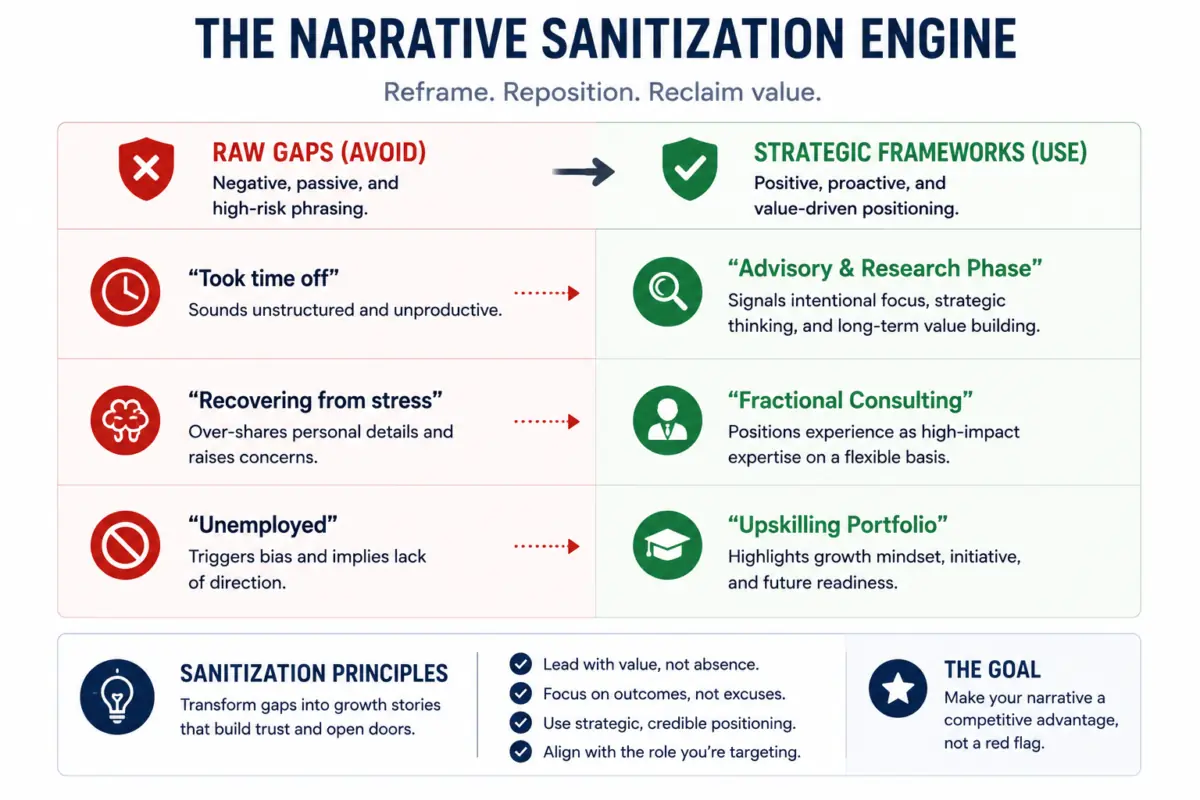
The Strategy of the Active Placeholder
To prevent automated systems from flagging your gap, you must give the system a record to parse. If your gap has exceeded four to six months, do not leave your current role as “Present” if you have already departed, nor should you leave a blank space at the top of your resume. Instead, insert an active, self-directed placeholder.
Label this block with terms that indicate intentionality and continuous engagement. Excellent choices include:
- Independent Consultant / Fractional Strategist
- Industry Research & Technical Upskilling
- Specialized Family Estate Management
Under this entry, treat your sabbatical with the same structural rigor as a corporate role. If you spent your time off studying new infrastructure-as-code patterns, learning a new programming language, or advising a colleague’s startup on their async workflows, detail those activities as discrete deliverables.
For example, a placeholder entry might read:
Strategic Consultant & Technical Researcher | Self-Employed | Oct 2025 – Present
- Conducted deep-dive evaluations of next-generation database clustering tools to maintain alignment with evolving enterprise backend standards.
- Provided fractional architectural advisory to early-stage SaaS ventures, optimizing their remote infrastructure and reducing cloud spend by 14%.
- Completed specialized certifications in advanced cloud-native architectures, managing a dedicated learning curriculum of 20+ hours per week.
By using this approach, you maintain chronological integrity. The ATS parses the dates, recognizes continuous activity, and keeps your score high enough to land on a human recruiter’s dashboard.
Functional vs. Hybrid Resume Formats
If you prefer not to use an active placeholder, you must pivot away from the traditional, hyper-strict reverse chronological resume format. Instead, adopt a hybrid format.
This layout places a comprehensive “Core Competencies & Key Achievements” section at the top of the first page. It highlights your technical mastery, leadership metrics, and domain expertise first, pushing your chronological employment history to the bottom or the second page.
When recruiters read a hybrid resume, their initial impression is shaped by your highest-value contributions, making them far more forgiving of a temporary gap in your timeline.
The Scripting Frameworks: What to Say, When, and to Whom
When you transition from the written resume to live conversations, consistency is your shield. The goal of your narrative is to convey that your time away from the market was an active, planned choice rather than an emergency exit.
In my work training recruitment teams, I advise them to watch for “defensive explaining”—long, winding justifications that signal insecurity. Your explanation must be crisp, professional, and delivered in under 90 seconds.
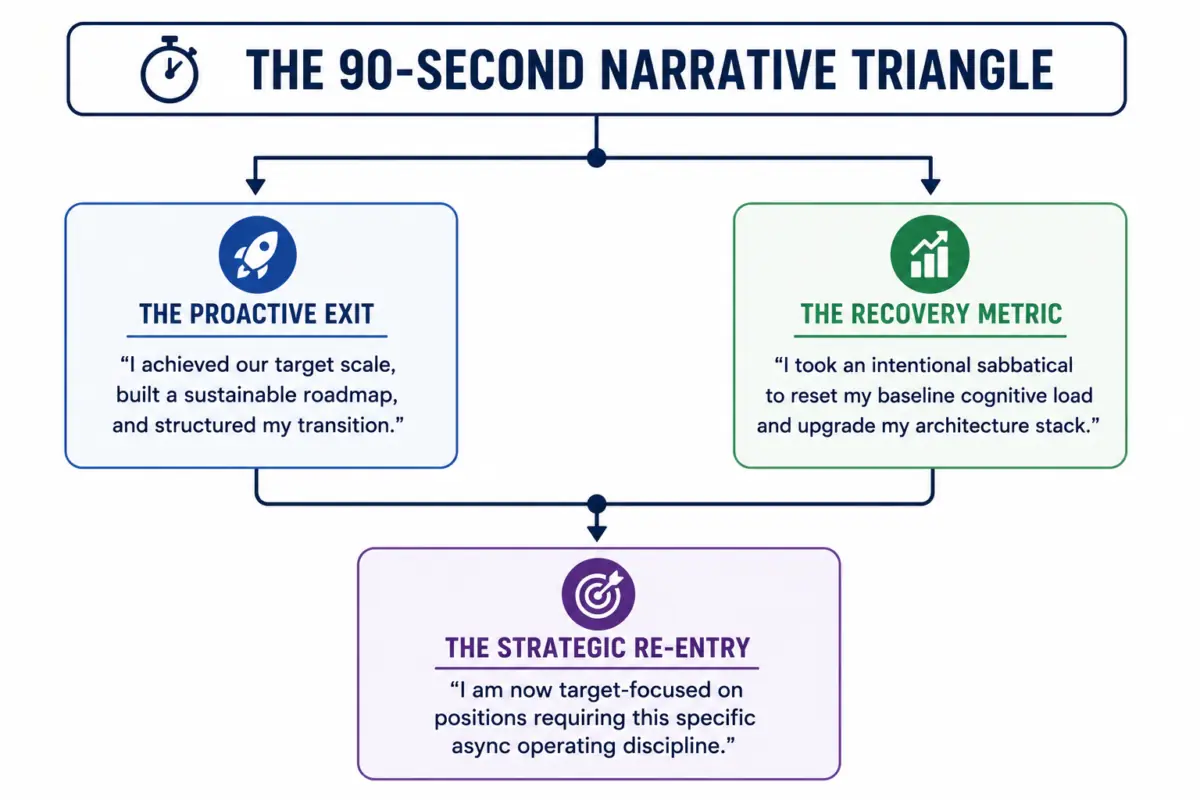
Script 1: The High-Performing Sabbatical
Best for: Directors, executives, and senior individual contributors who chose to exit a hyper-growth environment after hitting major milestones.
This script positions your exit as a planned, orderly transition following the completion of a major business objective. It reframes “burnout” as a logical point of reflection and renewal.
“At my previous company, my core mandate was to scale our remote engineering division from the ground up, which we successfully achieved by launching our core microservices architecture and stabilizing our offshore teams. After three years of high-intensity execution, I realized I had reached a natural transition point.
Rather than immediately jumping into another high-volume role, I made the deliberate decision to step back and take a structured sabbatical. I used this time to reset my baseline cognitive load, conduct independent research into emerging AI integrations, and spend time with my family.
I am now fully recharged, clinically focused, and looking for my next long-term partnership where I can apply this refined perspective.”
Script 2: The Fractional Pivot
Best for: Mid-to-senior professionals who engaged in light consulting,advising, or freelance work during their recovery phase.
This script highlights your continuous market relevance and frames your gap as a period of diversified professional growth.
“After delivering our Q3 product release cycle, I chose to transition out of my full-time operational role to explore fractional strategy work. I wanted to see how different remote organizations handle async communication and documentation bottlenecks.
Over the last several months, I’ve been advising two early-stage startups on their remote infrastructure and streamlining their project management pipelines. While this fractional consulting has been highly rewarding, it has also crystallized what I want next.
I missed the deep ownership and long-term impact of being embedded in a single, high-performing organization. That is precisely why I’m interviewing for this position today.”
Script 3: The Family / Wellness Reset
Best for: Professionals who experienced a severe, acute burnout episode or had to balance recovery with family care responsibilities.
This framework is direct, highly professional, and establishes clear boundaries without inviting intrusive follow-up questions. It uses precise, objective terminology.
“Following a highly demanding transition at my last organization, where I managed a rapid restructuring of our remote operations, I chose to take an intentional career break. I needed to address some pressing family health priorities and reset my own physical and mental baselines.
I approached this break with the same structured discipline I bring to my engineering projects. I put the necessary systems in place to ensure my family’s long-term stability and focused heavily on physical conditioning.
Those personal priorities are now completely resolved. I have 100% of my focus, stamina, and intellectual energy back, and I am ready to commit to this next chapter of growth.”
Overcoming the “Involuntary Exit” Bias
To win the offer, you must understand the psychology of the hiring manager sitting across from you. Many managers suffer from what industry surveys call “productivity paranoia”—a persistent fear that remote workers are disengaged or fragile.
If they suspect you left your last job because you simply “could not handle the pressure,” they will worry that you will break under their watch, too.
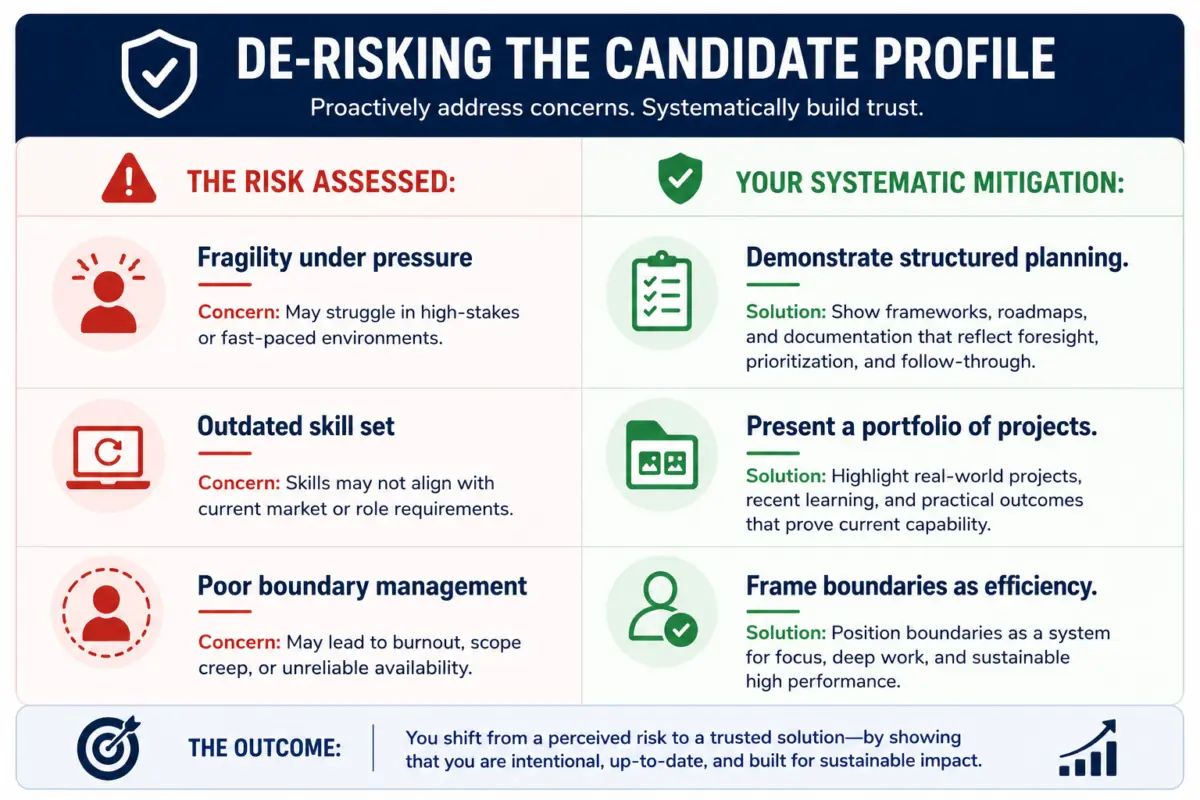
To de-risk your profile, you must show them that your burnout was not a failure of personal capability, but rather a structural mismatch that you have since diagnosed and corrected.
1. Own the Diagnosis of the Environment
Do not badmouth your previous employer. Instead, analyze the operational bottlenecks of your former company with the cold detachment of a consultant.
Identify the lack of asynchronous hygiene, the reliance on real-time messaging systems that created a continuous state of interruption, or the absence of clear documentation standards.
- Weak explanation: “The leadership was toxic, kept messaging me on Slack at midnight, and didn’t respect my weekends, so I had to quit.”
- Strong explanation: *”The organization lacked a mature documentation culture, leading to high-friction, synchronous collaboration patterns that inflated the collective meeting load to over 30 hours per week. This created significant operational inefficiencies and reduced our team’s deep work blocks.My focus now is on joining a company that prioritizes async-first communication protocols and values structured, written documentation.”*
This approach shifts the narrative. It moves the focus away from your personal tolerance for stress and toward your sophisticated understanding of organizational design and engineering efficiency.
2. Demonstrate Professional Safeguarding
Show the interviewer that you have built sustainable habits to prevent future burnout. Explain how you manage your cognitive energy, organize your workspace, and approach async workflows to protect your productivity.
Hiring managers respect candidates who know how to protect their own output. They want to hire adults who can manage their energy levels independently, especially in a distributed environment where direct oversight is minimal.
3. Show, Don’t Just Tell
If you claim to have spent your gap upskilling, present concrete proof. Share a link to a GitHub repository, an updated portfolio, or a brief case study outlining a project you researched during your sabbatical.
Providing evidence of self-directed work during your gap immediately refutes any suspicion of lethargy or professional regression.
Auditing Your Narrative: The Step-by-Step Back-to-Work Checklist
To ensure your re-entry strategy is coherent, professional, and highly effective, execute this pragmatic implementation checklist before submitting your next application.
Phase 1: Resume & Portfolio Alignment
- ☑️ Establish Chronological Continuity: Ensure your resume has no unmanaged gaps. Use a structured, self-directed placeholder (e.g., “Independent Consultant” or “Technical Researcher”) to fill any employment voids exceeding four months.
- ☑️ Audit Key Dates: Align your LinkedIn profile dates exactly with your resume. Discrepancies between these two platforms are an immediate red flag for recruitment teams.
- ☑️ Build a Proof Portfolio: Collect and document any code, advisory insights, certifications, or research papers generated during your sabbatical. Link to these directly from your resume.
- ☑️ Remove Emotional Language: Scan your resume and cover letters for defensive phrases like “Needed to escape a toxic culture” or “Took time off to find myself.” Replace them with professional, objective language focusing on strategic transitions and sabbaticals.
Phase 2: Strategic Positioning & Pitching
- ☑️ Refine Your 90-Second Story: Select one of the scripting frameworks provided above (Sabbatical, Fractional, or Wellness Reset) and customize it to your career trajectory.
- ☑️ Record and Review Your Delivery: Record yourself explaining your gap using your chosen script. Review the recording to ensure your tone is confident, direct, and free of defensive verbal cues.
- ☑️ Prepare Your Operational Analysis: Outline exactly why your previous company’s operational structure (e.g., lack of async communication standards, meeting fatigue) contributed to your exit. Be ready to explain this calmly and professionally without sounding bitter.
- ☑️ Define Your Boundary Strategy: Be prepared to explain how you manage your working hours, maintain focus blocks, and design your remote environment to ensure sustainable, high-impact performance.
Tactical Summary
Explaining a career gap due to burnout is not an exercise in confession; it is an exercise in strategic positioning. By structuring your resume to pass ATS screens, choosing a clear scripting framework, and showing a deep understanding of remote operational design, you can confidently control your narrative.
Career gaps aren’t the red flag they used to be – not when you’ve been intentional about how you spent that time. Handled well, a gap actually says something good about you: that you understand your own limits, know when to step back, and think long-term about your career instead of just grinding through burnout. That kind of self-awareness is exactly what employers want in someone they’re betting on for the long haul.
 About the author Joshua Ward
Startup Recruiter · Talent Advisor · UK Hey, I’m Josh — a recruiter-turned-writer based in London. I’ve helped build early teams at over 25 startups in the past 7 years, mostly in SaaS and fintech. Now I share insights about how small companies hire, what hiring managers really look for, and how to stand out in a noisy job market.