
In this article
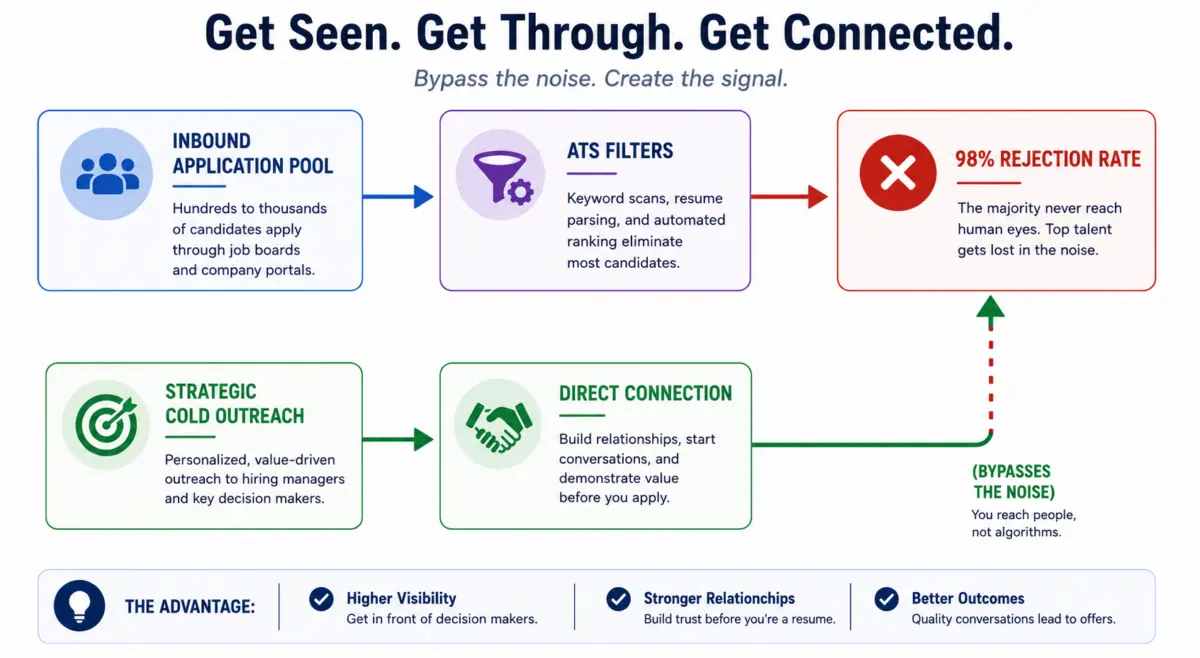
Every single second on LinkedIn, over 77 job applications are submitted. This creates a deafening wall of digital noise that modern talent acquisition teams must navigate daily. The standard response of the modern candidate is to lean heavily on volume: applying to dozens of open roles via “Easy Apply” buttons or sending generic, copy-pasted InMail templates to any user with “recruiter” in their job title.
The strategy does not work. This systemic inbound overload has forced internal human resource teams to build aggressive defensive barriers. They rely on automated applicant tracking systems (ATS) and strict keyword screening protocols to shield their calendars from underqualified candidates.
To secure a high-quality remote, hybrid, or enterprise role, you cannot rely on traditional inbound application funnels. You must go outbound. Doing so successfully requires abandoning the standard candidate script and adopting the psychological posture of a peer-level consultant.
Below is the exact methodology, structured around direct recruitment realities, to write cold LinkedIn messages that HR managers actually answer.
The Anatomy of Modern Talent Sourcing Fatigue
Internal corporate recruiters and HR business partners are exhausted. Having audited talent pipelines for remote-first scale-ups and Fortune 500 enterprises, I have seen the direct consequences of sourcing fatigue. The rapid integration of AI-assisted resume generation means that open roles frequently receive thousands of superficially polished applications within hours of publication.
Consequently, human resource teams are shifting their focus. Rather than sorting through an endless stack of passive inbound resumes, they prioritize targeted outbound sourcing and warm candidate interactions. According to Gem’s Recruiting Benchmarks Report, a sourced outbound candidate is five times more likely to be hired than an inbound applicant from a standard job board.
When you send a cold LinkedIn message, you step out of the unverified inbound pool and position yourself as a proactive outbound candidate. If your message resembles the generic, automated spam that clutters their inboxes, it will be deleted instantly.
Modern HR managers spot templated outreach immediately. Messages that begin with “Dear Hiring Manager, I hope this message finds you well” or “I am highly interested in your open role and believe my diverse background makes me a perfect fit” trigger cognitive alarms. They tell the recipient that you are executing a low-effort mass blast.
To cut through this fatigue, your outreach must be highly specific, culturally aligned, and focused on reducing the recruiter’s current workload rather than increasing it.
The Psychology of the Decision Maker: HR vs. Talent Acquisition vs. Hiring Manager
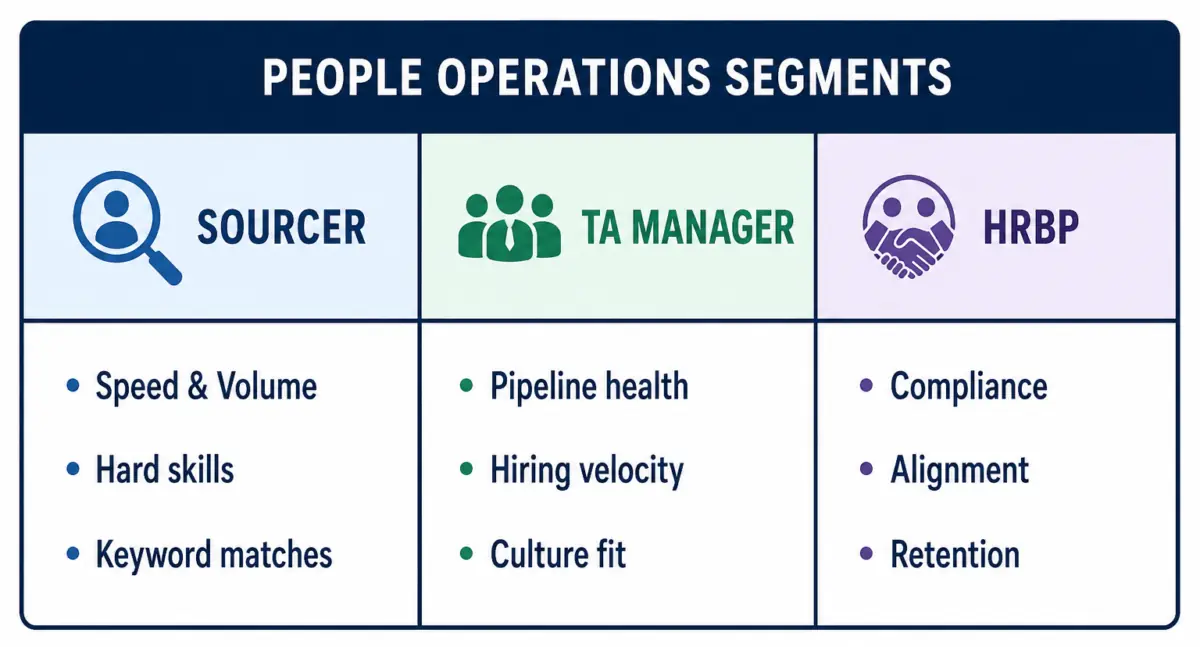
Before typing a single character, you must understand who you are messaging. Targeting anyone in the human resources department with the exact same copy-paste message is a common, costly error. The internal structures of modern people operations are highly segmented, and each persona values entirely different metrics.
The Sourcing Recruiter
Sourcing recruiters are transactional. They are evaluated on pipeline speed, volume, and exact keyword matches. Their main worry is locating qualified prospects to pass along to talent acquisition managers.
When messaging a sourcer, lead with direct, objective proofs of capability: your core tech stack, your key technical certifications, or your experience in a highly specific niche. They want to see that you meet their exact screening checklist.
The Talent Acquisition (TA) Manager
TA managers own the broader recruitment strategy and maintain a close connection with hiring managers. They care about pipeline health, hiring velocity, and team dynamics.
A message to a TA manager should highlight organizational context. It must show an understanding of their team’s specific growth stage, business challenges, or recent shifts in their target market.
The HR Business Partner (HRBP) or VP of People
HRBPs and executive people leaders rarely handle active resume screening. Instead, they focus on structural compliance frameworks, workforce planning, overall employee retention, and specialized workforce strategies like stipend optimization.
When communicating with an HRBP, frame yourself as a strategic resource. Your message should emphasize your experience with async workflows, managing distributed team architectures, or leading complex cross-functional initiatives.
The Pre-Message Protocol: Three-Step Strategic Preparation
A brilliant message sent from a lackluster profile will fail. When an HR manager opens your message, they will immediately hover over your profile photo to view your mini-card and click through to your full page. Your profile serves as the landing page for your outbound campaign; if it does not convert, your outreach is useless.
Step 1: Optimize the Profile (The Landing Page)
Data indicates that candidates with fully completed, strategic LinkedIn profiles have a 71% higher chance of securing an interview. Your profile must change from a passive resume database into a dynamic, proof-backed sales page.
- The Headline: Ditch generic titles like “Experienced Project Manager.” Instead, use a formula that combines your function, specialty, and environment:
[Function] | [Specialty/Core Metric] | [Target Context]. For example: “Remote Infrastructure Architect | Scaling Async Engineering Teams from 10 to 100 | Kubernetes & AWS Specialists”. - The “About” Section: Start with a strong statement of your professional focus. Detail the specific organizational problems you resolve, the technical environments you manage, and the exact business outcomes you deliver.
- The Experience Section: Avoid dry bullet points that read like an internal HR handbook. Frame your history around challenges overcome, metrics improved, and specific tools used. Use active language to describe how you built, led, or optimized various systems.
Step 2: Identify High-Value “Trigger Events”
Do not reach out to organizations at random. Focus your efforts on companies experiencing “trigger events”—specific business developments that signal a sudden need for external talent.
- Recent Funding Rounds: Series A or B funding announcements indicate that a company must scale its head count quickly to hit aggressive milestones.
- Executive Leadership Transitions: A newly appointed VP of Product or Chief Marketing Officer will typically rebuild their departments, bringing in trusted, highly competent specialists.
- Public Pain Points: Watch for posts from company leaders discussing complex operational challenges, system migrations, or new market expansions. These public updates provide a perfect, natural entry point for targeted outreach.
Step 3: Identify the Warmest Path to Connection
Before sending a completely cold message, check for mutual connection paths. This step can significantly increase your response rates.
- Niche Community Connections: Check if you share membership in specialized professional groups, Slack teams, or local industry chapters.
- Mutual Connections: See if a shared contact can provide a brief, warm introduction.
- Content Engagement: Spend three to four days engaging with your target’s public posts by leaving insightful, professional comments before sending a direct connection request.
Core Architecture of a High-Conversion Cold Message
A high-performing cold LinkedIn message is built on structured, persuasive copywriting principles. Every sentence must serve a distinct purpose, guiding the reader toward a specific, low-friction next step.
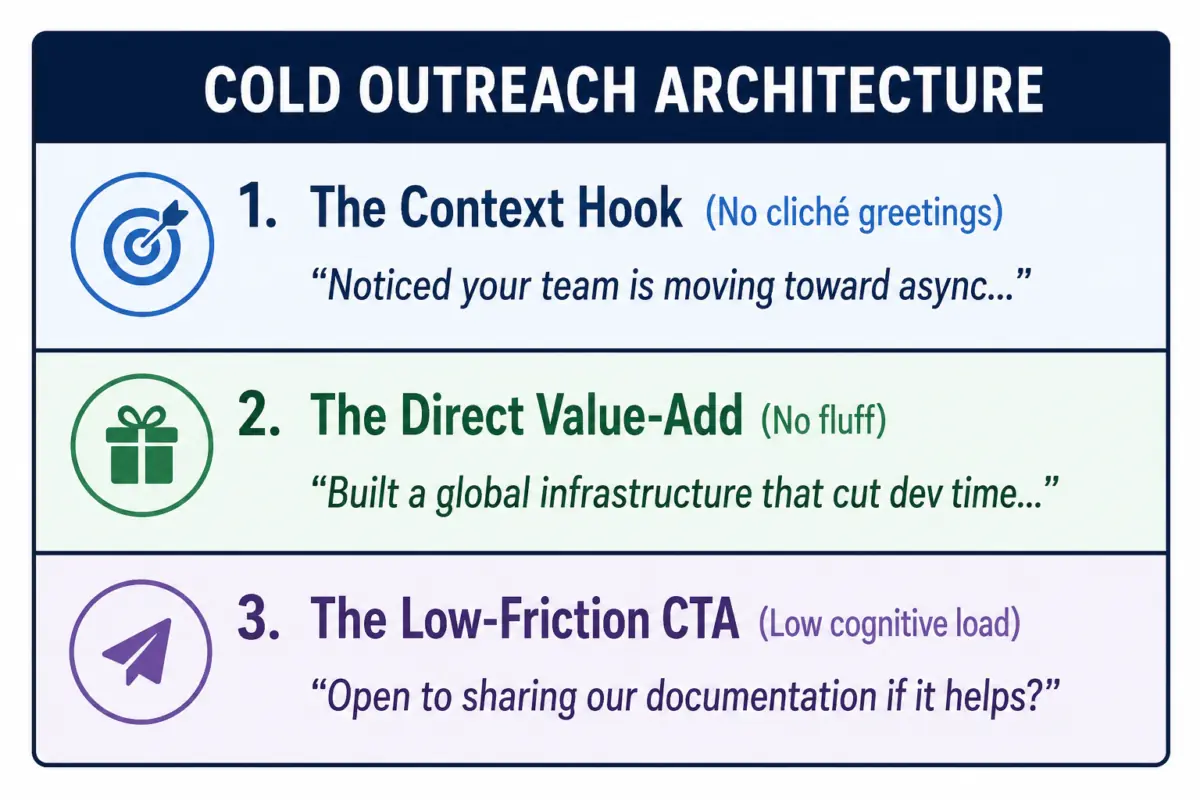
1. The Context Hook
Ditch long, cliché introductions. Begin immediately with a specific hook that establishes your professional context and shows you have researched the organization.
- Bad: “Hope you are having a wonderful week! My name is Alex and I am looking for a new role…”
- Good: “Noticed your engineering team is transitioning to a fully asynchronous workflow, as mentioned in your recent post on engineering culture…”
2. The Direct Value-Add
State exactly how your background solves a current business challenge. Focus on a single, clear outcome rather than listing your entire resume.
- Bad: “I have ten years of experience in project management and can do Agile, Scrum, and Kanban.”
- Good: “At my last firm, I established our async sprint framework, which reduced meeting overhead by 35% and accelerated our platform deployment cycles by three weeks.”
3. The Low-Friction Call to Action (CTA)
Do not ask for a formal phone screen or a 30-minute Zoom call right away. This asks for too much time from a busy professional and raises the barrier to response. Instead, use a low-friction CTA that requires only a quick, one-word reply or a simple confirmation.
- Bad: “Can we hop on a call this Thursday at 2 PM to discuss how I might fit into your organization?”
- Good: “Are you currently accepting external referrals for the platform engineering team, or should I monitor your careers page for future openings?”
Six Copy-Paste Blueprints with Line-by-Line Breakdowns
These six distinct, battle-tested templates cover a variety of professional scenarios. Select the blueprint that matches your career situation, adjust the bracketed details to reflect your background, and maintain the precise structure to protect your outreach performance.
Blueprint 1: The Remote Specialist / Async Practitioner
Use this option when reaching out to fully remote or distributed companies that prioritize independent execution and strong asynchronous communication skills.
Subject (If InMail): Sourcing for async-first teams / [Your Name]
Message: Hi [Recruiter Name],
I saw your recent post regarding [Company Name]’s move to expand its distributed team. Having managed remote operations for the last five years, I know that maintaining deep focus hours is a constant challenge for scaling engineering groups.
At my last company, I led a team of eight engineers, moving our daily syncs to async Slack updates. This shift cut our weekly meeting time by six hours per engineer while keeping our sprint completion rate at 94%.
If you are currently building out your pipeline for remote [Role Name] talent, I would love to share our internal documentation for async sprint planning.
Is this a focus area for your team right now?
Best, [Your Name]
Line-by-Line Breakdown: Why It Works
- “I saw your recent post regarding…” – Establishes immediate context and shows you are paying attention to their actual corporate updates.
- “Having managed remote operations…” – Connects your background directly to a common operational challenge in remote environments.
- “At my last company, I led…” – Uses quantitative metrics to prove your claims, rather than relying on buzzwords like “highly organized.”
- “If you are currently building out your pipeline…” – Frames your offer around sharing a useful resource rather than demanding an interview.
- “Is this a focus area…” – A simple, low-friction question that is very easy to answer.
Blueprint 2: The Fractional Talent Pitch
Use this option to approach HR business partners or talent leaders at mid-sized firms that need senior expertise but lack the budget for a full-time, permanent executive hire.
Subject: Strategic support for [Company Name]’s [Department]
Message: Hi [HRBP Name],
With many mid-sized companies navigating market volatility, balancing personnel budgets with high-impact leadership is an ongoing challenge.
I partner with firms on a fractional basis to optimize [specific function, e.g., cloud cost mitigation]. Recently, I supported an organization through a similar transition, helping them reduce their cloud infrastructure spend by 28% in 90 days.
I know you are focused on strategic talent alignment right now. Are you currently utilizing fractional leaders to support your core [Department] initiatives this quarter?
Best, [Your Name]
Line-by-Line Breakdown: Why It Works
- “balancing personnel budgets…” – Shows a strong understanding of the financial and strategic pressures faced by modern HRBPs.
- “I partner with firms on a fractional basis…” – Clearly establishes your business model, avoiding any confusion about your availability.
- “reduce their cloud infrastructure spend by 28%…” – Uses a clear financial outcome that directly appeals to operational efficiency.
- “Are you currently utilizing fractional leaders…” – A simple, high-level question that helps you quickly qualify the opportunity without demanding a meeting.
Blueprint 3: The Skill-First / Endorsement Leverage
Use this template to highlight specific, in-demand technical skills. This approach leverages the growing corporate transition toward skills-based hiring.
Subject: Technical sourcing: [Skill 1] & [Skill 2] expertise
Message: Hi [Recruiter Name],
I noticed [Company Name] has been expanding its projects involving [specific technology or platform, e.g., NestJS & microservices].
I specialize in this exact stack. My profile includes verified endorsements from tech leads for [Skill 1], and I recently finished a migration that cut database query times by 40%.
If you are currently sourcing candidates for upcoming [Tech Stack] roles, I would be happy to send over my portfolio of work in this area.
Are you accepting exploratory profiles for this stack at the moment?
Best, [Your Name]
Line-by-Line Breakdown: Why It Works
- “I noticed [Company Name] has been expanding…” – Displays direct awareness of the company’s technical direction and business needs.
- “My profile includes verified endorsements…” – Backs up your technical claims with social proof, encouraging them to view your profile.
- “If you are currently sourcing…” – Keeps the interaction professional and stress-free, presenting your portfolio as a helpful resource.
- “Are you accepting exploratory profiles…” – A straightforward question that recruiters can answer quickly based on their current open reqs.
Blueprint 4: The Trigger Event Alignment
Use this option when a target company announces a major milestone, such as a new round of funding, a geographic expansion, or a significant product launch.
Subject: Scaling the [Department] team / Series B milestone
Message: Hi [TA Leader Name],
Congratulations on the recent Series B funding announcement. Scaling a team quickly while maintaining your core product quality is a major operational challenge during this phase.
At my previous company, I joined right after their Series A and helped scale our core engineering team from 12 to 45 engineers. Throughout that growth, we kept our average time-to-hire under 22 days.
I know you have a busy hiring calendar ahead. Are you currently building out your sourcing pipeline for senior [Role Name] talent to support this next phase of growth?
Best, [Your Name]
Line-by-Line Breakdown: Why It Works
- “Congratulations on the recent Series B…” – Connects your outreach to an exciting, highly relevant corporate milestone.
- “joined right after their Series A…” – Demonstrates that you have successfully navigated this exact high-growth stage before.
- “kept our average time-to-hire…” – Addresses a key metric that talent acquisition leaders care about during periods of rapid scaling.
- “Are you currently building out…” – Positions you as a proactive solution to their upcoming recruitment challenges.
Blueprint 5: The Pain-Point Disruptor
Use this direct, high-impact template when you identify a clear, visible bottleneck or operational challenge within the target company’s public projects or platforms.
Subject: Optimizing [specific process/metric] at [Company Name]
Message: Hi [Hiring Manager or VP Name],
After reviewing your new platform release, I noticed that the mobile page load times are averaging over four seconds on slower cellular connections.
I specialize in mobile performance optimization. At my previous firm, I rebuilt our asset-delivery pipeline, which cut mobile latency by 55% and helped boost our checkout conversion rates by 8%.
I have put together a quick, three-point breakdown of mobile optimization strategies that might help your current engineering team.
Would you be open to me sharing that brief outline here?
Best, [Your Name]
Line-by-Line Breakdown: Why It Works
- “I noticed that the mobile page load times…” – Proves you have spent time reviewing their actual product, instantly separating you from generic applicants.
- “At my previous firm, I rebuilt…” – Links your technical skillset directly to tangible, bottom-line business outcomes.
- “I have put together a quick, three-point breakdown…” – Offers immediate, high-value insights before asking for anything in return.
- “Would you be open to me sharing…” – A highly respectful, low-pressure question that makes saying “yes” very easy.
Blueprint 6: The “Soft Connection” Nurture
Use this two-step relationship-building approach when there are no active job openings, but you want to establish a professional connection with a high-value employer for future opportunities.
Subject: Shared interest in [Industry Niche / Methodology]
Message: Hi [Manager Name],
I have been following your team’s public updates on transitioning to a product-led growth model. Your recent post regarding user onboarding experiments was highly insightful.
I run similar onboarding optimization tests within the [Your Industry] space. I would love to connect to follow your team’s updates as you continue testing these strategies.
I promise to keep my updates focused entirely on industry insights rather than pitch messages.
Best, [Your Name]
Line-by-Line Breakdown: Why It Works
- “Your recent post regarding user onboarding…” – Highlights your genuine interest in their public professional content.
- “I run similar onboarding optimization tests…” – Positions you as a peer-level professional working in the same niche.
- “I promise to keep my updates…” – Lowers their defensive barriers by promising not to spam them with pushy sales pitches.
Technical Execution and LinkedIn Nuances
To maximize your response rates, you must navigate the technical limits and design of the LinkedIn platform carefully.
Connection Notes vs. InMails
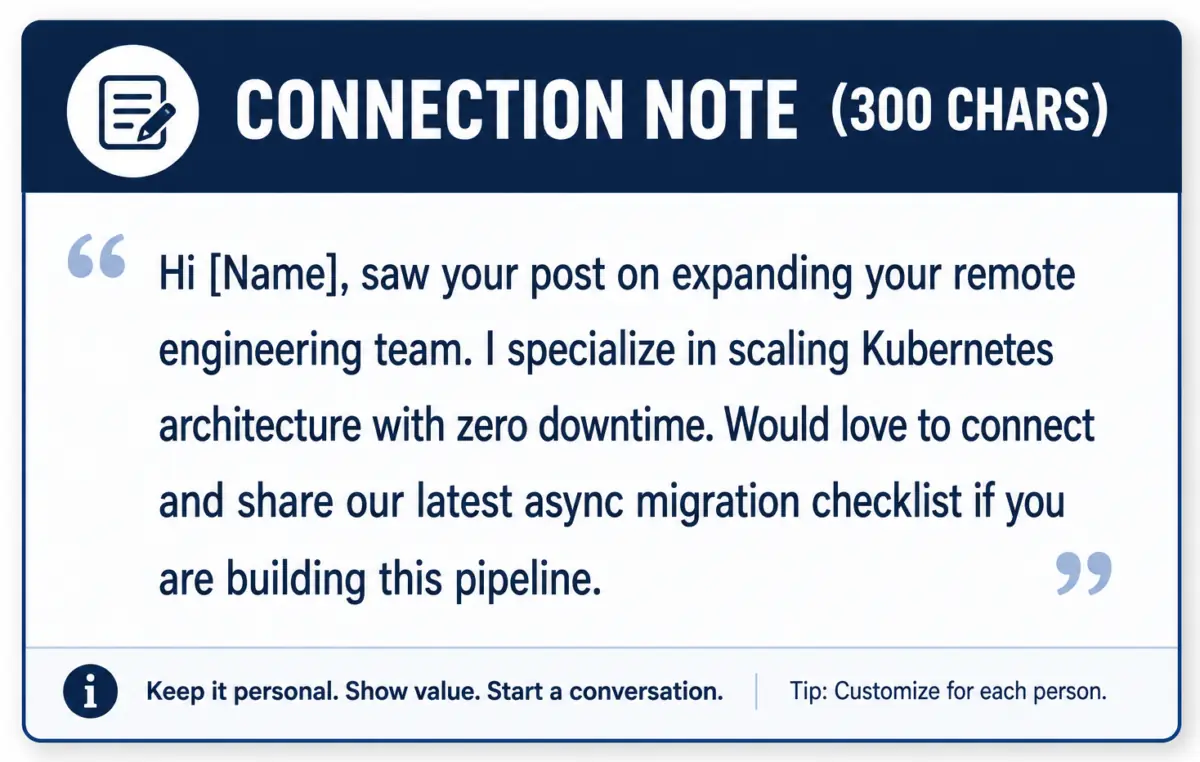
LinkedIn enforces a strict character limit of 300 characters for connection request notes. If you do not have a Premium subscription, your initial message must be incredibly concise.
If you use LinkedIn Premium or Recruiter, you have access to full-length InMails. However, you should still keep your messages under 150 words. Long, text-heavy messages look like homework and are often ignored.
Perfecting Your Follow-Up Timing
If you do not receive a response to your initial message, do not send follow-up messages too quickly. People operations teams manage heavy workloads, and sending multiple messages in a short window can feel like spam.
- Day 1: Send your initial, personalized connection request or InMail.
- Day 7: If they accept your connection request but do not reply to your note, send a short, value-focused follow-up message offering a relevant article, tool, or resource.
- Day 14: Send a final, polite check-in, highlighting your contact details and making it clear you are open to future opportunities when the timing is right.
Tracking Your Outreach Metrics
Treat your outreach like a professional sales pipeline. Keep a simple spreadsheet to track your metrics and refine your strategy.
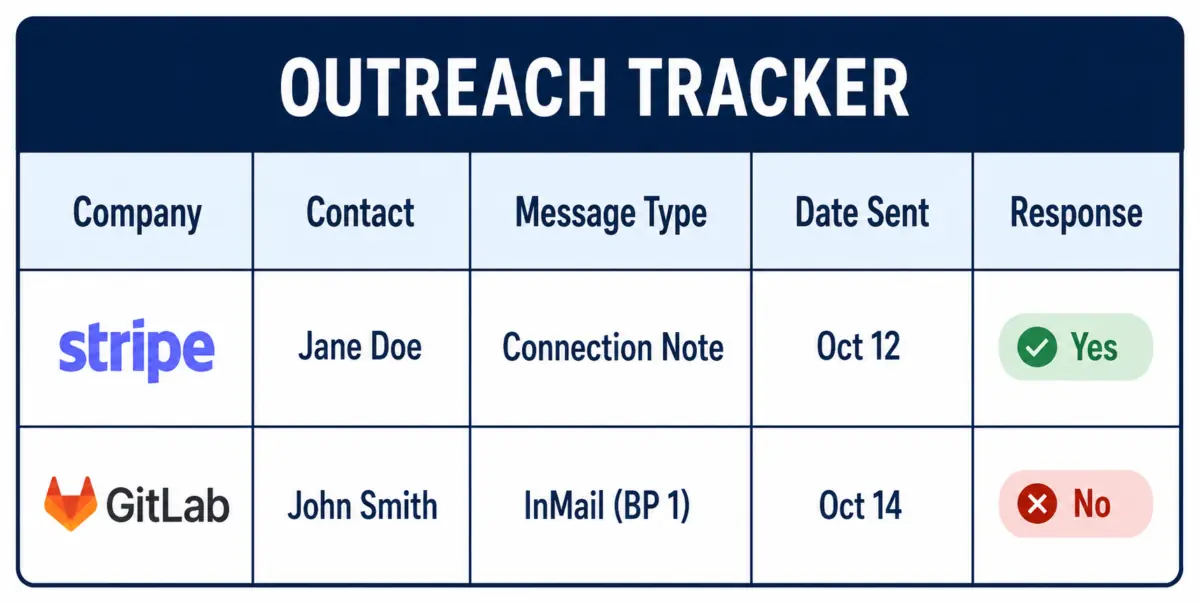
If your acceptance rate on connection requests is below 30%, focus on improving your profile’s headline, photo, and branding. If your response rate to messages is below 15%, work on making your hooks more personalized and simplify your calls to action.
Sins of Outreach: Red Flags That Trigger an Instant Block
In my career consulting work, I frequently review candidates’ sent folders to identify why their outreach is stalling. Most failed campaigns are sunk by a few common, avoidable mistakes.
1. The Telltale Signs of AI-Generated Content
Internal recruiters can spot AI-generated copy from a mile away. Avoid using overly formal language, highly repetitive structures, or generic filler phrases. If your message starts with “I hope this message finds you well in these transformative times,” it will likely go straight to the trash folder. Write naturally, as if you were speaking directly to a respected colleague.
2. Asking for Too Much, Too Soon
Do not ask a busy HR leader to review your resume, give you detailed feedback on your portfolio, or schedule a call during your very first interaction. Keep your initial request focused on starting a simple, professional conversation.
3. Ignoring the Company’s Stated Hiring Process
If a job posting explicitly states: “Please do not message our recruiting team directly; all applications must go through our portal,” do not ignore that instruction. Doing so shows that you struggle to follow clear directions, which is an immediate red flag for hiring managers.
The Outbound LinkedIn Protocol Checklist
Implement this structured, step-by-step workflow to launch your outbound LinkedIn campaign:
- Audit Your Profile: Ensure your headline, about section, and experience focus on quantified outcomes, technical skills, and target business contexts.
- Build Your Target List: Identify 15 to 20 target companies experiencing trigger events (funding, team growth, leadership changes, or public challenges).
- Map the Decision Makers: Find the specific people operations professional at each company (Sourcing Recruiter, TA Manager, or HRBP) who manages your target department.
- Initiate Soft Engagement: Spend three days engaging with their public posts, leaving helpful and professional comments to build familiarity.
- Customize and Send Your Hook: Use one of the blueprints above, personalizing the context hook and value-add to align with their specific challenges.
- Execute Your Follow-Ups: Keep a close eye on your inbox and send polite, value-focused follow-up messages at 7 and 14 days if needed.
 About the author Natalya Luft
Remote Culture Consultant · Former HR Director I’m Natalya -- originally from Kyiv, now based in NYC. I’ve spent 15+ years building and managing distributed teams across Europe. I write about culture, communication, and leadership in remote-first organizations. I believe remote work is about trust, not tools.