In this article
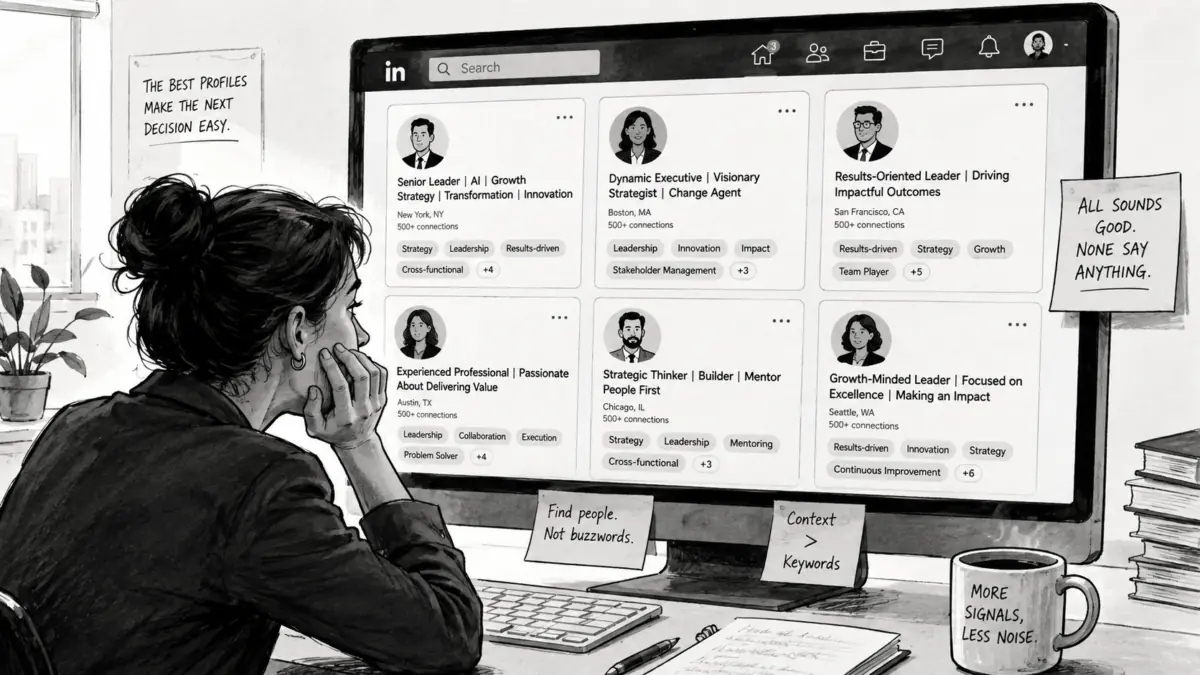
The recruiter pauses over the headline, not because it is impressive, but because it could describe almost anyone who has attended two planning meetings and once said “roadmap” with confidence. She scrolls. The About section promises a “proven track record of delivering impactful outcomes.” The current role lists seven responsibilities, all beginning with “responsible for.” There is no product, market, customer problem, or result she can hold onto.
She opens the next profile.
This is a composite scene, not a report from one particular hiring desk. Its small cruelty is familiar because nothing on the first profile is obviously bad. The spelling is correct. The photograph is professional. The language sounds senior. The candidate may be excellent. The profile simply asks the recruiter to do too much interpretive work.
That is the central LinkedIn mistake: confusing polish with clarity.
A recruiter scrolling past is not always rejecting a person. Often, she is declining an unfinished explanation.
The profile that says everything and reveals nothing
Most weak LinkedIn profiles do not look weak. They look inflated.
The headline contains six areas of expertise. The About section contains ten admirable qualities. Every job involved leadership, collaboration, strategy, execution, optimization, transformation, and stakeholder management. The profile is full of good words arranged so carefully that no actual work can get through.
This happens for understandable reasons. A LinkedIn profile sits in an awkward social position. It is public enough to be seen by colleagues, former managers, clients, friends, and strangers, yet personal enough to feel embarrassing when it becomes too direct. People soften specifics to avoid sounding boastful. Then they replace the specifics with professional vocabulary that sounds respectable but carries little risk.
The result is a profile written for everyone who might see it rather than for the person trying to understand it.
A useful profile makes a few decisions on the recruiter’s behalf. It identifies the kind of work you do, the level at which you do it, the problems you are trusted to solve, and the context in which you have solved them. It does not need to tell your entire career story. It needs to establish a credible shape.
A recruiter does not need your profile to sound impressive. She needs it to make the next decision easier.
That decision may be as modest as opening your full profile, saving it to a project, or sending a message. Profiles lose attention when those small decisions remain oddly expensive.
Recruiter search is becoming broader, not more forgiving
The old caricature of recruiting involved a person typing a rigid string of keywords into a database and accepting whatever came back. That system has not vanished, but it now shares the desk with tools that interpret natural-language requests, infer adjacent skills, compare similar profiles, and rank candidates for review.
In January, LinkedIn’s 2026 talent research reported that 93 percent of recruiters planned to increase their use of AI during the year, while 59 percent said AI was already helping them discover candidates whose skills they might not otherwise have found. LinkedIn also said early users of its Hiring Assistant were reviewing 62 percent fewer profiles per role. That does not mean a machine has become the hiring manager. It means fewer profiles may reach prolonged human attention.
Reuters later described LinkedIn’s hiring agents as systems that take instructions from recruiters and sift through profiles before a person follows up. The commercial success of those tools matters less to a job seeker than the behavioral change behind them: discovery increasingly begins with a description of the needed person, not merely an exact title.
This should help candidates with unusual backgrounds. A customer-success manager who has done implementation work may surface for an onboarding role. A journalist who has built audience analytics may appear in a content strategy search.
But broader discovery still depends on usable evidence. An intelligent search system cannot rescue a profile that has removed every distinguishing detail in the name of sounding versatile.
Your headline is a label, not a storage locker
The most common headline mistake is trying to fit an entire professional identity into one line.
“Leader | Mentor | Strategist | Builder | Speaker | AI Enthusiast” may feel expansive. To a recruiter, it creates a classification problem. What role should this person be considered for? At what level? In which function? What is the strongest reason to keep reading?
A headline works better when it names a recognizable professional center:
“B2B SaaS Product Manager focused on billing and payments”
“Data Analyst | Marketplace fraud and risk”
“Operations Director for multi-site healthcare teams”
These are not thrilling sentences. They are useful. A good headline does not have to carry your personality, mission, management philosophy, side business, favorite technology, and hope for civilization. It has one line.
There is also a subtler version of this error: allowing the employer’s internal title to obscure the work. “Associate III” may be accurate, but it is not informative outside the company. Keep the official title in the Experience section if accuracy requires it, then add a plain-language specialization where the format allows.
The About section written by a committee
A strangely common About section sounds as though legal, marketing, and a motivational speaker each edited one sentence.
It begins with passion. It proceeds to results. It mentions cross-functional collaboration. It ends with a commitment to excellence. No one can object to it, which is also why no one remembers it.
The problem is not that these statements are false. The problem is that they are untestable. “Results-driven” does not identify a result. “Strategic thinker” does not reveal a decision. “Strong communicator” does not show who needed to understand what.
A better About section can be short. It should answer three practical questions in ordinary language: What do you work on? What kind of environment have you worked in? What are you especially good at doing there?
For example:
“I lead lifecycle marketing for subscription products. My recent work has focused on reducing early churn, improving trial conversion, and building campaigns with product and data teams. I am strongest in situations where the customer journey is measurable but the handoffs between teams are not yet clear.”
That paragraph gives the reader a function, business model, set of problems, working context, and point of strength. It also sounds like a person who has noticed something about the work.
AI-generated profile copy has made blandness easier to produce and harder to notice. A generated paragraph may be grammatically smooth while containing no sentence that could only belong to you. Replace your name with another person’s. If the text still fits without resistance, it is not finished.
Responsibilities are not evidence
The recruiter in our opening scene reaches the Experience section and finds this:
“Responsible for leading cross-functional teams, managing strategic initiatives, improving processes, and supporting business growth.”
This could describe a vice president, a project coordinator, or someone who organized the holiday rota.
Responsibilities tell the reader what the job expected. Evidence shows what happened while you were there.
Evidence does not always mean a revenue figure. Many people do not have access to reliable numbers, and some work cannot be reduced cleanly to a percentage. Specificity can come from scope, complexity, audience, constraints, ownership, or change.
“Managed onboarding” becomes “Redesigned onboarding for three customer segments across email, in-product prompts, and sales handoffs.”
“Led a team” becomes “Managed six analysts supporting finance, operations, and regional leadership.”
“Improved internal processes” becomes “Replaced a monthly spreadsheet handoff with a shared reporting workflow used by four departments.”
Each version gives the recruiter something to compare with the role being filled.
Numbers help when they are honest and interpretable. “Increased engagement by 47 percent” is weak if the reader cannot tell what engagement means, over what period, or from what baseline. A modest fact with context is often more credible than a large percentage floating alone.
Profiles also become accidental copies of job descriptions. People paste the duties they were hired to perform, preserving the employer’s language and deleting their own contribution. The result proves that a role existed. It does not prove how the candidate occupied it.
The AI perfume problem
AI skills belong on a profile when they describe actual work. They become distracting when sprinkled across old roles to make them smell current.
LinkedIn’s 2026 Skills on the Rise analysis found growing demand not only for technical AI capabilities, but also for AI business strategy, cross-functional collaboration, stakeholder communication, risk, and compliance. The list was built from growth in skills added to profiles and growth in hiring among people who held those skills. “AI” is not one skill, and its value depends on what someone can do with it.
A marketer who used generative tools to create first drafts has a different skill from a product manager who designed an AI feature, an engineer who evaluated model performance, or a legal operations lead who built a review process for AI-generated documents. Writing “AI” beside all four experiences erases the distinctions a recruiter needs.
The stronger description names the tool or category only after naming the work:
“Built an internal evaluation set for customer-support responses and worked with engineering to track hallucination and escalation rates.”
“Introduced an AI-assisted research workflow for the content team, with source review required before publication.”
“Developed adoption plans and risk controls for generative AI tools used by sales staff.”
The mistake is not failing to appear modern enough. It is claiming modernity in a form too vague to evaluate.
Your career should not require forensic reconstruction
Some profiles create doubt through small inconsistencies rather than grand claims. Dates overlap without explanation. A consulting role appears full-time beside another full-time job. A promotion is shown as three disconnected jobs, making a five-year tenure look like repeated short stays. A career break is hidden behind an extended end date that will be difficult to defend later.
None of these details automatically disqualifies a candidate. They do invite questions. In a crowded search, the recruiter may not ask them.
Clarity is kinder than concealment. Group promotions under one employer. Label contract, fractional, volunteer, and advisory work accurately. If a role was remote for a company based elsewhere, state the arrangement rather than letting location fields tell competing stories.
Accuracy matters more than cosmetic continuity. A short gap is usually less troubling than a profile that appears to negotiate with the calendar.
The same principle applies to job titles. Inflating “Marketing Manager” into “Head of Growth” may help one search and damage the conversation that follows. Recruiters compare profiles with résumés, applications, references, and public company information. A title has to survive contact with other records.
Trust signals are quieter than personal branding
People discuss profile photographs with a level of confidence usually reserved for passport offices. Much of that advice reflects culture, industry, age, and bias more than objective hiring value.
The sensible standard is simpler: use an image that is recent, recognizable, and appropriate to the norms of the work you want. A creative director and a corporate attorney may make different choices. Neither needs to impersonate a stock photograph.
LinkedIn’s current profile verification guidance says verified members receive 60 percent more profile views and 50 percent more engagement on average. LinkedIn’s January research reported a 30 percent lift in connection requests for verified members. These are platform figures, not proof that verification causes recruiters to prefer one candidate, but they show how strongly LinkedIn is steering users toward identity and workplace confirmation.
Verification is useful when available and comfortable. It is not a moral grade. Access differs by country, employer, institution, and identification system.
The more basic trust problem is inconsistency. A highly polished profile paired with an empty work history feels odd. A senior executive page with no dates may look evasive. A consultant offering services without examples, a website, or a clear specialty creates the sense of a shop whose windows are lit but whose door has no handle.
Where profile advice stops being universal
The instruction to “be more specific” sounds neutral. It is not equally easy for everyone.
Some employees work under strict confidentiality rules. Some cannot publish client names, revenue figures, security projects, research topics, or government assignments. People in unstable jobs may reasonably avoid signaling that they are looking. Workers changing careers may have plenty of evidence, but not in the vocabulary favored by their target industry. Junior candidates cannot produce management scope they have never been given.
Country and class matter too. LinkedIn is central to recruiting in some markets and peripheral in others. A professional headshot, paid coaching, polished English, and public recommendations are easier to obtain when someone already has money, access, and a network willing to perform enthusiasm.
Personality matters, though less than people think. A reserved candidate does not need to become a daily content creator. Posting constantly is not the price of having a credible profile. Forced visibility often produces the familiar spectacle of a person publicly congratulating themselves for learning something they have not yet had time to practice.
The fair goal is not maximum self-promotion. It is enough legibility for the opportunity being sought.
For confidential work, describe the type and scale of the problem without exposing the client. For a career change, translate existing achievements into the new function rather than pretending the previous career did not happen. For early-career profiles, use projects, coursework, volunteer work, internships, and part-time jobs to show how you think and execute.
The quiet mistake of aiming at five careers
A profile often becomes vague because its owner is trying to preserve every possible future.
The candidate wants product roles, but could also do strategy. Operations might work. Consulting remains an option. There is interest in AI, climate, education, and perhaps venture capital. None of this is unreasonable.
Still, a recruiter is usually filling one role. A profile that asks to be considered simultaneously as a product leader, operating partner, advisor, investor, speaker, and founder may communicate breadth to one reader and lack of commitment to another.
You do not need one identity for life. You need a coherent version for the current search.
Choose a center and let secondary interests appear as supporting evidence. A product leader with marketplace experience may mention advisory work, but the advisory work should not push the product record into the background. A consultant moving toward an in-house role can frame projects around the operating problems they now want to own.
Focus is not a permanent contract. It is hospitality for the reader.
A better edit begins with subtraction
A useful profile revision rarely starts by adding another paragraph. It starts by removing language that creates the impression of substance without supplying it.
Delete adjectives you cannot prove. Remove duplicate skills. Cut the ceremonial opening from the About section. Replace lists of duties with selected examples. Correct dates before improving tone. Decide which role you want the profile to support for the next several months.
Then read only the first screen: photograph, name, headline, location, current position, and opening lines of the About section. Does it identify a plausible professional? Could a stranger explain what this person does without borrowing the words “strategic,” “passionate,” or “results-driven”?
Inspect each recent role for evidence. Two or three well-chosen details can establish scope and competence. Older roles can be shorter unless they contain experience relevant to the present direction.
Finally, search for yourself as a recruiter might. Use the role, specialty, tools, industry, and location that matter. The goal is not to stuff those terms everywhere. It is to check whether the profile uses the ordinary language of the work.
The recruiter from the opening scene returns to the first candidate later that afternoon. Someone on the team has sent the profile back with a note: “I think this might be the person from the payments company.”
There is enough context now to look again. The candidate has indeed worked in payments, but the word appears once, halfway down the page. The most relevant achievement is buried beneath a paragraph about leadership philosophy.
A week later, in our composite version, the profile changes. The headline now names B2B payments. The current role includes one product launch, one market, and one operational improvement. The About section loses the sentence about “driving transformative impact.”
Nothing dramatic happens. There is no flood of messages. One recruiter understands the profile more quickly than before and saves it to a search project.
That small shift is what a good LinkedIn profile is built to earn.
 About the author Ines Martínez
Digital Nomad & Resume Strategist · Spain/Mexico ¡Hola! I am a digital nomad and resume nerd who’s helped over 500 professionals craft winning CVs. My background is in UX writing, but I fell in love with career coaching while traveling across Latin America. I write practical guides and templates that actually help people get hired.