In this article
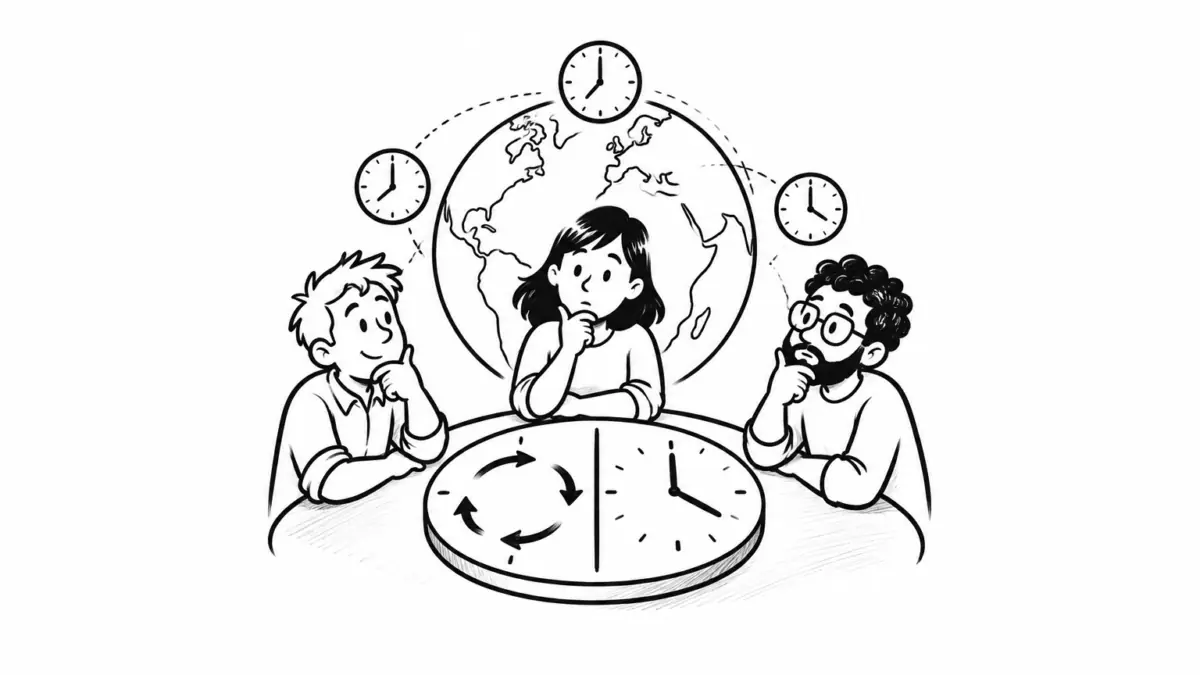
A team lead with colleagues in California, Germany, and Singapore has a recurring problem. The weekly planning meeting falls at 7:00 a.m. for one group, 4:00 p.m. for another, and close to bedtime for a third. Keeping the time fixed makes the calendar easy to remember, but the same people repeatedly absorb the inconvenience. Rotating it sounds fairer, until nobody can remember when the meeting is, attendance becomes uneven, and routine decisions slow down.
The useful question is not, “Which time is fair?” A meeting time cannot be equally convenient across widely separated time zones. The better question is: what kind of work is this meeting doing, and what should happen to people who cannot attend?
That distinction matters because time-zone problems are coordination problems before they are calendar problems. Research on hybrid and virtual teamwork separates geographic dispersion into spatial distance, the amount of overlap in working hours, and the pattern of where people are located. The amount of overlap changes what a team can decide live and what it must make possible in writing. A review of hybrid teamwork research makes this point clearly: temporal dispersion is about shared working time, not merely the number of hours between two clocks.
For a distributed team, a fair meeting policy has two parts. First, use live time only where it changes the work. Second, make the burden of inconvenient attendance visible and deliberate rather than leaving it to the most accommodating people. Rotation is one valid tool, but it is often the wrong default.
Start with the cost of missing the meeting
Before discussing times, name the consequence of absence. A meeting that gives an update has a different attendance requirement from one that resolves a dependency blocking three people. Teams often label both as “important,” then treat every absence as a failure of commitment. That creates a quiet expectation that people will join outside reasonable hours just to avoid being left out.
Working across time zones is common enough that it deserves a designed response. In Buffer’s 2023 survey of remote workers, 62% of respondents said their immediate team worked across multiple time zones, and 14% identified time-zone work as their largest remote-work struggle. The survey is not a universal measure of every team, but it is a useful reminder that the issue is ordinary operational work, not an exception for global companies. Buffer’s report explains the survey population and results.
Ask the organizer to classify the meeting by the cost of someone missing it. The classification should appear in the invite or the linked work record. It tells invitees whether attendance is expected, useful, or simply available.
| Meeting purpose | Cost if a key person misses it | Default scheduling response |
|---|---|---|
| Share information | Usually low if the material is accessible later | Send a written or recorded update; do not require a live slot. |
| Review a prepared proposal | Moderate if questions can be collected beforehand | Use written input first, then meet with the smallest decision group. |
| Resolve a dependency | High when work cannot continue without a decision | Find overlap for the decision owners; document the outcome immediately. |
| Handle an urgent incident | High and time-sensitive | Use an agreed coverage or escalation path, not a rotating general meeting. |
This prevents a common mistake: rotating an informational meeting while leaving a high-stakes decision meeting fixed at the same inconvenient hour. The first change looks equitable but does not address whose input is routinely absent when decisions are made.
Choose a scheduling model that fits the dependency
There are four workable models. None is universally best. The right choice depends on whether the meeting needs real-time exchange, whether its participants are stable, and whether absence changes a decision rather than merely delaying awareness of it.
| Model | Use it when | What can go wrong |
|---|---|---|
| Fixed overlap | A stable group needs short, frequent coordination and the time sits within reasonable hours for everyone. | A convenient slot for the majority becomes a permanent late or early burden for one person. |
| Rotating time | A recurring live discussion needs equivalent participation from regions with no humane common window. | Rotation becomes performative if absent people cannot shape the decision in another way. |
| Duplicate sessions | The content is the same, but discussion or questions are valuable in each region. | Separate sessions produce separate answers unless one owner reconciles them. |
| Async-first with a small live escalation | Most input can be considered independently, while a narrow issue may need rapid discussion. | The written request lacks enough context, so the team creates a meeting anyway. |
Use a fixed overlap for repeated coordination, not as a claim that the team has solved fairness. A product trio might need 25 minutes twice a week to settle handoffs between design, engineering, and product management. If all three can attend during a consistent midday-to-afternoon window, stability is valuable. People can protect the slot, arrange adjacent work around it, and recognize when a decision needs to wait for that shared window.
Use rotation when the same discussion materially benefits from voices that cannot reasonably attend at one fixed time. An all-hands question period, a recurring planning review, or a cross-region leadership forum may fit here. Rotate the painful slot on a published sequence: for example, one month early for the Americas, the next month late for Europe and Africa, then early or late for Asia-Pacific. Do not rotate randomly. Randomness makes the burden harder to anticipate and easier to miss in planning.
Use duplicate sessions when people need interaction, but not the same interaction. A manager can run two listening sessions about a proposed working agreement, gather comments in the same document, and publish one consolidated revision. The sessions are not two separate decisions. They are two routes into the same decision record.
Use async-first when the meeting is mostly a request to read, react, or report status. Atlassian’s guidance on deciding whether to sync asks teams to consider urgency, purpose, participant count, presenter format, and complexity. Those are useful prompts because they move the question beyond personal meeting preferences. Its “Think Before You Sync” play is especially useful for testing whether a live meeting has a task that could be completed in a shared document first.
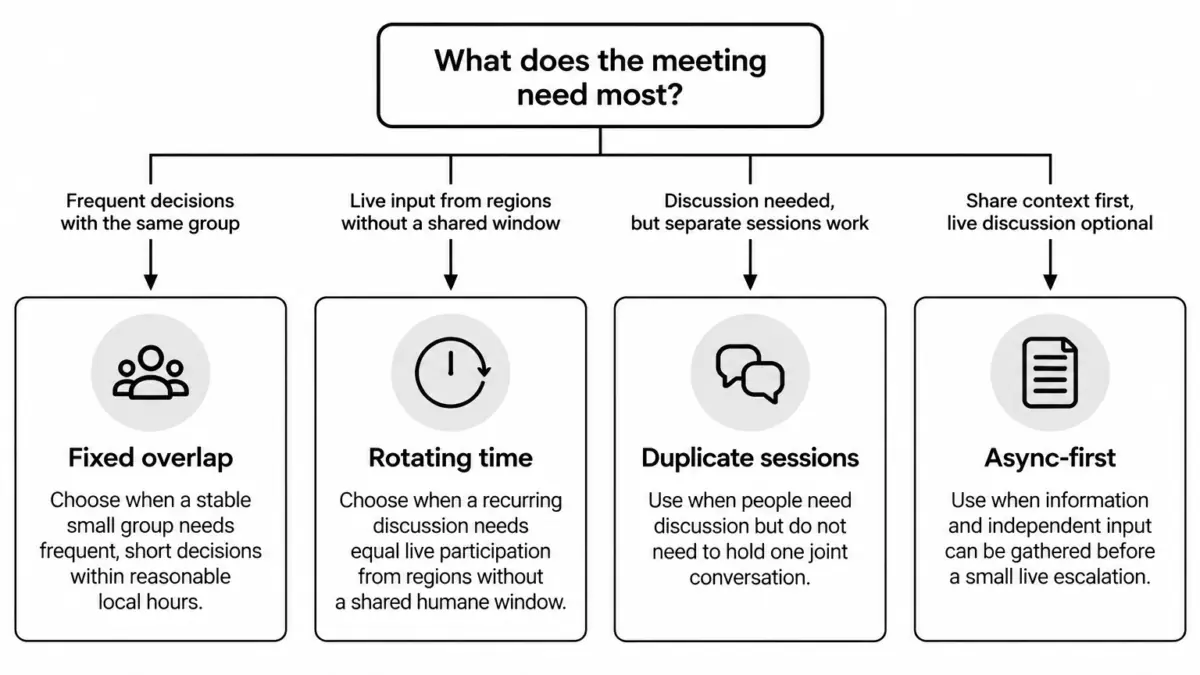
Text version of this visual
- Stable coordination: Choose fixed overlap when the same small group needs frequent, short decisions within reasonable local hours.
- Equal live participation: Choose a published rotation when a recurring discussion needs participation from regions without a shared humane window.
- Repeated interaction: Use duplicate sessions when people need discussion but do not need to hold one joint conversation.
- Context before conversation: Use async-first when information and independent input can be gathered before a small live escalation.
Make rotation a rule with a boundary, not a gesture
A rotation policy fails when it says only, “We will share the pain.” It needs enough detail that an organizer can schedule without renegotiating the principle each time.
| Rule component | Example decision | Why it matters |
|---|---|---|
| Eligible meetings | Monthly forums and quarterly planning reviews rotate; weekly execution check-ins do not. | Prevents rotation from disrupting work that needs a stable cadence. |
| Rotation unit | Rotate by quarter rather than every occurrence. | Lets people plan around an inconvenient period without relearning the schedule each week. |
| Protected hours | No recurring meeting starts before 7:00 a.m. or ends after 8:00 p.m. local time without agreement. | Turns “reasonable hours” into a boundary people can apply. |
| Alternative participation | Written comments are due before the meeting; a recording and decision note follow within one working day. | Prevents absence from becoming exclusion. |
| Exception owner | The team lead approves deviations and records why they were needed. | Keeps temporary urgency from silently becoming a new norm. |
The protected-hours line is not a substitute for judgment. A customer escalation may require a late call. A launch with a fixed external deadline may briefly create more live coordination. The point is that exceptions should be identifiable events with an owner, not a background condition imposed on whichever region has the least organizational influence.
Fair scheduling guidance from Atlassian makes a similar distinction: consider working hours, personal boundaries, and ways someone can participate synchronously or asynchronously when a meeting falls outside those hours. It also recommends revisiting the agreement when team locations or circumstances change. Its fair meeting scheduling play is a practical prompt for treating the policy as a working agreement rather than a one-time calendar cleanup.
Build the work record before asking people to join
Rotation addresses who can be present. It does not make a meeting inclusive by itself. If the only useful context is spoken aloud, the person attending at an inconvenient hour still does more work to prepare, and the person who cannot attend has little way to influence the result.
Every recurring cross-time-zone meeting should point to one record that answers five questions: What is being decided or reviewed? What material is already available? What input is needed before the call? Who will decide? What happens after the call? The record may be a project page, an issue, or a shared document. The tool matters less than the location being predictable.
| Field | What to include | Owner |
|---|---|---|
| Decision or outcome | A sentence describing the choice, approval, or problem to resolve. | Meeting organizer |
| Context | Links to the current plan, relevant constraints, and prior decision. | Work owner |
| Pre-work deadline | A time that gives each region a realistic chance to respond during its own day. | Organizer |
| Decision owner | The person accountable for closing the question after hearing input. | Team lead or sponsor |
| Outcome note | The decision, unresolved items, next action, and named owner. | Organizer or designated note owner |
This structure also limits a subtle failure mode in duplicate sessions. If the first session surfaces a constraint, the second group should see it before discussing the topic. Otherwise, each region spends time solving a different version of the problem, and the organizer must reconcile preventable disagreement afterward.
GitLab’s meeting guidance recommends checking participant time zones before scheduling necessary meetings, considering recordings for groups that span several zones, and balancing synchronous work with asynchronous methods. The handbook’s meeting guidance is helpful here because it treats documentation as part of meeting design, not as administrative cleanup.
Make the burden visible before it becomes resentment
Teams rarely need a complicated equity score. They do need a record that shows who is attending before normal work hours, after normal work hours, or during a protected personal period. Without that view, a team may sincerely believe it rotates fairly while one person has quietly joined six inconvenient sessions because the “urgent” exception keeps landing on their calendar.
| Question | What to inspect | Action if the answer is concerning |
|---|---|---|
| Who attended outside usual hours? | Recurring meetings, special reviews, and urgent calls. | Move the next eligible rotating meeting toward that region or change the format. |
| Who was absent from decisions? | Decision notes and pre-meeting comments. | Check whether written input arrived too late or the decision owner bypassed it. |
| Which meetings repeatedly overran? | Planned versus actual end time. | Reduce scope, split the topic, or move remaining discussion into the work record. |
| Which exceptions repeated? | Reasons given for after-hours scheduling. | Design a coverage rule or a separate regional handoff instead of calling another exception. |
This is where an HR systems lens is useful. Calendar data tells you that a meeting occurred. It does not tell you whether the meeting was necessary, whether a decision was documented, or whether a particular region had a meaningful route to contribute. Those fields need to live in the team’s operating record. Do not turn the review into surveillance of individual calendars; review the pattern of scheduled work and the quality of the handoffs it creates.
A fixed meeting time can remain fair enough when it is truly inside everyone’s normal working hours and the team makes adjustments elsewhere. A rotating schedule can remain unfair when it shifts inconvenience around but gives no alternate route to shape decisions. The evidence is in the pattern of participation, not in the policy label.
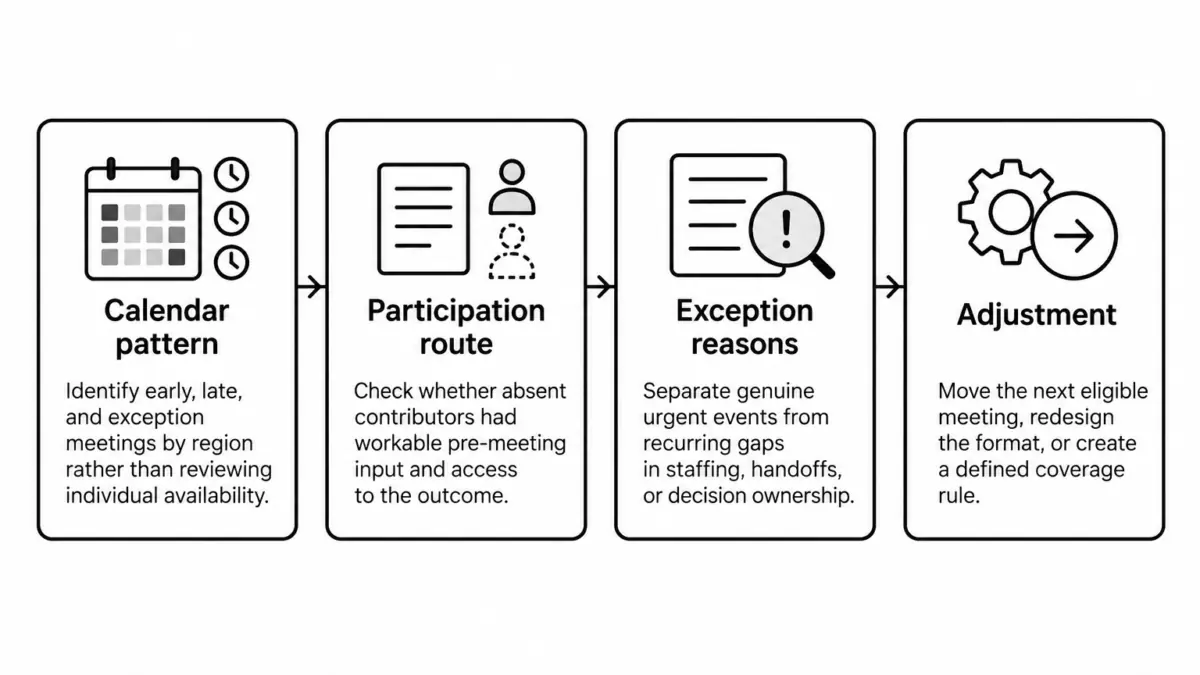
Text version of this visual
- Calendar pattern: Identify early, late, and exception meetings by region rather than reviewing individual availability.
- Participation route: Check whether absent contributors had workable pre-meeting input and access to the outcome.
- Exception reasons: Separate genuine urgent events from recurring gaps in staffing, handoffs, or decision ownership.
- Adjustment: Move the next eligible meeting, redesign the format, or create a defined coverage rule.
Set exceptions without building a second policy
Some work cannot wait for a considerate rotation. A security issue, production failure, or a decision tied to a live customer event may require immediate coordination. The answer is not to pretend this work is asynchronous. It is to separate urgent coverage from ordinary collaboration.
For an incident, identify the accountable responder or on-call group before the incident occurs. For a launch decision, name the decision owner and the narrow set of people whose input is required live. For a customer escalation, decide when a regional handoff is sufficient and when a cross-region call is necessary. The team should not solve these questions by repeatedly inviting everyone who seems responsible.
Be careful with the phrase “optional.” A meeting is not genuinely optional if the decision will be made from the conversation and a person’s work will be affected by it. In that case, either give them a written input path with enough lead time, delegate their input to a named representative, or move the decision to a slot where they can reasonably participate.
Try a two-week meeting schedule audit
Next week, do not announce a sweeping time-zone policy. Pick one recurring meeting that crosses at least two regions and audit it for two cycles. Add a one-sentence purpose, a named decision owner, a pre-work deadline, and an outcome note. Then ask three people in different time zones: Did you know what input was needed before the meeting? Could you contribute without joining outside your normal hours? Did the meeting produce a decision or simply create another discussion?
If the answer to the second question is repeatedly no, rotate the meeting only if its live discussion truly needs the whole group. If it does not, redesign the work record and reserve overlap for the point where a smaller group must decide. That is a more useful test of fairness than moving a calendar invite from one inconvenient hour to another.
 About the author Ewald Schäfer
HR Technology Specialist · Germany I’m Ewald — a passionate HR tech consultant from Berlin. I write about the intersection of automation, recruitment, and human capital. After leading several HRIS rollouts across Europe, I now focus on advising startups and writing practical content for job seekers and hiring teams alike. With a strong IT background, I bridge the gap between HR and technology: from API integrations and data security to workflow automation and cloud-based HR platforms. My mission is to help organizations not only digitize but truly optimize their people operations.