In this article
New managers often become the busiest person in the room for a very ordinary reason: people have learned that every loose end eventually lands with them.
A draft needs a sign-off. A customer exception needs a verdict. Two colleagues disagree about sequencing. Someone asks whether they can contact another team directly. None of these requests is ridiculous on its own. Together, they turn the manager into a human routing layer.
The answer is not to delegate everything and call it trust. Some decisions need a clear manager call. Some need expertise from people who will not own the outcome. Others should sit entirely with the person doing the work. The useful distinction is between deciding, consulting, and delegating—and being explicit about which one is happening.
This matters even more in distributed teams. A manager who is physically absent but still silently expected to approve every move creates delay without providing clarity. Google’s work on team effectiveness puts structure and clarity alongside psychological safety as important conditions for effective teamwork; people need to understand expectations, roles and how work gets done. Its practical guide to team effectiveness is a useful reminder that clarity is not the opposite of a healthy culture. It is part of one.
The three forms of managerial involvement
These terms are often blurred because they can sound equally collaborative. In practice, they create very different working conditions.
| Approach | Who makes the final call? | What the manager must provide | Best fit |
|---|---|---|---|
| Manager decides | The manager | Context, a decision date and a clear explanation of the outcome | High-risk calls, competing priorities, irreversible commitments or genuine deadlock |
| Manager consults | The manager | A defined question, relevant contributors and a statement that input will inform rather than determine the result | Decisions needing specialist knowledge, cross-team effects or challenge to an early view |
| Manager delegates | The named owner | Boundaries, success criteria, escalation conditions and enough authority to act | Repeatable choices close to the work, development opportunities and work where speed matters |
There is no prize for putting every decision through the same ritual. A manager who insists on consultation for a small operational choice can waste more expertise than they gather. A manager who delegates a politically sensitive decision without the relevant context is not developing someone; they are passing on risk.
Start with the practical question: what would make this decision unsafe, expensive, hard to reverse, or surprising to someone else? The answer tells you how much managerial involvement is warranted.
- Manager approves most choices10 manager decision touchpoints per 10 routine decisions
- Manager consults on selected choices5 manager decision touchpoints per 10 routine decisions
- Clear delegated boundaries2 manager decision touchpoints per 10 routine decisions
Start with the decision, not your comfort
New managers commonly over-approve for understandable reasons. They know they will be accountable for the team’s output. They may still be closer to the work than they intend to be. They may also worry that a different choice will reflect badly on them.
That instinct produces a neat-looking team and a fragile one. If every decision climbs upward, people get less practice weighing trade-offs. They also learn to bring half-formed issues to the manager instead of making a recommendation.
Before choosing an approach, write the decision in one sentence. “Improve onboarding” is a project. “Choose whether to replace the current onboarding email sequence this quarter” is a decision. The smaller sentence exposes who needs to know, what evidence matters, and whether delay is doing damage.
GitLab’s handbook assigns a Directly Responsible Individual to each decision and distinguishes the person driving work from the broader hierarchy that may make the final call. Its decision-making guidance is useful here because it treats ownership as something that should be named, rather than inferred from who speaks most in a meeting.
| If this is true… | Use this approach | What to say |
|---|---|---|
| The choice commits budget, changes a promise to a customer, or creates a difficult-to-reverse precedent | Decide, after consultation where needed | “Bring me the options and your recommendation by Thursday. I’ll make the call because this changes our customer commitment.” |
| The choice affects another team that holds knowledge your team lacks | Consult | “We need operations’ view before we decide. They are advising on feasibility; our team still owns the choice.” |
| The choice is within an agreed operating boundary and the person closest to the work can see the consequences | Delegate | “You own this. Keep the cost within the agreed range and bring it back only if the launch date moves.” |
| The team is divided but the work cannot wait for full agreement | Decide | “I’ve heard the objections. We are taking option B for these reasons, and we will review it after the first cycle.” |
The wording matters. “What do you think?” can mean anything from genuine invitation to a polite trap. People should not have to decode whether you are asking for a view, asking them to choose, or asking them to execute your choice.
A manager who must approve every small choice does not create control. They create a queue.
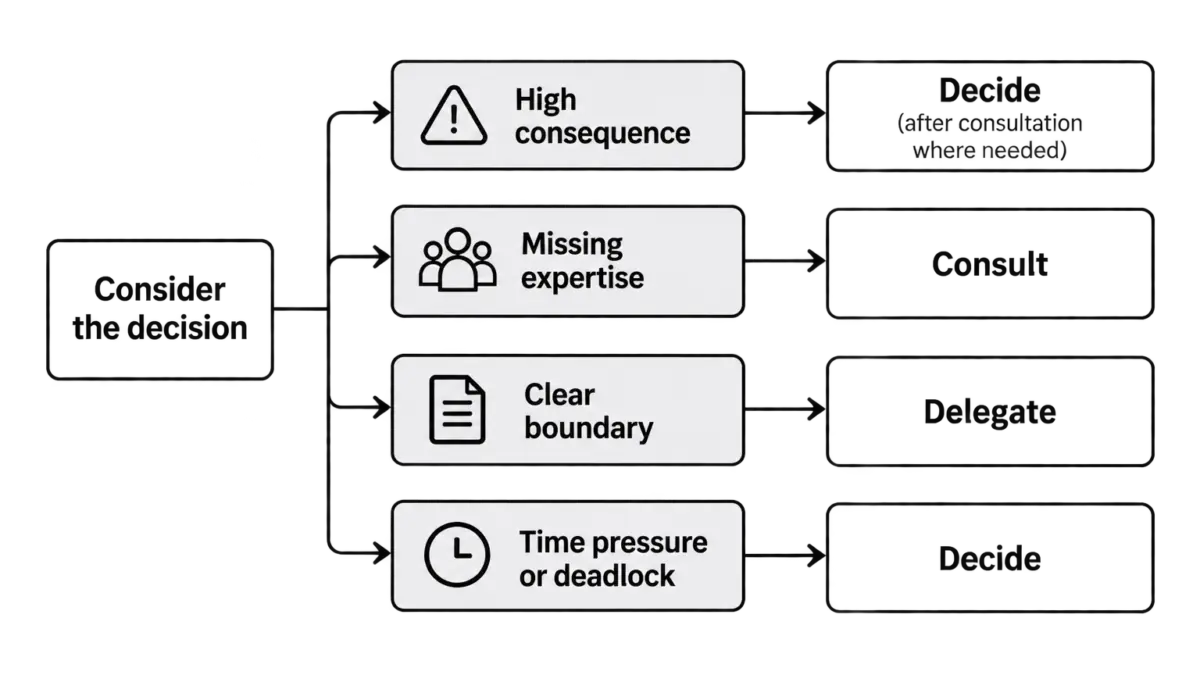
Text version of this visual
- High consequence: Manager retains the final call when commitments, material risk or hard-to-reverse outcomes are involved.
- Missing expertise: Consult people whose knowledge changes the quality or feasibility of the decision.
- Clear boundary: Delegate when the owner can act within known limits and see the consequences.
- Time pressure or deadlock: A manager decision can prevent prolonged uncertainty when agreement is not required.
Consultation is an input, not a vote
Consultation gets messy when managers promise influence they do not intend to give. The team is invited into a discussion, options are debated at length, and then a decision arrives that appears unrelated to what was said. Even when the decision is sound, the process teaches people that speaking up is theatre.
Employee voice is not the same thing as employee control. A manager can properly retain the final decision while still making consultation meaningful: ask a question that can be answered, involve people early enough for their information to matter, and explain how the input changed—or did not change—the final call.
The CIPD’s 2025 Good Work Index found that only 37% of surveyed employees said their manager was good at allowing employees or their representatives to influence final decisions. The report’s employee-voice findings do not mean every workplace decision should become a vote. They do suggest that managers should be careful not to confuse collecting opinions with giving people a credible route to shape work.
For a substantial decision, name four roles: the person who drives the process, the person who approves the outcome, the contributors whose knowledge is needed, and the people who need to be informed. Atlassian’s DACI decision framework uses exactly this distinction. You do not need to adopt its labels permanently. You do need to stop treating every attendee as if they have the same job.
One warning: consultation is not a way to avoid making a difficult call. If you are the approver, do not wait for unanimous enthusiasm when the trade-off is real. Explain the trade-off, record the decision, and give people a way to raise evidence that genuinely changes it.
Consultation earns trust when people can see where their information entered the decision.
Delegation needs a boundary, not a longer briefing
Delegation fails in two opposite ways. In the first, the manager hands over a task but reserves every meaningful judgment. The team member can prepare the comparison, chase the inputs and draft the recommendation, but cannot select an option without another approval. That is assistance, not ownership.
In the second, the manager says “you own it” and disappears. The person has nominal authority but no view of budget limits, stakeholder sensitivities, earlier commitments or the point at which the decision should come back up. That is abandonment with nicer language.
A usable delegation has five parts:
- The decision: the exact call the person can make.
- The intended outcome: what the choice should protect or improve.
- The boundaries: limits on money, time, customer commitments, technical risk or policy.
- The consultation required: whose knowledge must be included before acting.
- The escalation trigger: the conditions that bring the manager back in.
Notice what is absent: a demand that the person reach the same answer you would have chosen. If every delegated decision needs to mirror the manager’s private preference, the team will eventually stop exercising judgment.
Delegation is credible only when the person has both a boundary and the authority to act inside it.
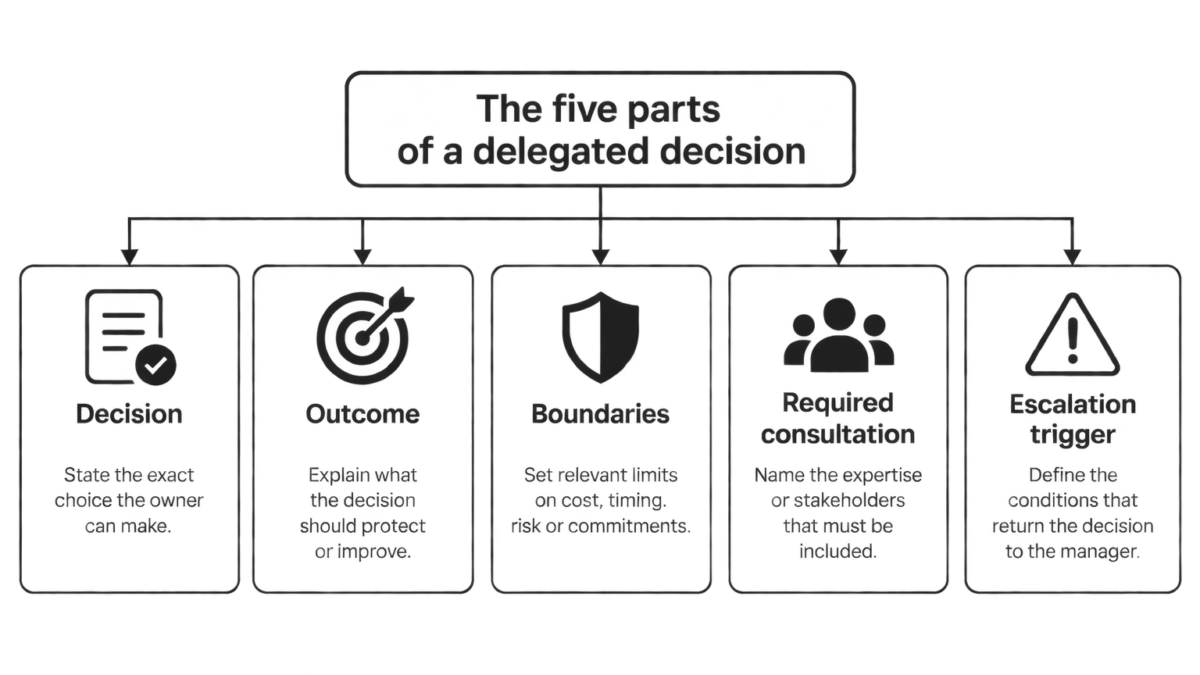
Text version of this visual
- Decision: State the exact choice the owner can make.
- Outcome: Explain what the decision should protect or improve.
- Boundaries: Set relevant limits on cost, timing, risk or commitments.
- Required consultation: Name the expertise or stakeholders that must be included.
- Escalation trigger: Define the conditions that return the decision to the manager.
The manager’s job changes after delegation
Delegation does not remove the manager from the work. It changes the work from deciding every detail to maintaining the conditions in which good decisions can happen.
That includes making priorities legible, sharing relevant history, connecting people to stakeholders, and checking whether the boundary remains sensible as facts change. It also means reviewing outcomes without conducting a prosecution.
After a delegated choice, ask: What did you notice? What information was missing? Which boundary helped, and which one got in the way? What would make the next decision easier to own? These questions improve the operating system without converting a normal mistake into a character judgment.
New managers sometimes fear that this looks less decisive. It usually looks more so. A team can tell the difference between a manager who needs to touch every decision and one who has designed clear routes for work to move.
The aim is not managerial distance. It is appropriate involvement. Decide when your authority is genuinely needed. Consult when other people can improve the judgment. Delegate when the work is close enough to someone else for them to own the call and learn from its consequences.
 About the author Joshua Ward
Startup Recruiter · Talent Advisor · UK Hey, I’m Josh — a recruiter-turned-writer based in London. I’ve helped build early teams at over 25 startups in the past 7 years, mostly in SaaS and fintech. Now I share insights about how small companies hire, what hiring managers really look for, and how to stand out in a noisy job market.