In this article
The Screen in Berlin
A hiring manager in Berlin is probably going to look at your resume on a phone while waiting for a coffee.
I’ve noticed a disconnect lately when talking to people trying to break into global remote work. Candidates often build these sprawling, multi-page career dossiers, assuming that a wider net naturally catches more fish. In reality, remote hiring is a game of high-speed, asynchronous filtering. According to recent data on remote work trends, nearly three-quarters of organizations are permanently shifting more roles to remote models in 2026.
This changes the fundamental geometry of the job hunt. You are no longer competing with the three other reasonably qualified people in your zip code who happened to see the job posting on LinkedIn on a Tuesday—you are competing with someone in Toronto, someone in Buenos Aires, and someone in London who all have the exact same software certifications you do.
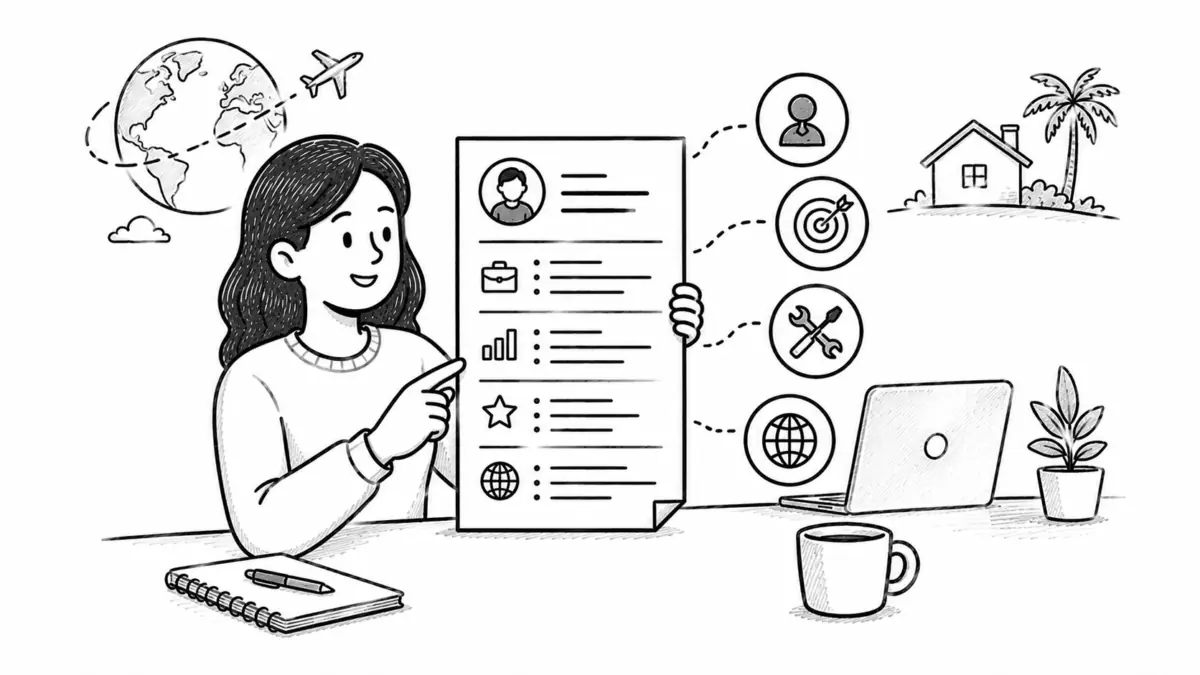
The primary function of a single-page resume is not to get you the job; it is to keep you from being disqualified in the first ten seconds.
If you hand a remote hiring manager a dense, three-page document, you are asking them to do the work of figuring out why you matter. They will not do that work. They will simply move on to the next PDF in the queue.
The Gravity of Signal Density
When you are bound by the physical constraints of a single page, every line has to fight for its right to exist. This introduces the concept of signal density, which essentially measures the ratio of compelling, highly relevant information to generic corporate filler.
One thing I’ve noticed is that deleting your own achievements is often psychologically harder than writing them in the first place.
You suffered through that chaotic nine-month software migration, or you spent three years dealing with a demanding enterprise client, so removing it from your work history feels like erasing a part of your identity. A candidate I worked with a while back was a senior operations manager who had three pages of beautifully formatted bullet points detailing every project she had touched since 2018. When we started cutting it down to a single page, she physically winced at some of the deletions.
But you have to do it.
If you are trying to compress a ten-year career into a single page, you will inevitably have to leave out projects you poured your soul into, simply because they don’t serve the immediate narrative of the job you are trying to land next.
A Mildly Contrarian View on the Robot Gatekeepers
There is a prevailing fear that if you don’t stuff your resume with the exact phrasing found in the job description, a faceless Applicant Tracking System (ATS) algorithm will instantly banish your application to a hidden folder, never to be seen by human eyes.
I think the ATS panic is drastically overblown for most mid-size remote companies.
Yes, enterprise giants use automated filtering heavily, but in most cases, the real bottleneck isn’t a robot. The real bottleneck is a tired recruiting coordinator scanning applications between Zoom calls. Designing a resume exclusively to appease a machine often results in a document that is fundamentally irritating for a human to read.
Reasonable recruiters do it differently, of course, and some companies rely heavily on auto-scoring, but I tend to find that human readability beats algorithmic keyword-stuffing almost every time.
Because of this, I have honestly stopped recommending the traditional “Professional Summary” section entirely.
This is heavily contested depending on the industry. A lot of career coaches will tell you the summary is your elevator pitch. But in my experience, nine times out of ten, a summary is just three sentences of vague adjectives—”dynamic, results-oriented professional with a passion for synergy”—taking up premium real estate that could be used for actual evidence of your competence.
Nobody warns you about this part.
We spend so much time trying to introduce ourselves that we forget to prove we can do the work. Just start with your experience.
The Geography Problem
Applying globally introduces a strange friction around location. Do you list your physical city? Your time zone? Just the word “Remote”?
Deel’s recent State of Global Hiring Report highlighted a weird trend: the “urban boomerang,” where remote workers are actually migrating back toward major cities after a brief exodus. Companies care about where you are, even if you never step foot in an office. Often, top startups aren’t hiring globally just to cut costs; they are doing it to access specialized talent pools in specific high-income markets like the UK, Canada, and Germany.
So, should you put your physical location on your resume? I wish I could give you a definitive rule here, but it genuinely depends on the company’s tax infrastructure and compliance footprint. You just have to guess based on the vibe of the job posting.
Some European companies prefer the exact opposite approach, expecting a multi-page CV with your photo and date of birth attached. But if you are applying to standard tech, SaaS, or digital-first remote companies, defaulting to a US-style, single-page format is usually the safest bet.
A Tangent on Time Zones
If you don’t list a city, at least list your working time zone (e.g., “Remote – CET” or “Remote – EST”). Global teams are increasingly prioritizing “nearshore” hiring over traditional offshoring purely for time zone alignment. If a company in New York is hiring, and you live in Bogotá, you are on the same time zone. That is a massive operational advantage. Signal it immediately.
Metrics, Memory, and Maritime Disasters
We’ve been beaten over the head with the advice to “quantify everything.” The industry standard is that every bullet point must contain a metric, a percentage, or a dollar amount.
Which is exhausting, frankly.
Oddly enough, adding too many metrics can actually make a resume feel less believable. If every single bullet point boasts a 300% efficiency increase or a $5 million revenue save, the numbers start to lose their gravity. It starts to look like you’re just mashing the keypad to appease a recruiter. A single, highly credible metric attached to a complex project carries far more weight than a dozen inflated ones.
Furthermore, hiring managers rarely remember the numbers anyway. They remember narrative.
I remember a hiring manager telling me about a candidate who included a single bullet point at the bottom of their page about hosting a weekly remote trivia game focused exclusively on 1990s maritime disasters. Did that prove the candidate was a great financial analyst? Not really. But the hiring manager brought it up in the first interview just to see what that was all about, and that conversation naturally bridged into how the candidate handled team communication during stressful quarterly closes.
Sometimes a resume needs a loose thread just to give the interviewer something interesting to pull.
The Aesthetic Trap
We spend an unreasonable amount of time agonizing over the visual geometry of a single piece of paper. Candidates will spend hours adjusting the margins by an eighth of an inch just to force a widow back onto the previous line, or debating whether a dark navy font header reads as more ‘senior’ than charcoal gray. In reality, the person reading it usually doesn’t even register the font choice unless it is aggressively difficult to read. What they are actually looking for is visual hierarchy—a map that tells their eyes where to go to find the job titles, the dates, and the scope of responsibility. If you rely too heavily on complex templates with multiple columns, progress bars for skills, and tiny icons, you are essentially burying the map under a pile of decorations. The irony is that the more a candidate tries to make their resume look like a professionally designed brochure, the less authentic it tends to feel to the person reviewing it. A perfectly sterile document can sometimes read like a mass-produced marketing flyer rather than a human career history. Sometimes a slightly plain, heavily text-driven document with clear spacing communicates far more confidence than a heavily stylized one. You want the reader thinking about your capabilities, not your layout choices.
A little bit of raw edge is okay.
The Comma-Separated Disaster
This brings us to the skills section. I frequently see candidate skills sections that look roughly like this:
Agile, Scrum, Kanban, JIRA, Trello, Asana, Microsoft Office, Google Workspace, Slack, Zoom, Communication, Leadership, Strategy, Execution, Python, HTML, Breathing.
That isn’t a skills section. That is a word cloud.
It rarely works.
The Incomplete Picture
At the end of the day, a single-page resume is just a highly compressed reflection of your professional life. It will never tell the whole story, and it shouldn’t try to. The hiring manager in Berlin finishing their coffee doesn’t need your whole life story anyway. They just need to know if you have the specific tools to solve the problem currently keeping them awake. If your page answers that question, the rest is just details.
 About the author Ines Martínez
Digital Nomad & Resume Strategist · Spain/Mexico ¡Hola! I am a digital nomad and resume nerd who’s helped over 500 professionals craft winning CVs. My background is in UX writing, but I fell in love with career coaching while traveling across Latin America. I write practical guides and templates that actually help people get hired.