In this article
The door closes. The Zoom call ends. You close your laptop or walk out of the office lobby, take a deep breath, and let out a sigh of relief. The hard part is over. Or is it?
For many job seekers, the period after the interview is actually the most anxiety-inducing phase of the entire hiring process. You enter a modern corporate limbo. Every hour feels like a day; every day feels like a week. You find yourself refreshing your inbox, wondering if you should reach out, what you should say, or if you will come across as desperate.
Most people treat the post-interview follow-up email as a mere formality—a polite chore to cross off their checklist. They copy a generic three-sentence template from the first page of a search engine, swap out the names, and hit send.
That is a massive missed opportunity.
A post-interview email is not just a thank-you note. It is a strategic, psychological touchpoint. It is your final pitch, your chance to correct a mistake, and your opportunity to transform a “maybe” into an enthusiastic “yes.”
Data backs this up. According to a comprehensive survey by Robert Half, a staggering 80% of hiring managers state that thank-you messages are helpful when deciding which candidate to hire. Yet, incredibly, the same study revealed that only 24% of candidates actually send them.
By simply sending a thoughtful, well-crafted follow-up, you immediately place yourself in the top quarter of applicants.
In my fifteen years of navigating both sides of the hiring table—first as an eager applicant trying to break into tech, and later as a hiring manager responsible for building product teams—I have read hundreds of follow-up emails. Some made me run to HR to fast-track an offer. Others made me quietly cringe and reconsider an otherwise decent candidate.
This guide is designed to help you write the former. We will examine the psychology behind why these emails work, dissect the anatomy of an exceptional follow-up, provide highly realistic templates across various scenarios, and discuss how to navigate the delicate art of timing.
1. The Psychology of the Post-Interview Window: Why Follow-Ups Matter
To write an effective follow-up, you must first understand the state of mind of the person reading it.
Hiring managers are incredibly busy. They are not sitting in a quiet room, thinking solely about your interview. They are likely context-switching between back-to-back candidate screenings, fire-fighting their daily operational issues, attending internal budget alignment meetings, and managing their current teams.
When you leave the interview, their memory of you immediately begins to compete with a dozen other priorities. This is where basic cognitive psychology comes into play.
The Recency and Primacy Effects
In psychology, the serial-position effect dictates that humans best remember the first and last items in a series (primacy and recency). While you cannot easily control where you fall in the interview lineup, you can control the “last” impression you leave. A beautifully tailored follow-up email functions as a secondary “recency” anchor. It pulls your conversation back to the top of the hiring manager’s mental stack.
Slowing Down the “Forgetting Curve”
Herman Ebbinghaus’s famous Forgetting Curve demonstrates that humans lose roughly 50% of new information within days, if not hours, unless that information is reinforced. When you send a personalized follow-up that references a specific, engaging moment from your interview, you force the brain to re-access those memories. You are quite literally keeping the mental image of your competence alive.
The Power of “High-Intent” Behavior
In sales, the speed and quality of a follow-up are directly correlated with closing a deal. Job hunting is, at its core, a consultative sales process where you are the solution. Employers do not just want people who can do the job; they want people who want to do this specific job at this specific company.
When you write a generic “Thank you for your time, I look forward to hearing from you” email, you signal low intent. It looks automated. But when you write a highly tailored message that connects your skills to a problem the manager brought up during the interview, you signal high intent. You demonstrate that you are already thinking like an employee.
2. The Anatomical Breakdown of a Perfect Follow-Up Email
An exceptional follow-up email is a structured composition. If you look at the messages that successfully move candidates to the next round, they almost always share a specific five-part anatomy.
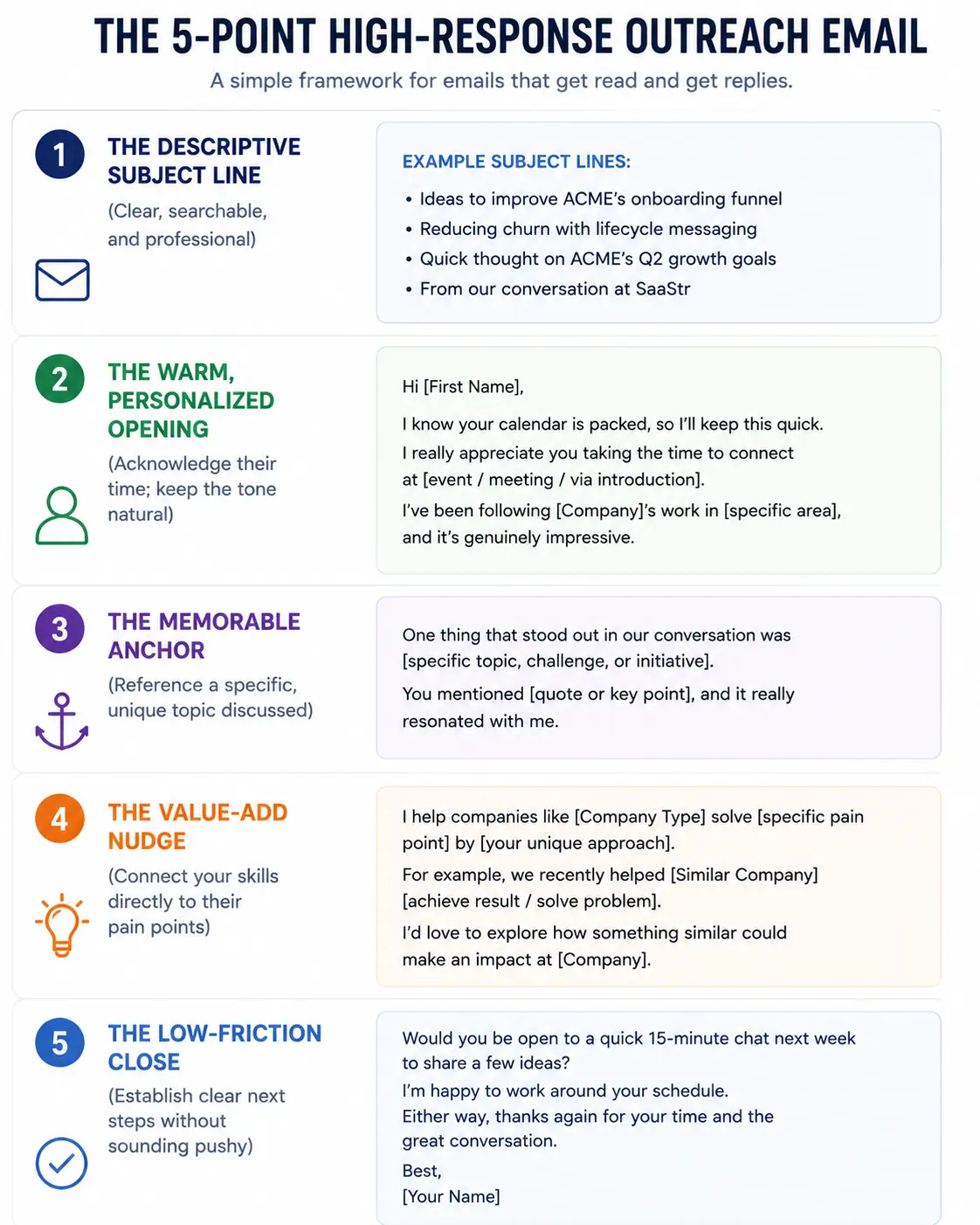
1. The Subject Line
Your subject line must serve two purposes: it must get opened, and it must make your email easily searchable later when HR or the hiring manager is looking for your thread. Avoid vague subject lines like “Hi” or “Follow up.”
2. The Salutation and Warm Opening
Match the culture of the company. If it is a traditional financial institution, “Dear Mr./Ms. [Last Name]” is appropriate. If it is a modern tech startup or a creative agency where everyone goes by first names, “Hi [First Name]” is much more natural. Thank them sincerely for their time, but do not sound overly subservient. You are a peer offering valuable skills, not a beggar asking for a favor.
3. The Memorable Anchor
This is where 90% of candidates fail. They write: “It was great learning more about the company.” This is incredibly boring.
Instead, find your anchor—a specific topic, joke, challenge, or project discussed during the interview.
- Example: “I really enjoyed our discussion about the challenges of scaling your content strategy as you expand into the European market.”This proves you were actively listening, and it immediately differentiates you from the pool of generic candidates.
4. The Value-Add Nudge
This is your final pitch. Take that memorable anchor and connect it directly to your expertise. Keep it brief—one or two sentences. Show them how you would tackle the exact problem you discussed.
- Example: “After our call, I was thinking about your plan to migrate your database. It reminded me of a similar transition I managed at my previous role, where we minimized downtime by using a phased migration strategy. I would love to bring that same systematic approach to your engineering team.”
5. The Low-Friction Close
Keep your call to action (CTA) gentle. Do not ask, “When will I get an offer?” or “Can you give me an update?” Instead, reaffirm your enthusiasm and offer a smooth path forward.
- Example: “I’m incredibly excited about the prospect of joining the team. Please let me know if I can provide any additional references or portfolio samples to help with your decision.”
3. Subject Lines That Actually Get Opened
The subject line is your digital handshake. If it is messy, lazy, or overly aggressive, it sets a bad tone before the email is even opened. Here are several categorized options that strike the right balance between professionalism and modern workplace dynamics.
Standard & Highly Professional
Use these for traditional industries (legal, finance, corporate enterprise) or when you want to play it safe.
Thank you for your time today - [Your Name]Great meeting you today, [Interviewer's First Name] - [Your Name]Follow-up: [Your Name] for [Job Title] role[Job Title] Interview Follow-Up: [Your Name]
Modern, Conversational, & Engaging
These are ideal for startups, creative fields, tech companies, and modern agencies where the culture is less rigid.
Enjoyed our conversation today, [Interviewer's First Name]!Quick note to say thanks (and a thought on [Topic Discussed])Great speaking with you about [Project/Topic Name] todayThanks for the chat, [Interviewer's First Name]! [+ [Job Title]]
Following Up After Silence (The Gentle Nudge)
Use these when you have waited past the agreed-upon deadline and need to check in without sounding impatient.
Checking in: [Job Title] role - [Your Name]Following up on next steps for [Job Title]Quick update / [Your Name] - [Job Title]
4. Five Real-World templates and Mock Examples
To write a truly human follow-up email, you cannot simply rely on generic templates with brackets like [Insert Skill Here]. You need to see how these emails read in action.
Below are five fully written, highly realistic mock examples tailored for different scenarios. Feel free to use the structures and adapt the phrasing to match your specific voice and industry.
Template 1: The Classic 24-Hour Thank You (Highly Personalized)
Best for: Almost any professional role where you want to show strong interest, active listening, and professionalism within 24 hours of the interview.
The Scenario: You interviewed for a Product Marketing Manager role. During the conversation, the hiring manager mentioned they are struggling to coordinate their product launches across different time zones.
Subject: Great meeting you today, Sarah! / Product Marketing role
Hi Sarah,
I wanted to send a quick note to thank you for taking the time to chat with me this afternoon. I really enjoyed learning more about how your team approaches product marketing at [Company Name], and our discussion about cross-functional alignment was a highlight for me.
Our conversation about the logistical challenges of coordinating product launches across EMEA and APAC teams particularly resonated. I spent some time thinking about this after our call, and it reminded me of my time at Pioneer Corp, where we solved a similar issue by implementing a centralized “Launch Hub” template in Asana. It dramatically cut down on miscommunications, and I’d love to bring that kind of structured organization to your upcoming product cycle.
I am incredibly excited about the prospect of joining the team and helping streamline your upcoming campaigns. Please let me know if there are any other materials or portfolio samples I can send over in the meantime.
Hope you have a wonderful rest of the week!
Best regards,
Marcus Vance
[LinkedIn Link] | [Portfolio Link] | [Phone Number]
Template 2: The Value-Add Follow-Up
Best for: Roles where showing proactive problem-solving, strategic thinking, or technical capability is highly valued (e.g., SEO, UX/UI design, engineering, or strategy).
The Scenario: You interviewed for an SEO Specialist role. During the interview, you discussed the company’s recent dip in organic traffic on their blog. You decide to send a quick, non-intrusive value add to show how your brain works.
Subject: Enjoyed our conversation today, David! (And a quick SEO thought)
Hi David,
Thank you so much for your time today. It was a pleasure discussing the future of the organic search team at [Company Name].
I was particularly intrigued by your mention of the recent organic traffic dip on your resource hub after the latest algorithm update. After our call, I did a quick, high-level audit of a few of your top-ranking blog posts out of curiosity. I noticed a pattern where several high-value pages are missing structured schema markup for their FAQ sections, which might be impacting your rich snippet visibility.
I actually put together a quick, three-point bulleted list of potential quick wins for your resource pages. I’ve attached it as a simple PDF to this email just in case it’s helpful to you and the team right now, regardless of how this hiring process shakes out.
Our conversation only confirmed my excitement about this role. I would love to bring this level of proactive analysis to your team full-time.
Let’s stay in touch!
Warmly,
Elena Rostova
[LinkedIn Link] | [Phone Number]
Template 3: The Multi-Interviewer Approach (How to Segment Your Notes)
Best for: When you interview with a panel of people and need to send separate, unique notes to each interviewer without sounding like a copy-paste robot.
The Scenario: You had a panel interview with two people: Jessica (the Hiring Manager) and Tom (the Technical Lead) for a Software Engineer role. If you send them the exact same email, they will notice. You must customize each email based on what you discussed with them individually.
Email to Jessica (The Hiring Manager – Focus on Culture & Team):
Subject: Great speaking with you today, Jessica!
Hi Jessica,
Thank you so much for taking the time to walk me through the engineering team’s roadmap today. I was incredibly impressed by your focus on psychological safety within the dev team and your commitment to keeping “tech debt days” on the calendar.
It’s rare to find a leader who prioritizes sustainable engineering practices so highly, and it made me even more excited about the prospect of joining [Company Name]. I’m confident my background in agile team environments will allow me to integrate seamlessly into your team culture.
I look forward to hearing about the next steps in the process. Have a great weekend!
Best,
Jordan Park
[LinkedIn Link] | [GitHub Link]
Email to Tom (The Technical Lead – Focus on Architecture & Tech Stack):
Subject: Thanks for the tech deep-dive today, Tom!
Hi Tom,
I wanted to send a quick thank-you for the technical interview today. I really enjoyed getting into the weeds of how you are structured and your plans to migrate your legacy services over to a microservices architecture.
Our discussion about handling state management using Redis was particularly interesting. I went back and reviewed a project I worked on last year where we tackled a similar scaling bottleneck, and it reminded me of how crucial it is to get those caching strategies right early on.
If you have any additional questions about my technical background or want to take a closer look at my past repository work, please let me know.
Thanks again for the great conversation!
Best,
Jordan Park
[LinkedIn Link] | [GitHub Link]
Template 4: The “No Response” Check-In (Polite, Structured Nudge)
Best for: When the hiring manager told you they would make a decision by a certain date (e.g., “by Friday”), that date has passed, and you have waited an additional 2-3 business days without hearing anything.
The Scenario: You interviewed for a Project Manager role. They said they would get back to you by last Tuesday. It is now Friday morning, and you haven’t received an update.
Subject: Checking in: Project Manager role – [Your Name]
Hi Amanda,
I hope you’re having a productive week.
I’m writing to gently check in on the status of the Project Manager role. I know you were hoping to finalize next steps by earlier this week, and I wanted to reiterate my strong interest in the opportunity.
I completely understand that hiring timelines can be highly dynamic and unexpected priorities pop up. If there are any updates you can share, or if you need any additional information from my end to help with your decision, please let me know.
I appreciate your time and look forward to hearing from you whenever you have a moment.
Best regards,
Devon Miller
[Phone Number] | [LinkedIn Link]
Template 5: The “Decision Maker” Pitch (Short, Impact-Driven for C-Suite)
Best for: Executive, senior-level, or high-stakes roles where the person you are emailing is an incredibly busy C-level executive or VP who values extreme brevity and commercial focus.
The Scenario: You interviewed with the VP of Sales for a Senior Account Executive role. They do not have time to read long paragraphs. They want to see impact, confidence, and commercial clarity.
Subject: Quick follow-up / [Your Name] for Senior AE
Hi Robert,
Thank you for the direct, no-nonsense conversation yesterday regarding the expansion of your mid-market sales team.
Our discussion about the 15% gap in your outbound pipeline was eye-opening. I am incredibly confident that my experience building out outbound playbook structures at my previous company—which drove a 30% increase in qualified pipeline in under six months—will allow me to hit the ground running and help your team close that gap in Q3.
I am highly motivated to join [Company Name] and start driving revenue. Let me know when you are ready to discuss the next steps.
Best,
Samantha Cruz
[Phone Number] | [LinkedIn Link]
5. The “Multi-Interviewer” Trap: How to Navigate Panel Interviews
When you are interviewed by a panel—whether it is three people in a room or a sequential series of back-to-back video calls—you face a dangerous trap: The Copy-Paste Temptation.
It is incredibly tempting to write one fantastic thank-you email and send it to all three interviewers. Many candidates assume these busy professionals will never compare notes.
This is a dangerous assumption.
Often, recruiters or hiring managers will forward all candidate communications into a single candidate tracking system (like Greenhouse, Lever, or Workday). When they open your candidate profile, all of your emails will appear in a neat, threaded list. If an interviewer notices that you sent identical, carbon-copy emails to the VP, the Mid-level Manager, and the Junior Engineer, it immediately erases the authenticity of your message. It screams, “I am checking a box, and I do not view you as individuals.”
Instead, use these strategies to manage panel follow-ups:
- Take Quick Notes During the Interview: Write down at least one unique question each person asked you, or a specific comment they made.
- Segment by Focus: If you cannot remember specific details, segment your emails by their roles. Write a business-focused, strategic note to the hiring manager; write a technical, day-to-day execution note to the peer; write a culture-and-onboarding note to the HR representative.
- Keep Them Distinct: Even changing the opening paragraph and the specific reference point is enough to make each email feel personalized.
6. The Timing Matrix: When Exactly to Hit “Send”
When it comes to follow-up emails, timing is everything. Send it too early (like five minutes after walking out of the building), and you look desperate or automated. Send it too late (like four days later), and you look disorganized or disinterested.
To navigate this, use this simple Timing Matrix:
| Scenario / Trigger | Optimal Send Window | The Rationale |
| Standard Interview | Within 24 Hours | Shows high enthusiasm, respect for their schedule, and hits the inbox while their memory of you is fresh. |
| Morning Interview | Late Afternoon (4:00 PM – 5:30 PM) | Gives you time to reflect. It lands in their inbox as they are wrapping up their day and checking emails. |
| Late Afternoon Interview | Next Morning (9:00 AM – 10:30 AM) | Keeps you top-of-mind as they start their workday and plan their morning. |
| Friday Interview | Monday Morning (9:30 AM) | Sending an email on Friday afternoon means it will get buried under weekend emails. A Monday morning send ensures it’s fresh for the new week. |
| No Response (Post-Deadline) | 2 to 3 Business Days After the Deadline | Shows patience. If they said “by Wednesday,” wait until Friday morning or Monday morning to check in. |
| No Response (No Deadline Given) | 5 to 7 Business Days | Gives the company adequate time to interview other candidates without you appearing overbearing. |
The “Weekend Rule”
Never send follow-up emails on Saturdays or Sundays. Doing so can suggest a lack of professional boundaries or an disorganized schedule. Keep your communications strictly within normal business hours (typically 9:00 AM to 5:30 PM in the interviewer’s local time zone).
7. The “Oops, I Messed Up” Recovery Strategy
We have all been there. You walk out of an interview, and as soon as the door shuts, you realize you gave a terrible answer to a critical question. Or perhaps you completely forgot to mention a massive project that directly relates to their problems.
Can you use the follow-up email to fix this?
Yes—if you do it with extreme grace, brevity, and zero defensiveness.
Do not write a long, defensive essay explaining why you were nervous or why your answer was bad. Instead, frame your correction as a thoughtful, post-interview reflection.
Here is an example of how to execute this perfectly:
“…I’ve been thinking about your question regarding how I manage conflicting stakeholder priorities. During our call, I focused primarily on our ticketing system, but I realized I missed mentioning a crucial piece of my process. At my last company, I actually established a bi-weekly prioritization steering committee with department heads, which reduced project scope creep by 20%. I’d love to bring that same systematic stakeholder management to your team…”
This approach transforms a moment of self-doubt into a demonstration of reflective thinking and professional maturity. It shows that you care about accuracy and are constantly evaluating your own performance.
8. Real-World Do’s and Don’ts (Learned the Hard Way)
To ensure your follow-up achieves the desired effect, keep these absolute rules in mind:
The Do’s:
- Do keep it concise: A follow-up email should almost never exceed 200–250 words. If it looks like a wall of text, a busy manager will close it immediately.
- Do proofread meticulously: A single typo in a thank-you email can destroy a great interview. It shows a lack of attention to detail at the precise moment you are supposed to be putting your best foot forward.
- Do link your personal sites: Make it incredibly easy for them to find your LinkedIn, portfolio, or GitHub by placing clean, professional links in your email signature.
- Do accept a “No” with grace: If you follow up and receive a rejection, send a final, warm note thanking them anyway and asking to stay in touch. This keeps the door open for future opportunities.
The Don’ts:
- Don’t apologize for taking their time: Avoid phrases like “Sorry to bother you” or “I know you’re busy, but…” This diminishes your professional value. You are a peer, and your time is valuable too.
- Don’t follow up on multiple platforms: If you emailed them, do not also message them on LinkedIn, call their office, and DM them on Twitter. This crosses the line from “enthusiastic” to “boundary-crossing.”
- Don’t use passive-aggressive phrasing: Never write things like, “Since I haven’t heard back from you, I assume you went with someone else…” or “I am checking in for the third time…” This immediately disqualifies you.
- Don’t over-promise: Do not make wild claims about what you can achieve in your first week just to sound impressive. Keep your value propositions realistic and grounded in your past achievements.
The Follow-Up is Your Lasting Impression
The post-interview follow-up is not a test of your spelling or a simple polite formality. It is a test of your communication skills, your emotional intelligence, and your strategic thinking.
Use the psychology, structures, and templates outlined in this guide to build a follow-up strategy that feels authentic to your voice. Remember: you are not just asking for a job; you are initiating a professional relationship. Make that first impression count.
 About the author Yuri Ko
Hi 👋🏼 I’m Yuri, founder of Jobicy — a global platform for remote jobs and digital careers. I’ve spent years building hiring tools, career resources, and supporting distributed teams. My mission is to make remote work accessible, transparent, and human-centered. Through my articles and products, I share honest, actionable insights to help people grow their careers and help companies succeed in the modern work environment.