In this article
Changing your mind publicly is usually a sign of better professional judgment, not weaker judgment. Career changers often treat a past statement as a permanent contract: “I said I wanted product management,” “I told my network I was leaving finance,” or “I built my portfolio around this direction.” That interpretation is too rigid. A stated career direction is a working model of the evidence available when you made it; it is not a database field that must never change. The difficult part is not deciding privately that the model no longer fits. The difficult part is publishing an update that preserves the useful history, identifies what changed, and gives other people a reliable next action. If you do this carelessly, colleagues may see churn where there was actually learning. If you do it well, they can see the chain of reasoning and decide whether they can help.
This distinction matters because a career change is partly an information-management problem. Your résumé, LinkedIn profile, conversations with former colleagues, course choices, and applications are separate records of the same professional narrative. They will not update themselves when your understanding changes. Research on intellectual humility defines the relevant capability as recognising the limits of one’s knowledge and the possibility that a current belief may be wrong; it is not a demand for theatrical self-doubt or permanent indecision. The research review on intellectual humility also makes an important qualification: the social and personal conditions around a belief affect whether people can revise it. That is familiar territory for career changers. The more public the earlier statement, the more tempting it becomes to defend it after the evidence has moved on.
What exactly are you changing when you change your mind publicly?
You should separate the conclusion from the evidence, the goal, and the identity attached to it. A conclusion is a current claim such as “I should pursue customer-success roles.” Evidence is the material that supported the claim: projects completed, job descriptions examined, conversations held, work samples attempted, or patterns observed in prior work. A goal is the outcome you want from work, perhaps more direct customer contact or a route into a sector. Identity is the compressed label that makes the conclusion feel expensive to revise: “I am becoming a customer-success person.” These four objects often collapse into one sentence, which is why a practical correction can feel like a repudiation of the self.
For a career changer, the public revision should normally alter only the object that the new evidence actually challenges. If a month of work-shadowing shows that you enjoy discovery calls but dislike retaining-account administration, the revised conclusion may be that a sales-engineering path fits better than account management. Your goal of working closely with customers may remain intact. Your prior project work has not become false, and your professional identity does not need a dramatic rewrite. Longitudinal research on graduate-to-work transitions found that career identity can continue changing well beyond the initial years of work, including through revising and re-exploring possible selves. That career-identity research does not turn every preference into a career plan, but it supports the more ordinary point: revision is part of development rather than proof that development failed.
In practice, use a sentence with three fields: previous view, new evidence, current direction. “I had been aiming for operations management; after building reporting workflows and interviewing users, I found that the systems-design part is where I do stronger work, so I am concentrating on HR systems analyst roles.” The sentence has a defined scope. It does not claim that the old field is worthless, and it does not announce that the new direction is guaranteed. It gives a reader something more useful than enthusiasm: a change log.
- Write the previous conclusion in one sentence.
- List the evidence that no longer fits it.
- Separate your goal from the job-title label.
- State the next direction at task level.
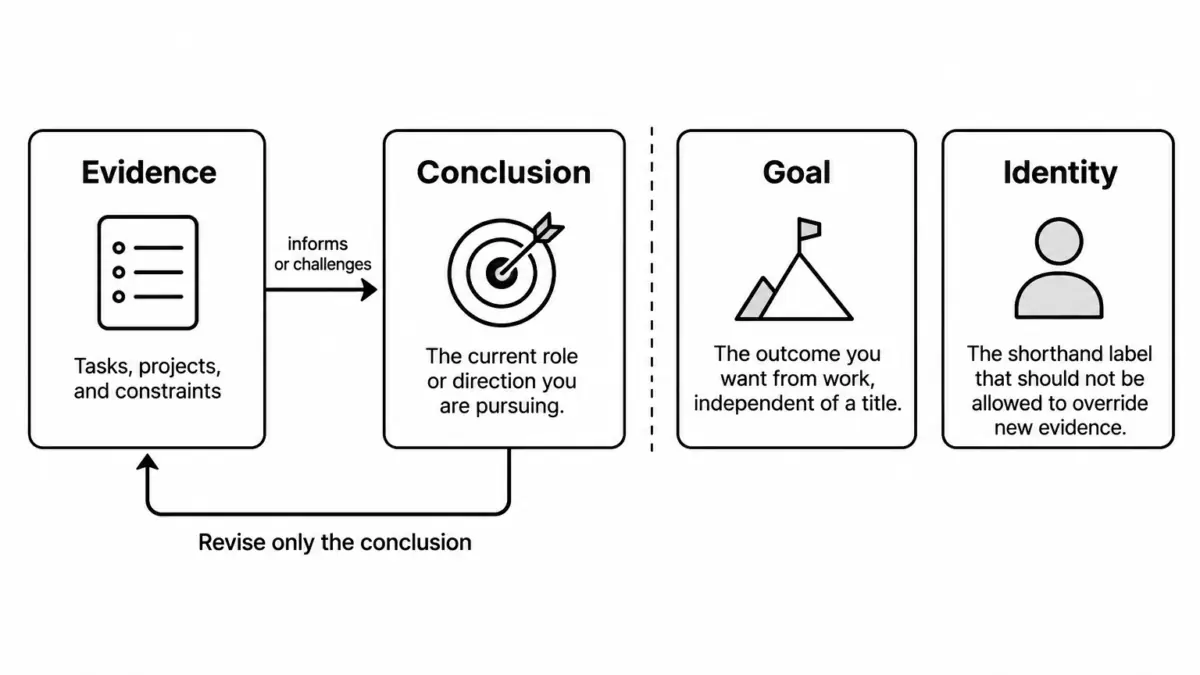
Text version of this visual
- Conclusion: The current role or direction you are pursuing.
- Evidence: Tasks, projects, and constraints that support or challenge the conclusion.
- Goal: The outcome you want from work, independent of a title.
- Identity: The shorthand label that should not be allowed to override new evidence.
When should you announce a revision rather than keep testing privately?
You should announce a revision when it changes another person’s reasonable expectations or when you need access to information that private testing cannot provide. The first case is operational. If a mentor is introducing you to operations leaders while you have decided to stop pursuing operations roles, leaving the old request in place wastes their social capital. The second case is evidential. You may need a conversation with a systems administrator, a short project, or feedback on a portfolio piece to decide whether the emerging direction is viable. Silence preserves optionality, but it can also preserve a stale record that sends people toward the wrong help.
Do not announce every fluctuation. A revised view needs more than one disappointing course module, one rejected application, or a difficult day. It needs a mismatch that can be named. The mismatch may concern the work itself, the environment required to do it well, the skills you want to practise, or the cost of acquiring those skills. Cognitive dissonance research is useful here because it describes a familiar defensive response to conflicting information: people can reinterpret, reject, or seek confirming information rather than alter a belief. The American Psychological Association’s overview of the theory is not career advice, but it explains why an expensive investment of time can make a weak career hypothesis feel strangely difficult to retire.
A modest threshold is enough. Before publishing an update, record the old claim, the evidence against it, and the next claim that you can test. If the only new statement is “I am open to anything,” you have not revised a direction; you have removed the address label. Career changers need some uncertainty, but other people still need to know what kind of introduction, vacancy, or critique would be relevant. The update may be provisional. Provisional does not mean vague.
- Identify whose next action depends on your current direction.
- Check that the revision rests on a named pattern, not one bad day.
- Define the information or access that public discussion would unlock.
- Keep testing privately when no expectation or request needs changing.
How can you make the update credible without writing a confession?
You make it credible by showing the dependency that changed. Credibility does not come from apologising for having been wrong, nor from presenting a tidy origin story in which every earlier move secretly led to the destination. It comes from enough detail for another person to inspect the reasoning. Name the object you tested, the condition you observed, and the consequence for your next step. “After completing two data-cleaning projects, I learned that I prefer building the intake rules and field definitions to analysing the final dashboard. I am now applying for junior operations-systems roles and rebuilding my portfolio around workflow design.” A hiring manager or former colleague can understand what to do with that.
A career narrative becomes unreliable when it rewrites old records. Avoid saying that you “always knew” if the evidence says otherwise. A public revision works better when it preserves continuity honestly: the earlier work developed a capability, exposed a preference, or ruled out a condition. This is particularly useful in a career change because adjacent experience often has more value than the title suggests. A recruiter does not need to accept that your previous role was secretly the new role. They need to see which repeatable tasks, tools, and decisions transfer, and which new work you are doing to close the gap.
Use different levels of detail for different audiences. A broad LinkedIn post may need one compact paragraph and a clear description of your focus. A message to a mentor can include the evidence and a direct request. An interview answer should keep the account short, then move to the work you can now demonstrate. Excess detail has a cost: it invites people to evaluate every abandoned option rather than the present one. Your aim is an auditable update, not a deposition.
- State the former direction: name it without disparaging it.
- Name the new evidence: describe a task, pattern, or constraint rather than a mood.
- Set the current direction: say what roles, projects, or learning now fit.
- Make one request: ask for feedback, a relevant introduction, or a work sample review.
- Name the former direction without dismissing it.
- Describe the work that changed your view.
- State the current focus with an appropriate confidence level.
- Ask one person for one relevant next action.
What does a careful public revision look like in practice?
Say a team of six is preparing an internal mobility programme. Four members have announced an interest in people management, and two have said they are exploring specialist tracks. One participant, Lina, has told her manager and peers that she wants a people-manager role. Over six weeks, she leads a planning session, handles a delivery conflict, and shadows two performance conversations. She finds that she enjoys clarifying dependencies and improving the team’s intake process, but the repeated personnel administration and escalation work do not fit the kind of responsibility she wants. The useful conclusion is not that she has “failed leadership.” It is that her original label bundled together distinct kinds of work.
Step one is for Lina to update the evidence record before she updates the audience. She writes: “Management hypothesis: I wanted broader responsibility and cross-team influence. Evidence: I preferred operating design, workflow clarity, and reporting logic; I did not want personnel-management duties as the main work.” Step two is to define the revised target narrowly: operations programme lead or people-operations systems specialist, depending on the available work. Step three is to identify who holds stale expectations: her manager, the programme organiser, and two colleagues who offered introductions to management mentors. Step four is to send each person an update proportionate to the relationship, rather than publishing a vague declaration and hoping the correct people infer the change.
Her message to the manager can be direct: “I want to update my development focus. The management rotation clarified that I am most effective when I am designing the operating system around the work: intake rules, ownership, and reporting. I am shifting my next development work toward programme operations rather than line management. Could we discuss one project where I could own that type of design?” This message corrects the record, retains the value of the rotation, and creates an actionable request. It does not claim certainty beyond the evidence. A useful team climate allows people to raise questions, concerns, and mistakes without anticipating embarrassment or punishment; research on psychological safety and knowledge sharing also treats this as a group-level condition, not a personality trait that one employee can manufacture alone.
The cost is visible even in a small group. If Lina leaves the old management target uncorrected, five people may continue acting on an obsolete assumption: her manager allocates a management-adjacent task, the programme organiser schedules a mentor, and three peers frame her interests incorrectly in conversations. If each action requires only 20 minutes, that is 100 minutes of effort aimed at the wrong destination. The correction may take Lina 25 minutes to prepare and send, plus a 30-minute manager discussion. A 55-minute update prevents 100 minutes of misdirected support and, more importantly, protects the credibility of the next request. The arithmetic is not a universal benchmark. It shows why a small career update can be an operational improvement rather than an act of self-expression.
- Stale manager task allocation20 minutes
- Stale mentor scheduling20 minutes
- Three peer introductions60 minutes
- Update preparation and manager discussion55 minutes
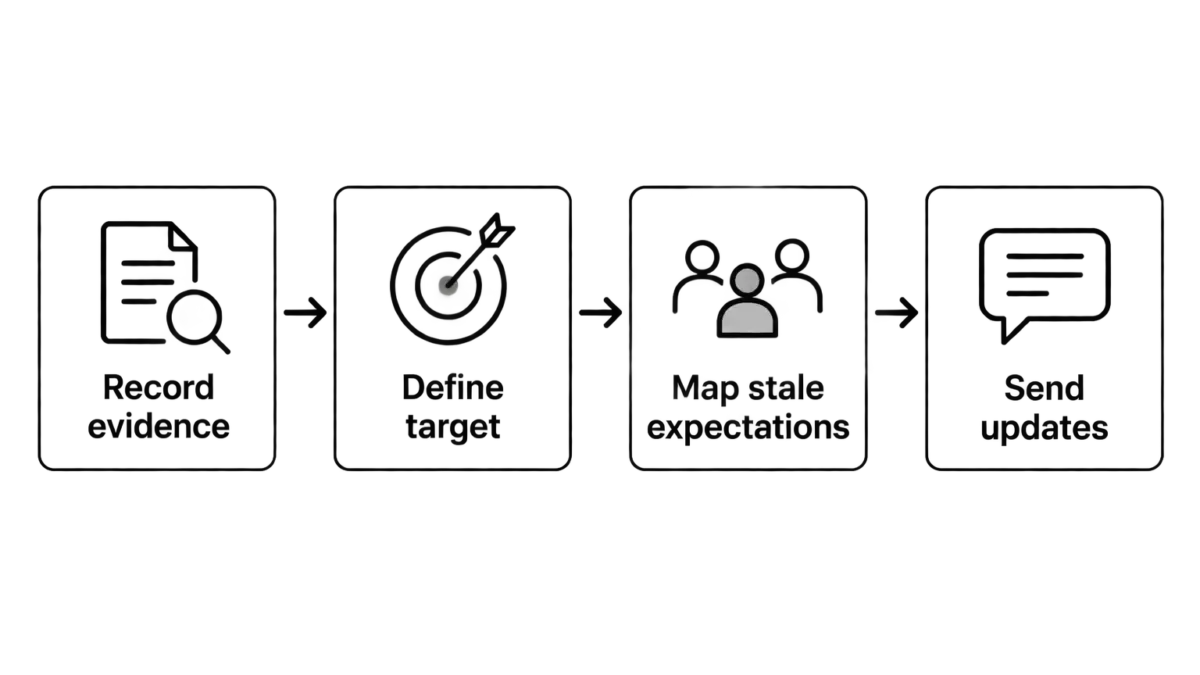
Text version of this visual
- Record evidence: State what work was tested and what the result showed.
- Define target: Choose the next direction at the level of tasks and responsibilities.
- Map stale expectations: Identify people who may still act on the earlier target.
- Send updates: Tailor the detail and request to each relationship.
Which mistakes make a revised direction look unstable?
The most damaging mistake is replacing one oversized identity with another. “I am no longer in marketing; I am a data person now” may feel decisive, but it gives readers no information about the work you can do, the evidence for the shift, or the boundary around the claim. Titles are poor containers for early-career exploration because they include too many different tasks. A better statement identifies the function: campaign measurement, customer research, data quality, dashboard maintenance, or analytics engineering. It is harder to misunderstand and easier to test.
A second mistake is treating disagreement as proof that the old direction remains correct. Former colleagues may resist a change because they know you through the older role, because they see risk you have not considered, or because the update creates practical inconvenience. Those are different inputs. You should ask what evidence they have, especially if they can identify a missing capability, market constraint, or overlooked job requirement. You should not preserve a direction merely because someone preferred the earlier version of your professional story. The point of a public revision is to improve the model, not to hold a vote on your identity.
A third mistake is promising a final answer before the work supports one. Career changers sometimes announce a target as certain because they fear that conditional language will sound uncommitted. In a technical system, a provisional value is not a broken value; it is a value whose status is known. “I am concentrating my search on…” and “I am testing whether…” are precise if followed by a real scope and a next action. They become evasive only when the scope never narrows. The appropriate level of confidence is a professional signal in itself.
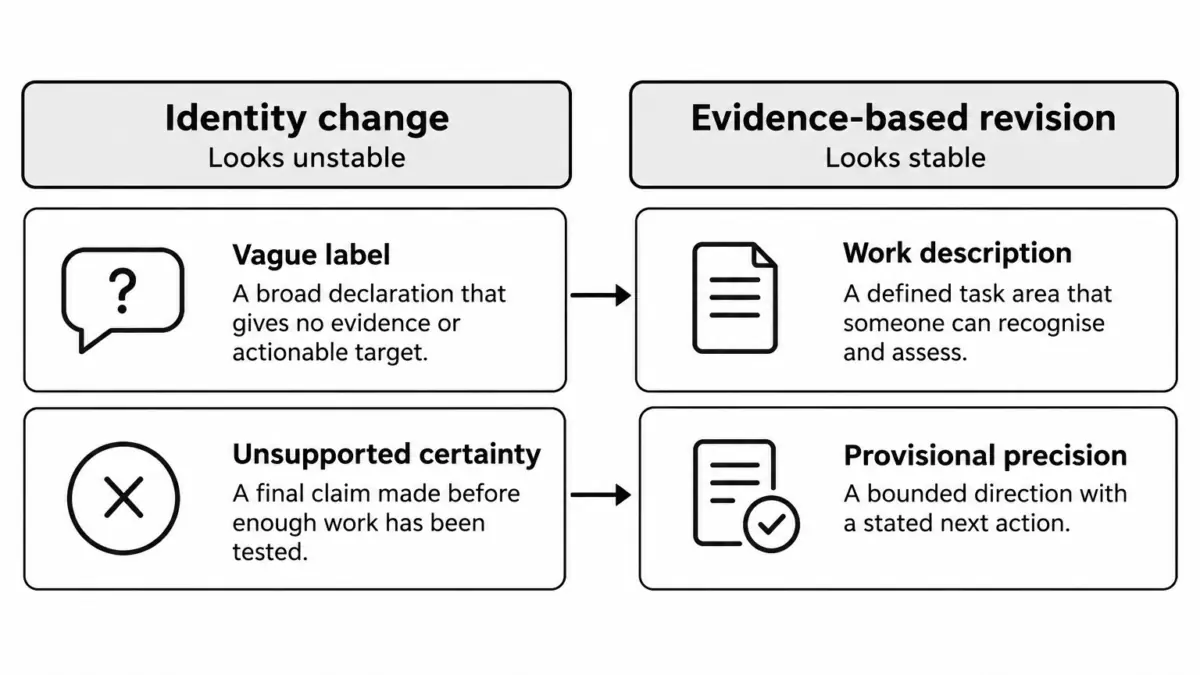
Text version of this visual
- Vague label: A broad declaration that gives no evidence or actionable target.
- Work description: A defined task area that someone can recognise and assess.
- Unsupported certainty: A final claim made before enough work has been tested.
- Provisional precision: A bounded direction with a stated next action.
How should you handle people who still repeat your old story?
You should correct the record briefly and consistently. People retain old descriptions because they encountered them first, because profile fields and old posts remain searchable, or because they have not seen your latest work. Assume outdated information before assuming hostility. “A small update: I have moved my focus from general operations management to workflow and HR systems work” is often enough. If a person is introducing you to someone, add the task-level description: “They are looking at roles involving intake design, field governance, and reporting workflows.” Concrete nouns travel better than an identity correction.
Then repair the records you control. Update the headline, the summary, the featured work, the résumé profile, and any standard message template. Keep the historical projects that support the new direction, but revise their framing. A project previously described as “team leadership experience” may be more accurate as “defined intake rules, assigned ownership, and documented exceptions for a six-person project group.” The work has not changed. The metadata has. In practice, this is where many public revisions fail: the verbal announcement is current while the searchable fields still tell the old story.
You should also accept a limit. A public revision cannot fix an audience that benefits from keeping you in an old category, nor can it compensate for a workplace that punishes ordinary learning. Reviews of interventions intended to increase speaking up have found mixed results and note that educational efforts alone may not change deeply rooted patterns. That systematic review of psychological-safety and voice interventions concerns healthcare settings, so its results should not be transferred mechanically to every office. Its caution does transfer: a person can communicate carefully, but cannot single-handedly configure a team’s hierarchy, incentives, or response to dissent.
- Public profile fields3 records
- Application materials2 records
- Portfolio project descriptions2 records
- Direct relationship updates4 records
- Correct the description in one calm sentence.
- Update searchable profile and portfolio fields.
- Retain earlier projects but revise their task-level framing.
- Repeat the new description consistently in introductions.
Where does this advice stop working?
This advice is for a genuine revision supported by new information, not for using constant reinvention to avoid the slow work of acquiring competence. If you change direction after every difficult project, every uncomfortable feedback conversation, or every routine rejection, the problem may not be public communication. It may be that you have not stayed with any test long enough to learn from it. A career path does not become wrong merely because its first version is tedious, socially awkward, or less flattering than expected.
It also stops where disclosure creates a material risk that you cannot control. You do not owe a broad public announcement of a private career exploration, a personal circumstance, or an unfinished decision. You can update the people whose actions depend on the information and leave the wider audience unchanged until the evidence is stronger. Public revision is useful when it corrects a work record and helps others act accurately. It is not a requirement to narrate every internal change while you are still deciding what the evidence means.
The standard is narrower than personal authenticity and more useful. Change the record when the work has changed, say why in terms another person can inspect, and give them the current address for their help. That method will not persuade people who require a fixed story from you. It is not designed for them.
 About the author Ewald Schäfer
HR Technology Specialist · Germany I’m Ewald — a passionate HR tech consultant from Berlin. I write about the intersection of automation, recruitment, and human capital. After leading several HRIS rollouts across Europe, I now focus on advising startups and writing practical content for job seekers and hiring teams alike. With a strong IT background, I bridge the gap between HR and technology: from API integrations and data security to workflow automation and cloud-based HR platforms. My mission is to help organizations not only digitize but truly optimize their people operations.